
The sargassum in Tulum is back. Several stretches of the coast returned to red and orange on the monitoring scale this week, three weeks after the arrivals thinned enough for the water to clear.
Red and orange sit at the heavy end of the color scale used to grade beach conditions day by day. UnoTV reported on Wednesday that several points along the Tulum coast were holding there, with municipal and federal crews cleaning every morning.
The timing is what gives the week its weight. Specialists had placed the close of the arrival season somewhere between September and October, hotels on the beach road were deciding whether to reopen for winter, and the federal plan for the destination assumes clean sand when the first visitors of the high season land.
Red and orange on a coast that was turquoise in September
Three weeks ago the story ran the other way, for a moment. This publication reported on September 23 that turquoise had returned to stretches of public beaches, with arrivals down sharply since the opening days of the month.

The moment was short. On some of the beaches inside the Parque del Jaguar, the sand came up clean, and the water ran clear for a day or two, and then the algae was back on the same stretch. Anyone who saw those mornings saw the best of the season, and it did not last the week.
Zofemat, the municipal office that manages the federal beach strip, was careful with that improvement from the first announcement. The drop did not mean the season had ended, nor did it mean the crews would stand down.
The year behind it explains the caution. By September 17, the office had removed more than 6,500 tons of the macroalga from the Tulum coast in 2026 and logged more than 1,800 container runs to the disposal site. All of 2025 produced roughly 5,000 tons. In mid-August, the running count stood at 4,880 tons, and that figure excluded the hotels, the navy brigades, and the Conanp teams working inside the national park.
Crews start at first light. Playa del Pueblo, Parque del Jaguar, Punta Piedra, and Conchitas come first because those are the beaches a resident or visitor can walk onto without paying anyone.
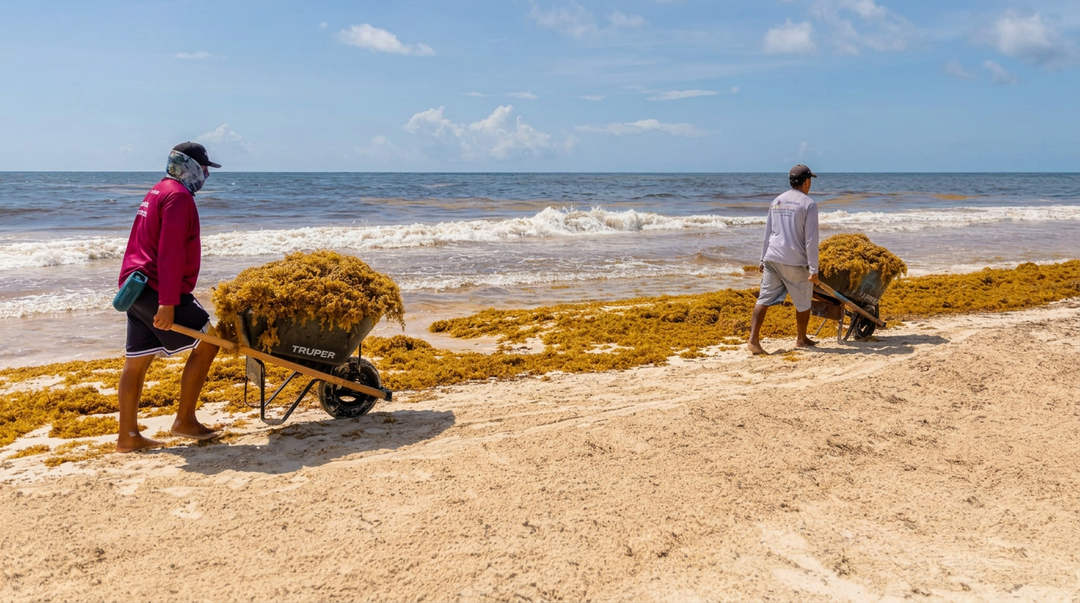
Conditions move within hours. A stretch that is clear at eight in the morning can carry a line of algae by the afternoon if the wind turns, which is why the published status for one beach rarely reflects that of the one beside it. The daily beach-by-beach report is updated here.
Five priority zones, and Tulum is one
The cleanup runs under a priority scheme built on five zones, with crews assigned to each and a daily forecast that tells them where the algae is concentrating, so that vessels and containment barriers can be moved before it lands.
Those five priorities are regional rather than municipal. State and federal attention concentrates on Cancún, Puerto Morelos, Playa del Carmen, Tulum and Mahahual, as El Heraldo de México reported on October 3. That is the geography the hotel sector means when it calls the response regional.
Yovana Torres, a Tulum resident, told UnoTV the work is starting to show. "It still needs to improve, but I think it is progress," she said.
Hoteliers put the yearly cleanup bill near 150 million dollars
David Ortiz Mena, president of the Asociación de Hoteles de Tulum, acknowledged to the same broadcaster that the destination is carrying a heavy share of arrivals and said the response is being managed at a regional level rather than beach by beach.
He has put numbers on it elsewhere. On October 2, he said the hotel sector across Quintana Roo spends roughly $ 150 million a year on containment and removal, and that this spending does not keep the algae off the sand.
The weekly arithmetic is harder on the coast road. Ortiz Mena said in August that removal had passed 500,000 pesos a week at some properties, while occupancy at beachfront and downtown hotels was not clearing 40 percent.
Several owners answered by shrinking the calendar. Hotels on the coastal strip have moved to seasonal operations, opening only during the months when demand and water availability justify a payroll.
The sargassum in Tulum sits inside a record state haul
The figure circulating this week is the federal one. The Secretaría de Marina reported on September 8 that more than 123,400 tons had been collected in Quintana Roo during 2026, against 92,782 tons for all of 2025, a difference of more than 30,600 tons with the year still running.
Two state reports have passed it since. Sema, the state environment secretariat, put the statewide total at 133,646 tons on September 18, of which 75,148.95 tons were removed by Sema and the municipalities and 57,497.24 by the navy. At the start of October, Sema head Oscar Rebora said the count had reached 138,000 tons and could pass 150,000 before the year ends.
The two accounts do not line up. The navy's September release credits the Armada de Mexico with the whole 123,400 tons, while Sema's report ten days later credits the navy with 57,497 of a larger state figure. Neither office has explained the gap, and both describe the same thing: a second consecutive record year for Quintana Roo.
Money has moved more slowly than tonnage. Por Esto reported on October 1 that the navy is working on an operating budget of 19.5 million pesos for the 2026 season, 0.27 percent above the previous year. The 2027 federal budget proposal sets aside a far larger sum, with 1,867 million pesos allocated to the navy.
195 credentials and a free park gate, while flights thin out
The official answer to a bad season sits mostly on land. Tulum Renace, announced on July 17 and published in the Diario Oficial de la Federacion, carries ten actions for the destination. The first removed the entry fee at the Parque del Jaguar for national visitors, and entry to the archaeological zone and the protected area was set at 80 pesos for Mexicans, free on Sundays, and 265 pesos for foreign visitors.
On October 1, Tourism Secretary Josefina Rodriguez Zamora handed over the first 195 credentials to service providers working inside the park, each carrying a QR code a visitor can check against the official register. The padron is meant to reach 600.
Air connectivity is the part the plan has not fixed. Passenger traffic at the Tulum airport fell by 33.2 percent in the first half of 2026, and international traffic fell by 40.8 percent, according to the federal civil aviation agency's operational statistics. Aeromexico suspended its operations there on September 30, and Volaris will suspend its own on January 7.
Seasonal international routes return to the airport on October 24.
That date is the one the coast is working toward. What the crews pull off the sand between now and then is the part nobody schedules, and the color on the map has already turned twice in three weeks.
Have you walked a Tulum beach this week, and which stretches were clear? Join the conversation and share your perspective with us on Instagram and Facebook at @thetulumtimes.

The Tulum Times · Newsletter
The story continues in your inbox.
Essential Tulum news and local insight, a few times a week. Free.
No spam. Unsubscribe anytime.
Tulum Sargassum Updates and Beach Conditions
Live seaweed conditions, cleanup updates, forecasts, and practical beach planning across Tulum and the Riviera Maya.

“The best journalists reporting from paradise, highlighting the heroes that keep Tulum the most beautiful place in the world! THANK YOU!”