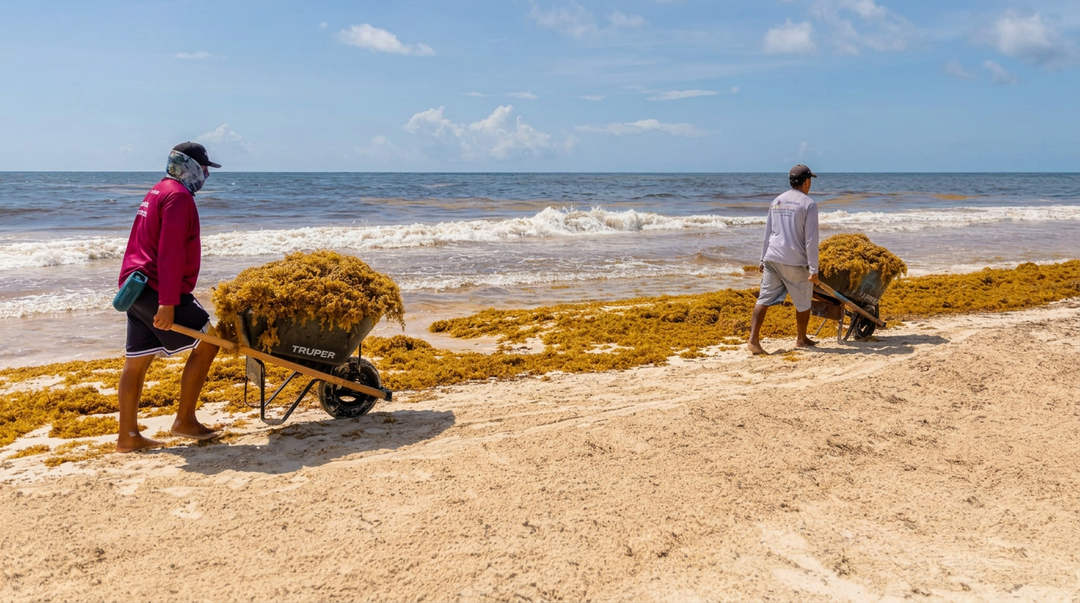

Zofemat crews have pulled 4,880 metric tons of sargassum off Tulum's beaches so far in 2026, a volume the municipal agency describes as close to double what the coast received in previous years.
The count comes from David Buchanan, director of the Zona Federal Marítimo Terrestre in Tulum, the municipal office responsible for the federal beach strip. In mid-July, the same office reported 2,800 tons. Another 2,000 have come off the sand since then.
Most of the work is not in that number. Hotels clear their own beachfronts, the navy runs separate brigades along the coast, and Conanp handles the stretch inside Parque Nacional Tulum. Zofemat's figure is the one published regularly, and it covers only what municipal crews haul away themselves.
A number that stops at the municipal crews
"This year has been atypical. We have received almost more than double what came in previous years. So far we have collected more than 4,880 tons through Zofemat alone," Buchanan said.

Container traffic gives a better sense of the full operation. More than 1,500 container trips have been logged this season when movements by hotels, municipal authorities, and other institutions working the coast are added together. Every one of those loads has to end somewhere, and where it ends has become its own problem. Buchanan warned in July that leachate from decomposing sargassum can reach the aquifer, coastal vegetation, and wildlife when the disposal site is not properly lined.
Where 2026 sits against last year's record
In March, Buchanan told La Jornada Maya that Tulum closed 2025 with more than 5,000 tons, a record at the time, and estimated that the 2026 season could reach 10,000 tons. He also said arrivals began in the first days of January, months before the usual window between late March and early April.
The state numbers move in the same direction. Quintana Roo's Secretaría de Ecología y Medio Ambiente reported on August 12 that 106,848 tons had been collected statewide this season. Federal projections put the full-year figure near 119,000 tons, above the 96,000 registered in 2025. Environment Secretary Alicia Bárcena has said the 2026 volume is four times last year's and 27 times the historical average.
Brian Barnes, a marine scientist at the University of South Florida, told the Associated Press that the record 2025 bloom never fully dissipated and carried enough biomass to seed a new one closer to shore. Roughly 90,538 tons were floating off Quintana Roo on August 2, according to the same reporting.

110 navy personnel work the coast daily
Buchanan said more than 110 members of the Secretaría de Marina are deployed every day at different points along the shoreline. Conanp works the section inside the national park. In March, the same office counted 35 Zofemat staff and 32 navy personnel on the beaches, which puts the current deployment roughly double its size when the season opened.
Cleaning has become close to permanent. Crews go out daily, and the municipal office runs parallel campaigns to pull solid waste off the same stretches of sand.
Sargassum does not hit every Tulum beach the same way
Swell, currents, the shape of the shoreline, and the points where the algae concentrate all differ from one stretch to the next, Buchanan said, which forces crews to work each sector on its own terms. One stretch can absorb the bulk of an arrival while the beach beside it stays usable.
Wind direction decides much of the rest. Óscar Rébora, head of the state environment secretariat, said on August 12 that westerly winds push the algae onto the beaches while northerly and easterly systems deflect it, and that a run of northerly wind had produced a temporary break in arrivals along the state coast.
Fonatur, Semar, and Sectur walked the shoreline this month
Representatives of the three agencies toured coastal points to assess conditions, as part of the federal push that brought Fonatur director Sebastián Ramírez Mendoza to Tulum's council chamber on August 12 for a working session with the municipal ecology cabinet. Ramírez Mendoza said the national sargassum strategy carries a budget of 2.6 billion pesos.
The evaluations are meant to settle whether anti-sargassum barriers should be installed or reinforced in a given sector, whether the equipment on hand is sufficient, and how many people each stretch actually needs.
Fonatur has also raised a second concern about the cleanup itself. Heavy machinery removing algae from the sand drags large quantities of sand along, accelerating coastal erosion. The agency has been promoting equipment that separates sand from dried sargassum, allowing the material to be returned to the dune.
The 11,000 meters already in the water
SEMA reports 11,000 meters of containment barrier installed statewide, with a target of 40 kilometers if federal support arrives. Published state material does not break down how much of either figure corresponds to Tulum.
No date yet for the new barriers
Buchanan acknowledged that keeping the entire municipal shoreline clear at once ranks among the hardest parts of the job this year. The 4,880 tons still does not represent everything removed from Tulum in 2026, and the season that opened in January has no announced end.
Neither Fonatur nor the state has said which stretches of the Tulum coast would receive barriers first, or when the equipment would arrive. Until that decision lands, the work stays where it has been all year. Crews clear the sand in the morning and wait to see what the tide leaves overnight.
Which Tulum beaches have stayed clearest for you this season, and where has the sargassum been worst? Join the conversation and share your perspective with us on Instagram and Facebook at @thetulumtimes.
This image was generated or enhanced using artificial intelligence to improve its quality.

The Tulum Times · Newsletter
The story continues in your inbox.
Essential Tulum news and local insight, a few times a week. Free.
No spam. Unsubscribe anytime.
Tulum Sargassum Updates and Beach Conditions
Live seaweed conditions, cleanup updates, forecasts, and practical beach planning across Tulum and the Riviera Maya.

“The best journalists reporting from paradise, highlighting the heroes that keep Tulum the most beautiful place in the world! THANK YOU!”