

The 2027 federal budget proposal reserves 1,867 million pesos for Mexico's navy to address sargassum in Quintana Roo and assigns none of it to the state or municipalities.
The exact number in the annex is 1,866,901,200 pesos, around 110 million dollars at the 16.97-peso reference rate published by Banco de México on September 11. It carries a single key, 26131180002, inside the annex of Programas y Proyectos de Inversión, and the funds are entirely federal.
That puts Tulum inside the coastline the money is meant to protect and outside the list of institutions that will spend it. The Secretaría de Marina, Semar, executes the project. The crews that clear this municipality's sand answer to other budgets. And the figure is a proposal, not a law, until the Cámara de Diputados votes in November.
One budget key, 1,866,901,200 pesos
The line sits in the investment annex of the Proyecto de Presupuesto de Egresos de la Federación, delivered to San Lázaro on September 8 by the finance secretary, Édgar Amador Zamora. It concentrates spending in Quintana Roo and names Semar as the agency responsible, with no transfer to the state government or the coastal ayuntamientos.

The project is filed under the sustainable development axis of the Plan Nacional de Desarrollo 2025-2030.
Above it in the same document sits a larger envelope. Ramo 13 carries a program for the protection of the marine environment with more than 2,163 million pesos, most of it aimed at sargassum in the Mexican Caribbean, and the sargassum project itself is placed under the Unidad de Inteligencia Naval. The strategy written into it runs in five stages: monitoring, containment, collection at sea and on the coast, transport, and final disposal. For 2027, the stated target is to collect 100 percent of the sargassum estimated in the priority attention zones.
A central logistics building, a dock and new hulls
The file describes construction and purchases rather than operating costs.
- A central logistics support building
- Three additional support buildings
- A dock
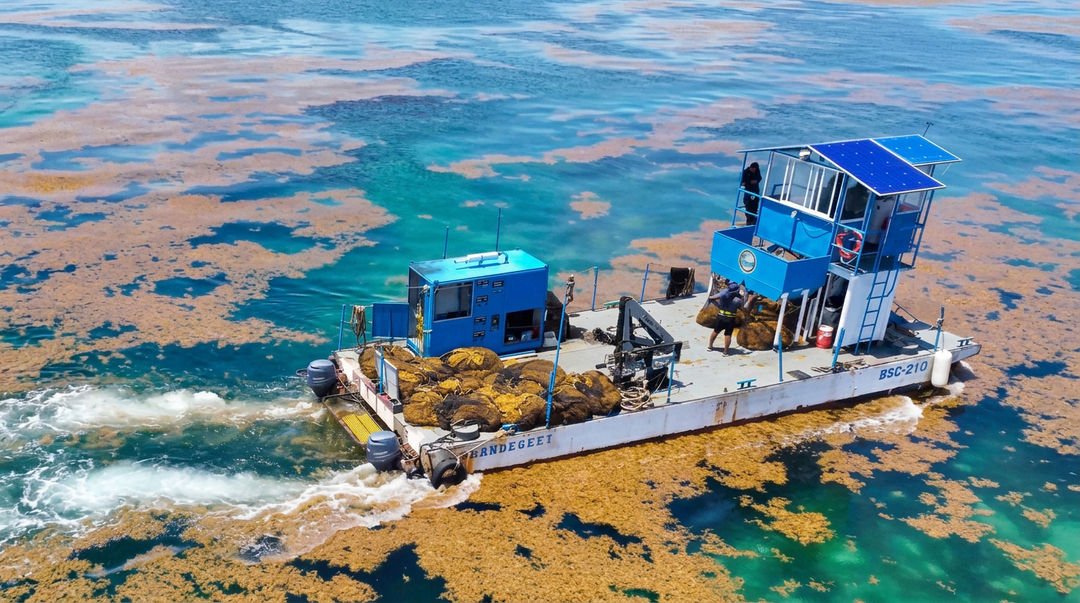
- Oceanic and coastal sargassum vessels
- Tugboats
- Vehicles, systems and specialized equipment
The purpose attached to that list is the capacity to collect the algae before and after it lands, across ocean, island, and coastal zones.

Semar is not starting from zero. In the state environment secretariat's report, closed on August 31, the fleet working in Quintana Roo counted 37 vessels, among them one transoceanic ship, 11 coastal sargassum boats, and three built for shallow water, backed by 37 vehicles and heavy machinery on land and around 350 people working the sand.
768.7 million plus 1,866.9 equals the July announcement
The number did not appear from nowhere.
On July 30, at the morning press conference in Palacio Nacional, President Claudia Sheinbaum presented a sargassum strategy for Quintana Roo worth 2,635.6 million pesos, to be spent in two stages. The navy secretary, Admiral Raymundo Pedro Morales Ángeles, said the first stage would cost 768.7 million pesos in 2026, with the aim of raising the collection capacity at sea to 1,870 tons per day. The plan covers Cancún, Playa del Carmen, Puerto Morelos, Tulum, and Mahahual, spanning 40 to 50 kilometers of coast.
Add 768.7 to 1,866.9, and the result is 2,635.6, the announced total to the decimal. That addition was made at this desk, not in the budget document, which sets out the 2027 line without reference to the July announcement. On the published figures, the money now in front of the deputies is stage two.
The scale of this year's arrivals is the argument behind both stages. At that same conference, the federal government reported that the presence of sargassum in the Mexican Caribbean was 27 times the historical average, with as much as 90,538 tons floating offshore on the heaviest days and roughly 10 percent of that volume reaching the beaches of Quintana Roo. The governor, Mara Lezama, said her administration had spent more than 770 million pesos in state funds on monitoring, containment, and collection.
Tulum ranks fourth at 16,471 tons
The state environment secretariat reported 124,852 tons of sargassum removed from the Quintana Roo coast between April and August, 29,069 tons more than in the same months of 2025.
The municipal breakdown puts Playa del Carmen first with 42,063 tons, Cancún second with 29,899, Puerto Morelos third with 17,111, and Tulum fourth with 16,471. Othón P. Blanco, which includes Mahahual, reported 14,013 tons. Isla Mujeres removed 3,877, Cozumel 1,375, and Lázaro Cárdenas 39.
Semar has 12,855 meters of barriers in the water along a coast where 1,176 kilometers of beach have been affected by sargassum this year. The state target for the cycle is 16,030 meters, and what is already installed sits mostly off Solidaridad and Tulum.
Those counts deserve care. The same secretariat reported 121,110 tons for January through August with a cut on August 31, which is lower than the April to August figure published twelve days later, so the two cuts cannot both be complete. Municipal counting runs on its own track as well. In April, the director of Tulum's federal maritime zone office, Juan Buchanan, put the municipality's accumulated collection at 1,224 tons, against 462 tons reported for the same month of 2025, and said the count excluded what hotels and the Jaguar Park brigades removed.
For anyone planning a trip around it, the sargassum months and the wet months overlap almost exactly, a coincidence our rainy season guide sets out month by month.
The sargassum budget names no beach and no bidding date
What the document leaves out matters as much as what it contains.
It does not divide the money between destinations. Cancún, Playa del Carmen and Mahahual appear nowhere as line items, and neither does Tulum. The scope is written as the coastal and insular strip of the entire state. There is no breakdown of how much goes to each building, the dock, or the fleet, no tender calendar, and no exact sites. In this project, there is also no parallel amount for Semarnat or Conanp, the two federal bodies that hold the environmental and protected-area mandates on the same coast.
What that leaves is one agency, one state, and a list of assets with no map attached.
The deputies have until November 15 to approve the Presupuesto de Egresos de la Federación, after the Ley de Ingresos clears the lower house on October 20 and the Senate on October 31. The figure can move in committee before any of that. On October 1 and 2, ahead of every one of those dates, Mexico hosts an international meeting on sargassum with Caribbean countries and Japan, and whatever comes out of it will land while the budget is still open.
Should the money go to intercepting sargassum at sea, or to the crews clearing it off Tulum's sand? Join the conversation and share your perspective with us on Instagram and Facebook at @thetulumtimes.

The Tulum Times · Newsletter
The story continues in your inbox.
Essential Tulum news and local insight, a few times a week. Free.
No spam. Unsubscribe anytime.
Tulum Development, Permits, and Construction Watch
Reporting on permits, construction, regulation, and major development decisions shaping Tulum’s urban growth and investment climate.

“The best journalists reporting from paradise, highlighting the heroes that keep Tulum the most beautiful place in the world! THANK YOU!”


