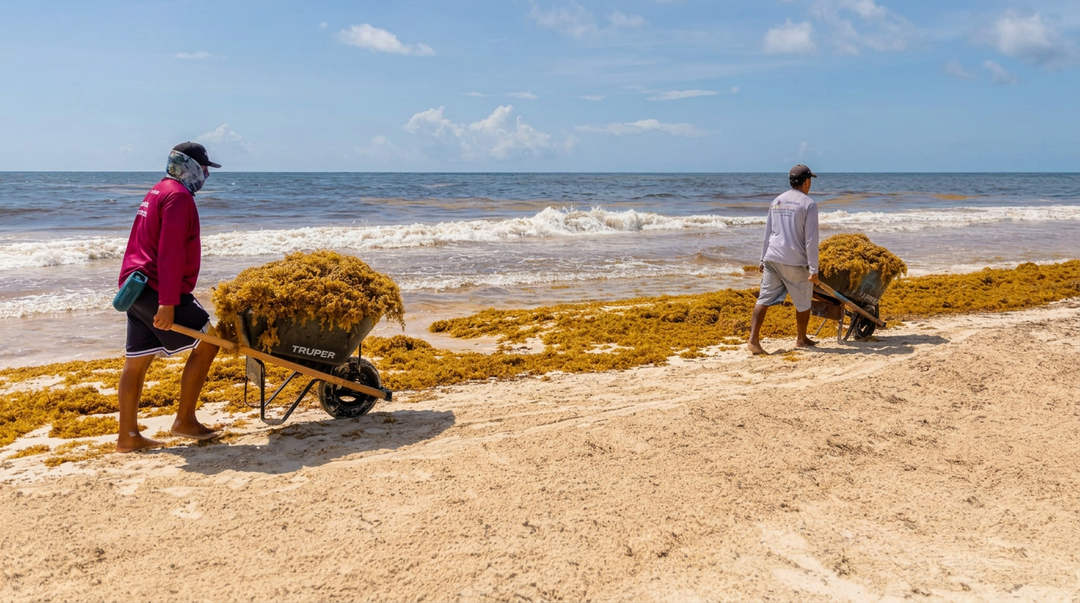
Sargassum in Tulum has thinned enough for the water off Playa Paraíso to turn clear again, ZOFEMAT said, after a season that put more algae on municipal beaches than all of 2025.
The season now easing began in January. In an ordinary year the first mats reach this coast at the end of March, and the arrival that started in the opening days of 2026 has not stopped since.
The relief has arrived at the emptiest point of the calendar. One beach rental operator says she is working at a fifth of her normal capacity, part of the hotel zone is shut until October, and the season that helped empty those rooms is only now letting go of the sand.
More than 5,600 tons, and half of them since mid-July
David Buchanan García, head of the Zona Federal Marítimo Terrestre in Tulum, put the municipal collection at more than 5,600 tons so far in 2026, against the more than 5,000 tons removed across the whole of 2025.

The comparison is his own benchmark. In March, he told La Jornada Maya that 2025 had broken the municipal record with more than 5,000 tons and that 2026 could bring double that, up to 10,000, because the algae had arrived months ahead of schedule. The count now sits a little above half that projection with the last weeks of the season still to run.
The pace is the part worth reading twice. By the middle of July, ZOFEMAT crews had removed more than 2,800 tons, nearly double what they had removed from the same beaches by that point in 2025.
Roughly 2,800 tons in six and a half months, then the same again in seven weeks.
One caveat accompanies each of these figures. The count covers only what municipal crews collect. What hotels remove from their own stretches and what the brigades inside Parque del Jaguar pull off the sand sit outside it, as the department noted in April, when its running total stood at 1,224 tons.

The cleanup rule that keeps loaders off the wet sand
Buchanan García said the cleaning has not slowed with the algae. Crews from the three levels of government work alongside the Secretaría de Marina, ZOFEMAT and private service providers to stop new mats from settling on the sand.
How the sand is cleared matters as much as how much comes off it. Speaking to Reportur last week, Buchanan García ruled out that the cleanup had cost Tulum a significant amount of beach, and said the hotel zone and the national park still show wide stretches of sand. He has also said that poor cleaning practices can accelerate erosion, which is why ZOFEMAT, the navy, and Conanp have held back from using heavy machinery.
The other risk starts after the trucks leave. This publication reported in July that Buchanan García considers the removal worthwhile only if the final destination avoids creating a second problem, since leachate from decomposing sargassum can reach the aquifer, vegetation, and coastal fauna.
Turquoise at Playa Paraíso, brown water further out
The visible recovery is concentrated at points like Playa Paraíso, where the water has cleared again, and the band of algae along the shoreline has narrowed. The tourism sector expects the trend to hold over the coming weeks, and ZOFEMAT said monitoring, collection and cleaning will continue as a preventive measure regardless.
Not every operator sees the same coastline. Sonia Fraide, of the equipment rental company Sun and Moon, told Reportur on September 3 that the arrival has dropped, but the sea still retains the brown tint left by the macroalgae, and that the cleaning needs reinforcement with boats working offshore.
The regional monitors place the turning point earlier in the summer. Esteban Amaro Mauricio, who directs the Red de Monitoreo de Sargazo in Quintana Roo, has said the arrival peaked in June and July and has since been falling, with the season expected to close between September and October.
Those two accounts sit oddly together. The network dates the peak to the start of the summer, while the municipal count took on as much tonnage after mid-July as it had in the six and a half months before it. Collection lags arrival, since crews are removing what has already piled up, and neither figure has been reconciled with the other in public.
Statewide, the arithmetic runs on another scale entirely. Quintana Roo had collected around 110,000 tons by the middle of August, and the monitoring network estimates the year could end near 150,000 tons.
Sargassum in Tulum eased with part of the hotel zone closed
What the improvement is worth commercially is a separate question, and this week the answer is not much.
Fraide said her business is running at about 20 percent, held down by weak demand and by the temporary closure of hotels along the beach road. Some of those hotels do not plan to reopen until October, which puts the destination in the position of getting its water back a month before the customers.
The algae is one line in a longer ledger, and it ran ahead of schedule all year. As The Tulum Times reported in the spring, ZOFEMAT logged 244 tons in February alone, compared with 59 tons in the same month of 2025. Readers checking conditions before picking a beach can follow the daily state of the coast on our live sargassum meter, and the month-by-month pattern is set out in our guide to the sargassum season.
Fraide expects the hotels to be closed back in October. The monitoring network expects the season to end in the same weeks. Whether the year finishes near the 5,600 tons already counted or near the 10,000 Buchanan García projected in March depends on what the current sends between now and then.
Has the water cleared on the stretch of beach you use, or is it still carrying the brown tint? Join the conversation and share your perspective with us on Instagram and Facebook at @thetulumtimes.

The Tulum Times · Newsletter
The story continues in your inbox.
Essential Tulum news and local insight, a few times a week. Free.
No spam. Unsubscribe anytime.
Beach Access, Public Shoreline, and Coastal Rules in Tulum
Coverage of public beach access, coastal restrictions, closures, and the balance between tourism and public space.

“The best journalists reporting from paradise, highlighting the heroes that keep Tulum the most beautiful place in the world! THANK YOU!”