


Long-term rentals in Tulum averaged 19,066 pesos a month across the 113 listings advertised on Vivanuncios on September 2, and that number covers the apartment and nothing else.
Asking prices are not the same thing as rents paid. A portal shows what landlords hope to get, on a day when the town sat deep in its low season, and hotel occupancy across the Mexican Caribbean had slipped under 60 percent. Treat the figures below as the ceiling of a negotiation rather than a market measurement.
They are still worth knowing, because most guides to living here quote a rent range in dollars and stop there. The rent is the easy part. The electricity, the water connection, and the guarantees a landlord will ask for decide whether the budget holds.
113 listings, and a 19,066 peso average
The Vivanuncios long-term section for Tulum carried 113 properties on September 2, running from 1,800 pesos a month at the bottom to 50,000 at the top. The spread is wide because the listings mix rooms, studios, furnished condos in gated developments, and whole houses.
Grouped by size, the asking prices on that day looked like this.
- One-bedroom apartments and studios, roughly 11,000 to 14,000 pesos in La Veleta and around 13,000 pesos in the town center.
- Two bedroom apartments, roughly 13,500 to 15,000 in La Veleta, 16,000 to 18,500 in the center and 18,000 to 19,000 in Aldea Zamá.
- Three-bedroom apartments, around 32,000 in La Veleta and 33,000 in the center, with one Aldea Zamá penthouse listed at 65,000.
- Four- and five-bedroom houses in the center, roughly 55,000 to 60,000.
At the official rate published for September 1, 17.0147 pesos per dollar, a 13,000-peso apartment works out to about 764 dollars a month, and the 19,066-peso average to about 1,120.
Guides written for arriving foreigners land above or below the portal depending on who wrote them. Rentar en Tulum, updated on August 28, 2026, lists rooms and studios in the center at 7,000 to 11,000 pesos, and a comfortable one- or two-bedroom apartment with amenities at 15,000 to 30,000 pesos. Tribu Tulum, a local real estate site, quoted a one-bedroom in Aldea Zamá at 1,200 to 2,500 dollars a month and a La Veleta studio at 800 to 1,500 dollars a month in a market guide dated February 12, 2026. Those are broadly the same apartments, described by people for different reasons.
La Veleta and the center against Aldea Zamá
Three areas absorb most of the long-term demand, and they are not interchangeable.
Aldea Zamá is the planned development, with paved streets, gated buildings, pools and gyms, and it carries the highest asking rents of the three. It is also the area with the highest concentration of furnished vacation units, which means a long-term tenant there is bidding against nightly rates.

La Veleta grew fastest and sits west of the highway, closer to the town than to the beach. It has the deepest supply of one- and two-bedroom apartments in the 11,000 to 15,000 range, and the widest quality range within it, from finished condos to buildings still going up next door.
The center, Tulum Pueblo, is where the same square meters cost the least, and where the trade is noise, traffic, and older construction. It is also the only one of the three where a tenant can live without a car.
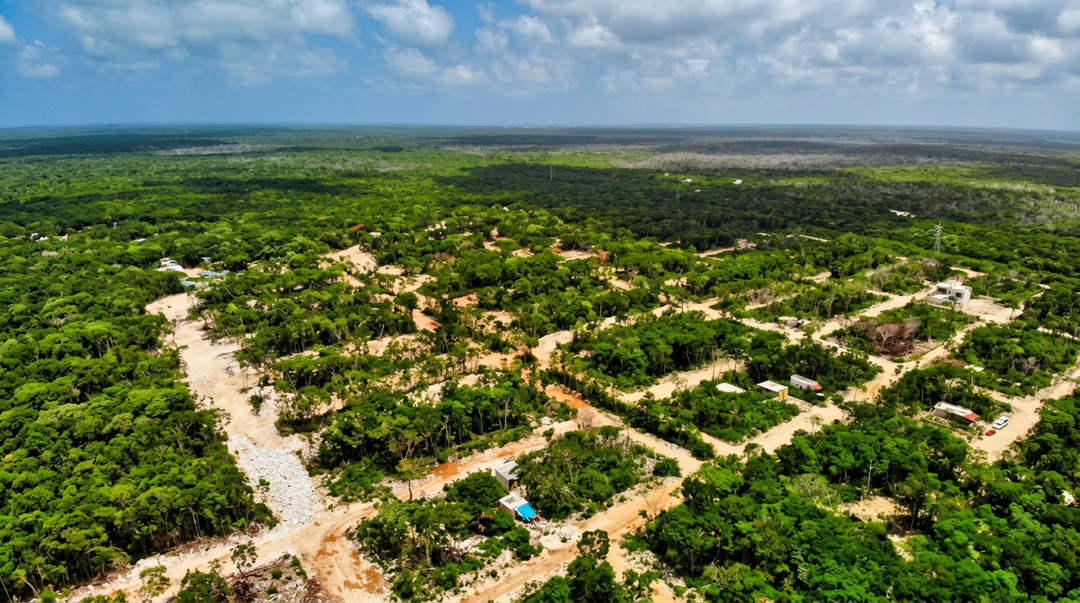
Past those three, Región 15 and the newer colonias to the west are cheaper again. That is where the connection questions further down this page stop being theoretical.
Long-term rentals in Tulum rarely include the utilities
Almost nothing on a Tulum lease is bundled. Electricity, water, gas, and internet are normally the tenant's, and a building with common areas adds a maintenance fee on top.
Electricity is the line that surprises people, and the reason is structural rather than personal. Quintana Roo Hoy reported on July 22, 2026, that Tulum is billed under CFE tariff class 1B, with residents petitioning to be moved to the cheaper 1C tariff already used by other municipalities in the state. Under 1B, according to Infobae's account of the rules published on May 1, 2026, a household loses its subsidy once its average monthly consumption exceeds 400 kilowatt-hours. On 1C, the same ceiling sits at 850.
Air conditioning through August moves a household past 400 faster than most arrivals expect. Once the subsidy ends, the bill is calculated at the high-consumption tariff until consumption has remained under the threshold for 12 consecutive months and CFE has been asked to reclassify the account.
Rentar en Tulum puts a CFE bill at 800 to more than 3,000 pesos per two-month cycle, driven mostly by air conditioning, and estimates 1,500 to 2,500 pesos a month for electricity, water, gas, and internet combined on a frugal budget, rising to 2,500 to 5,000 pesos a month on a comfortable one. Those are the site's own estimates rather than measured averages, and they assume a household still on the subsidized side of the tariff.
Two questions belong in the first conversation with a landlord. Whose name is on the CFE account, and what did the last two bills say?
A deposit, a guarantor and a póliza jurídica
The paperwork side of a Mexican lease is where foreign tenants most often get stuck, and it has less to do with immigration status than people assume.
A security deposit is standard, and Vivanuncios listings state the amount on a case-by-case basis rather than following a published municipal norm. What comes after it is the harder part. A Mexican landlord will usually want a guarantee that a tenant with no local credit history cannot easily give: an aval or fiador, a guarantor who owns property in the state and signs alongside the tenant.
The substitute is a póliza jurídica, a rental protection policy issued by a specialist company that screens the tenant, drafts the contract and handles the legal side when things go wrong. MoradaUno, a Mexican rental services firm, put the cost of one at 25 to 80 percent of a month's rent depending on coverage, in a guide published on June 26, 2025, and listed official identification for both parties, proof that the property is registered, tenant income verification and personal references among the documents required. That is a national figure from a company operating mostly in central Mexico, not a Tulum price, and local agencies quote their own.
For a foreign tenant, a policy provider will typically ask for a passport, a visa or immigration document, and proof of income, according to the Mexican broker Rentapoliza, whose guidance page for foreign tenants was last updated in August 2024. The same page names the two levers a landlord will usually accept in place of a guarantor: a larger deposit, or several months of rent paid up front.
One caution on the legal frame. The lease chapter of the Quintana Roo civil code was not publicly readable at the time of writing, so this guide makes no claim about statutory minimum terms, rent increase limits or notice periods in the state. A contract of a year or longer is worth having read by a local lawyer or notary before signing, not after.
Some addresses have no CFE contract of their own
This is the part that does not appear in rental guides written from outside Tulum.
Part of the municipality's housing stock sits in colonias that were settled before the paperwork was completed, and in some of them, individual electricity contracts do not exist.
The situation is being worked on, slowly and in named places. Quintana Roo Hoy reported on July 2, 2026 that 117 meters had been installed under a collective metering scheme in two Tulum colonias, 72 in Tumbenkin and 45 in Nassim, with Arrecifes next in line. Atilano Aranda Rejón, president of the Comité General Étnico Pluricultural de Tulum, described the scheme as an important step for residents of settlements where basic services have been a long-standing demand. The model places a meter at a transformer and divides consumption among the connected households rather than issuing each one its own contract.
For a tenant, the consequence is narrow and specific. An apartment in an unregularized colonia may have electricity without a CFE account, water delivered by well or by delivery rather than from the utility, or an address the utility does not formally recognize. Rent there if the price and the place suit you. Just establish it before signing, because a working light switch is not proof of a legal connection.
December changes the arithmetic
Tulum's rental market runs on a tourist calendar.
Rentar en Tulum notes that the December-to-March high season pushes prices up, and that rates drop for stays of several weeks or months. Both halves of that sentence matter to someone signing a lease. The first says when a landlord has options. The second says that length is the tenant's strongest bargaining chip, in a town where the competing offer is a nightly rate.
September and October sit at the far end of that cycle. A tenant looking now is negotiating with a landlord who has just come through the quietest months of the year.
The questions that belong in the visit, not the contract
Before any money changes hands, ask these on site.
- Whose name is on the CFE account, and can you see the last two bills?
- Is the water supplied by CAPA, by a well, or by delivery, and who pays for it?
- Is there a maintenance or condominium fee, how much is it, and what does it cover?
- Is the property in a regularized colonia, and does the landlord hold a title or a deed for it?
- What guarantee is required, and will a póliza jurídica be accepted in place of an aval?
- Does the lease run through the high season, and what happens to the rent at renewal?
The figures on this page come from listings and guides current as of the start of September 2026, during the deepest week of the low season, and they will change. The tariff class will not move without a decision from CFE, and the connection status of a colonia will not move without a regularization file. Those two questions outlast any rent table, including this one.
For the wider market, our guide to the Tulum real estate market covers where prices are heading, the truth about buying property in Tulum, which handles the ownership rules foreigners run into, and our neighborhoods coverage tracks Aldea Zamá, La Veleta, and Región 15 as they change.
What are you actually paying for a long-term rental in Tulum, and did the utilities come as a surprise? Join the conversation and share your perspective with us on Instagram and Facebook at @thetulumtimes.

The Tulum Times · Newsletter
The story continues in your inbox.
Essential Tulum news and local insight, a few times a week. Free.
No spam. Unsubscribe anytime.
Tulum Neighborhoods, Growth Corridors, and Area Guides
Context and practical guidance around Aldea Zama, La Veleta, Region 15, Selva Zama, and the urban geography shaping Tulum.

“The best journalists reporting from paradise, highlighting the heroes that keep Tulum the most beautiful place in the world! THANK YOU!”


