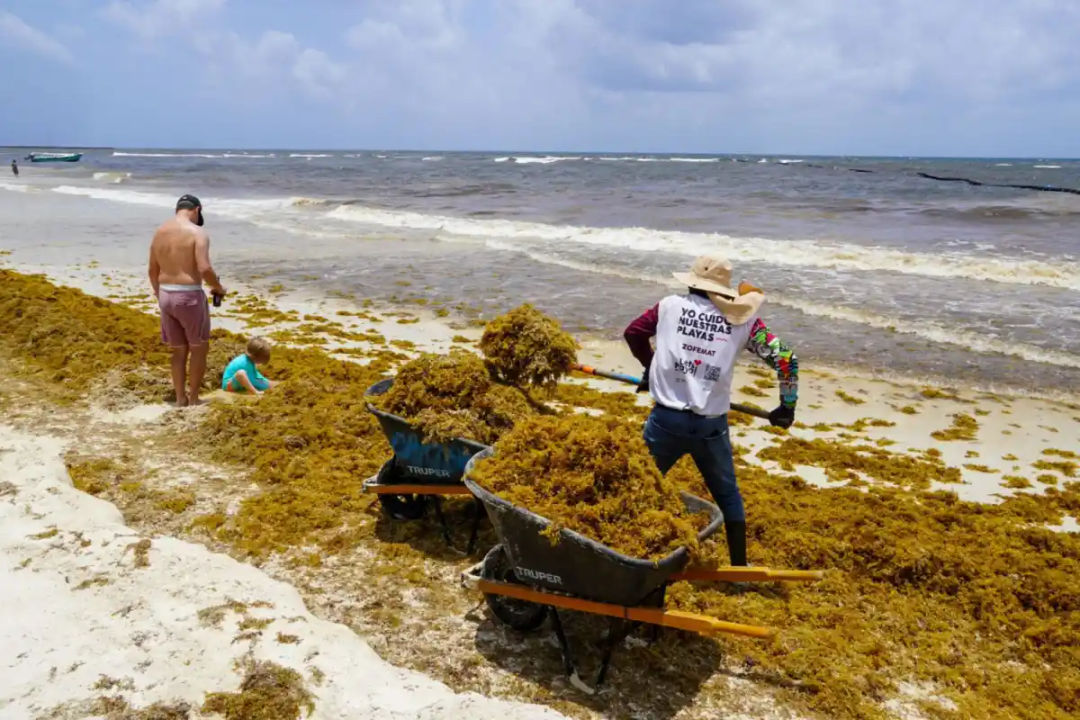
Three Tulum beaches carry excessive sargassum this week, on an 11-beach red list published by the independent platform Sargazo Monitor, with Mahahual and Punta Allen also in the worst category.
The Tulum entries are the hotel zone, Playa Punta Piedra, and Playa Paraíso. The same update from Sargazo Monitor found 52 of the 74 beaches it tracks across the Riviera Maya in favorable condition, and 22 carrying some level of seaweed. Several of the other red-listed beaches sit on Cozumel's windward east coast, which faces the open Caribbean with nothing between it and the incoming mats.
That split matters more than the raw count. Most of the coast is usable on most days. The stretch that is not usable happens to be the one Tulum sells, and Quintana Roo's environment secretary, Óscar Rébora Aguilera, has said the heaviest arrivals of the year are still ahead, across August, September, and October.
Eleven beaches in red, and Tulum's hotel zone is one
Sargazo Monitor builds its daily picture from satellite imagery, live beach cameras, and citizen reports, cross-checked against data from NOAA, the Secretariat of the Navy, SAMMO, and the University of South Florida Ocean Lab. It is not a government product, and its readings move faster than official bulletins, which is why hotel staff and tour operators check it before promising a client a clear morning.
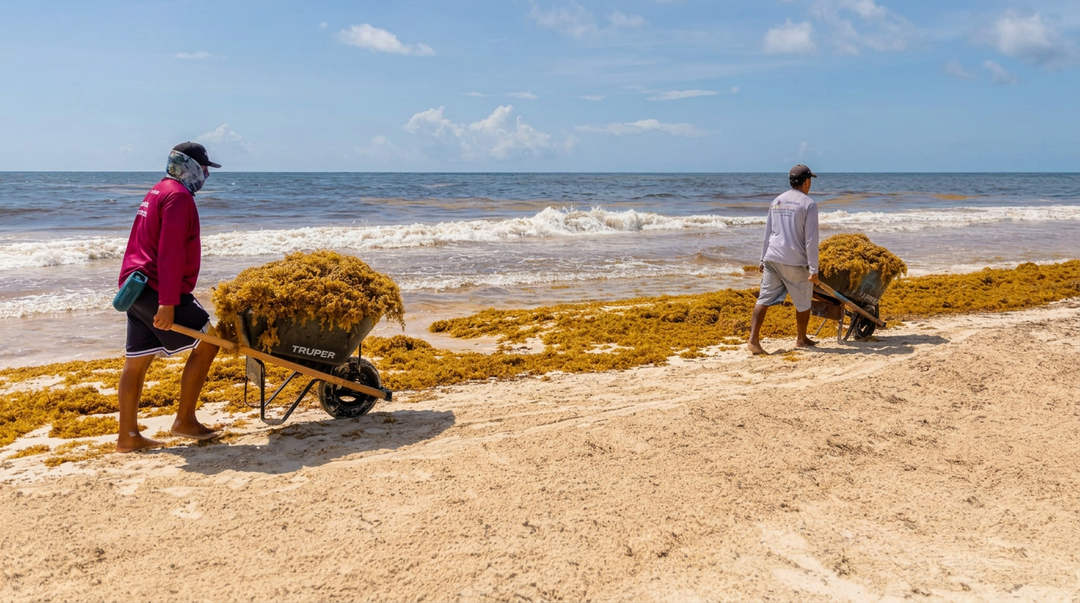
Conditions on this coast can reverse within a day. A single night of easterly wind can bury a beach that was clean at sunset, and a shift in current can strip it again by the following afternoon.
88,998 tons off the sand, with August still ahead
Semar reported that its 2026 season collection reached 88,998 tons across Quintana Roo, part of the National Sargassum Strategy the Navy coordinates with state and municipal crews. State environment authorities put their own running total near 92,500 tons, roughly matching the full-year record set in 2025 with five months still to run.
State projections cited by Reuters this week put the year's total arrival above 119,000 tons, against last year's 96,000. Reuters also reported that the surge has forced closures at some of the coast's best-known destinations and that the federal government is drawing up an emergency response.
The Navy's deployment now includes 11 specialized coastal vessels, an amphibious collector, 18 support boats, two barges, and four drones, along with more than 9,000 meters of containment barrier. State reporting in early July noted that 41 percent of the planned barrier had still not been installed.

A cleanup bill three times a hotel's power bill
David Ortiz Mena, president of the Mexican Caribbean Hotel Council, said recently that operators have started evaluating whether to open only during lighter sargassum periods, given cleanup costs and the hit to occupancy.
"A hotel can end up spending up to three times more removing sargassum than it pays for electricity," Ortiz Mena said, adding that the private sector has carried the cleanup burden largely on its own in recent years.
Eugenio Barbachano, a Tulum council member, told Reuters the commercial damage is already severe. "The tourism drop is extremely serious," he said, describing the current period as critical rather than merely slow for businesses across the Riviera Maya.
Carlos Solís, a local tourism services provider, framed the problem in terms of what the state actually sells. Quintana Roo markets beaches, blue water, and things to do in it, he said, and nobody wants sargassum.
What Tulum sargassum takes out of the state economy
Governor Mara Lezama has said that managing the seaweed costs Quintana Roo roughly 11 percent of its gross domestic product, on the order of 2 billion dollars a year. The figure describes total economic drag, not a line item in the state budget, and it tracks with an Inter-American Development Bank study cited by state officials this month.
The Riviera Maya hotel association puts the industry's own direct cleanup spending at about 150 million dollars annually.
The health cost falls on the people holding the shovels. Workers who clear beaches by hand have reported skin irritation and burning, headaches, fatigue, and nausea linked to the algae, according to a 2025 study published in a scientific journal. Marine scientists have also warned that decomposing sargassum blocks sunlight from underwater plant life and can leach arsenic and other heavy metals into the sand.
Catching the algae offshore before it rots on the sand
At the July 16 presidential press conference, Environment Secretary Alicia Bárcena said about 90,000 tons of sargassum were then floating off Quintana Roo, with roughly 9,000 tons reaching beaches every day. She called the situation extremely serious.
Her stated fix is to intercept the algae at sea, where the federal target is 2,500 to 6,000 tons, using the Navy's collector vessel plus a second being brought from the Pacific. The reasoning is chemical rather than cosmetic. Once sargassum lands and decomposes, it releases hydrogen sulfide and becomes toxic, which also destroys any value it might have as raw material.
Bárcena said the fishing charter has been amended so sargassum counts as a fishery resource rather than waste, and that a circular economy park is planned for Puerto Morelos, where companies have expressed interest in producing biomass, biofertilizer, and cosmetics.
President Claudia Sheinbaum announced on July 20 that her government would present a comprehensive sargassum strategy within 15 days. That window closes in the first week of August, the same stretch Rébora identified as the start of the heaviest arrivals of the year.
Have you changed a booking, a tour, or a beach day because of sargassum this month? Join the conversation and share your perspective with us on Instagram and Facebook at @thetulumtimes.

The Tulum Times · Newsletter
The story continues in your inbox.
Essential Tulum news and local insight, a few times a week. Free.
No spam. Unsubscribe anytime.
Tulum Sargassum Updates and Beach Conditions
Live seaweed conditions, cleanup updates, forecasts, and practical beach planning across Tulum and the Riviera Maya.

“The best journalists reporting from paradise, highlighting the heroes that keep Tulum the most beautiful place in the world! THANK YOU!”