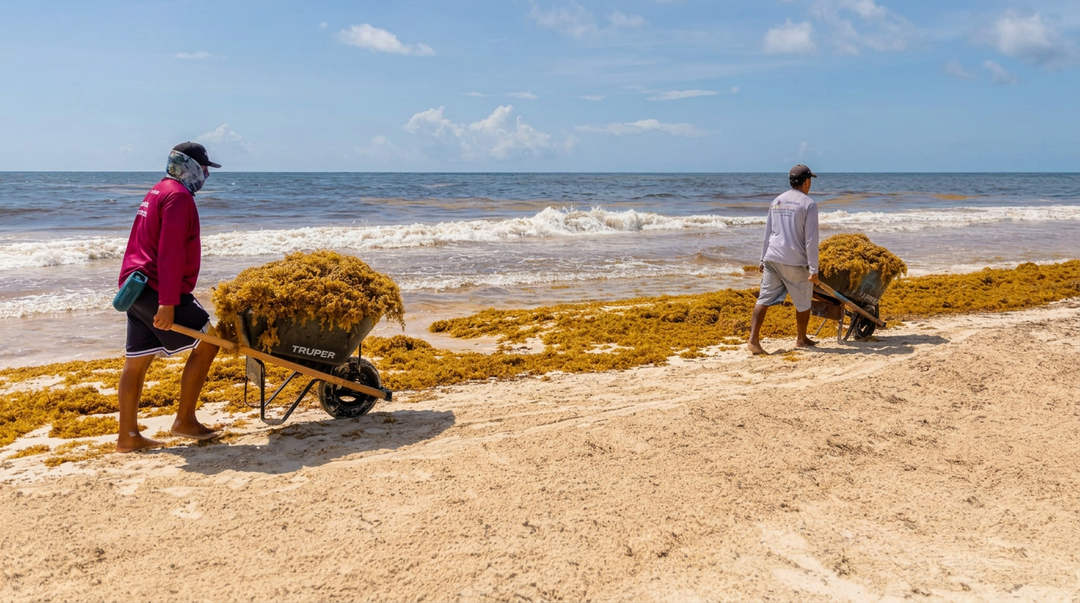

El sargazo en Tulum ahora tiene una línea presupuestal federal. El gobierno gastará 2 mil millones de pesos en embarcaciones y barreras diseñadas para capturar el alga en el mar antes de que llegue a la arena.
La presidenta Claudia Sheinbaum presentó la Estrategia de Atención y Manejo del Sargazo el jueves 30 de julio, nombrando a Cancún, Playa del Carmen, Puerto Morelos, Tulum y Mahahual como los cinco tramos de costa donde se concentrará el equipo. Alicia Bárcena, secretaria de Semarnat, dijo en la misma conferencia que 2026 ha entregado cuatro veces el volumen de 2025 y 27 veces el promedio histórico, un año que calificó como difícil y atípico.
Para Tulum, el anuncio llega aproximadamente siete meses después del inicio de una temporada que se suponía comenzaría en abril. Las cuadrillas de Zofemat ya habían removido más de 2 mil 800 toneladas métricas de las playas municipales a mediados de julio, cifra cercana al doble de la registrada en el mismo período de 2025, y el equipo que se supone las ayudará todavía se está comprando.
Bárcena coloca 2026 en 27 veces el promedio histórico
La escala que Semarnat describió es más fácil de entender en el mar que en la playa. Bárcena dijo que hasta 90 mil 538 toneladas métricas de sargazo se mueven por el Caribe mexicano en un día cualquiera, y que aproximadamente 9 mil toneladas de esa masa llegan diariamente a la costa de Quintana Roo. Solo una fracción de lo que flota nunca toca tierra, pero esa fracción ha crecido.

Su relato de dónde proviene comienza en 2011, cuando el Mar de los Sargazos frente a Florida rompió su contención, y el alga comenzó a derivar hacia África occidental. Se asentó en el Atlántico tropical entre África y Brasil, donde la descarga de nutrientes y el agua más cálida convirtieron un hábitat natural en un motor de reproducción. Las corrientes y el viento llevaron el resultado de vuelta a Quintana Roo.
El calendario se movió con él. La ventana de llegada solía abrirse en abril y cerrarse alrededor de septiembre. Este año el alga estaba en la arena de Tulum en enero.
A dónde van los primeros 768.7 millones de pesos
La fase uno, que transcurre durante 2026, tiene 768.7 millones de pesos para equipo: dos remolcadores, seis embarcaciones de recolección de sargazo costero, 1.5 kilómetros de barreras dinámicas, y 50 kilómetros de barreras de contención costera. El almirante Raymundo Pedro Morales, secretario de Marina, presentó cuatro líneas de acción detrás del gasto: recolección en aguas abiertas, recolección en aguas poco profundas, limpieza en las playas mismas, y disposición final.
Los números muestran dónde está puesto el esfuerzo. La capacidad actual ronda las 1 mil 227 toneladas métricas diarias en el mar y 950 en las playas. Se proyecta que el nuevo equipo eleve la cifra combinada a 1 mil 870 toneladas diarias, con una meta de 4 mil toneladas al día el próximo año. La gobernadora Mara Lezama, quien ha invertido más de 770 millones de pesos de fondos estatales en el problema durante su administración, ha argumentado durante años que interceptar el alga en el agua es mejor que perseguirla en la arena.


Los propios totales de recolección de Semar explican la urgencia. La Marina reportó 92 mil 782 toneladas métricas recolectadas en Quintana Roo durante 2025 y 96 mil 151 toneladas hasta ahora en 2026, los dos años más pesados registrados. Alrededor de 588 trabajadores estatales y municipales están en la costa diariamente, junto con equipos de hoteles.
El sargazo en Tulum ya ha llenado mil viajes en contenedor
El presidente municipal Diego Castañón Trejo caminó por Playa del Pueblo el 15 de julio con David Buchanan, director de la oficina de Zona Federal Marítimo Terrestre de Tulum, para revisar una operación de limpieza que no se ha detenido desde que comenzó el año. Las cuadrillas de Buchanan han completado más de mil viajes en contenedor hacia sitios de transferencia, moviendo material que solo Zofemat cuenta en más de 2 mil 800 toneladas métricas.
Esa cifra cubre solo a las cuadrillas municipales. Los hoteles a lo largo de la carretera de playa tienen sus propios equipos de limpieza, y el volumen que mueven no aparece en el conteo municipal, lo que significa que el tonelaje real que sale de la costa de Tulum es mayor que cualquier cifra única publicada hasta ahora.
Los datos nacionales acumulados compilados por Simsar, el sistema de monitoreo del sargazo recolectado, posicionan a Tulum como el destino más afectado del país entre enero de 2022 y julio de 2026. Esos totales se colocan incómodamente junto a las cifras anuales de Semar para Quintana Roo, y los dos sistemas parecen estar contando cosas diferentes.
El riesgo al acuífero bajo cada montón
Buchanan ha sido directo sobre la parte de la operación que recibe la menor atención. Remover el alga de la arena solo es útil si el lugar a donde va después no crea un segundo problema. El lixiviado del sargazo en descomposición puede llegar al acuífero, la vegetación detrás de la duna, y la fauna costera que depende de ambas.
El plan federal encamina el material recolectado a cuatro sitios preparados donde será secado y pretratado para su uso en biofertilizante, biocarbón y biogás. En Tulum, las cuadrillas ya colocan el alga sobre geomembranas para secarla, en parte para recuperar arena antes de la disposición y ralentizar la erosión de playas que causa la limpieza agresiva.
El daño mientras permanece es bien documentado. La descomposición libera sulfuro de hidrógeno, el olor a huevo podrido que vacía un club de playa e irrita las vías respiratorias. El contacto directo con alga descompuesta puede causar dermatitis, en parte por los metales pesados absorbidos del agua. En las aguas poco profundas, mantos densos bloquean la luz solar y agotan el oxígeno, lo que empuja a los arrecifes y lechos de pasto marino más allá de lo que toleran.
Una meta diaria de 4 mil toneladas que llega el próximo año
Sheinbaum dijo que aproximadamente 150 científicos están trabajando con Semarnat y la Secretaría de Ciencia en dos preguntas: por qué este año produjo tanto, y qué puede llegar a ser de manera rentable la biomasa recolectada. El 1 y 2 de octubre, México alberga una conferencia de la Puerta Global UE-Caribe sobre sargazo, financiada por la Unión Europea, con naciones caribeñas asistiendo para comparar enfoques.
La segunda fase, la que lleva la recolección a 4 mil toneladas al día, está escrita para el próximo año. Las cuadrillas de Tulum tienen el resto de esta temporada para pasar antes de que cualquiera de eso llegue, y este año la temporada no comenzó en abril y no muestra signos de terminar en septiembre.
¿Las cuadrillas de limpieza han mantenido tu tramo de playa en Tulum usable este verano, o el sargazo ganó la temporada? Únete a la conversación y comparte tu perspectiva con nosotros en Instagram y Facebook en @thetulumtimes.
This image was generated or enhanced using artificial intelligence to improve its quality.

The Tulum Times · Newsletter
La nota sigue en tu correo.
Lo esencial de Tulum y contexto local, un par de veces por semana. Gratis.
Sin spam. Cancelá cuando quieras.
Tulum Sargassum Updates and Beach Conditions
Live seaweed conditions, cleanup updates, forecasts, and practical beach planning across Tulum and the Riviera Maya.

“The best journalists reporting from paradise, highlighting the heroes that keep Tulum the most beautiful place in the world! THANK YOU!”