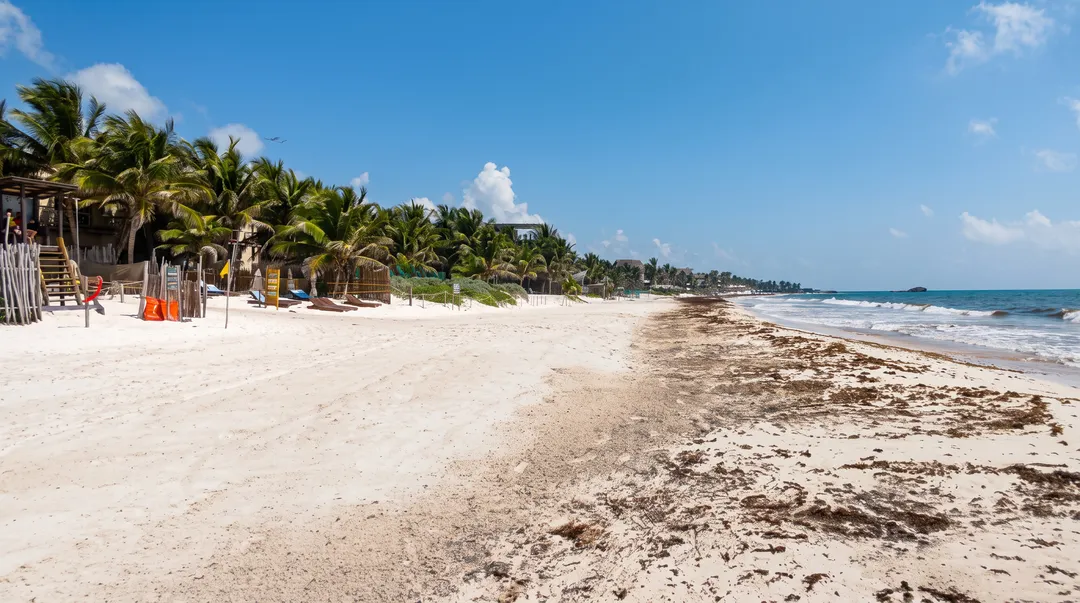
The head of Tulum's federal beach zone office rejected the claim that sargassum collection has cost the municipality significant sand, though he conceded that careless cleanup work can accelerate erosion.
David Buchanan García, director of the Zona Federal Marítimo Terrestre (Zofemat) in Tulum, credited method rather than fortune. "Fortunately, and not only by luck, simply by doing the job well, but we also have not lost much beach," he said, stressing the need to keep machinery use to a minimum and to work with equipment that lifts seaweed without dragging sand behind it.
The reassurance lands in the heaviest sargassum year Tulum has recorded, and in the same month that researchers published figures pointing the other way. For hotels, beach clubs and anyone who sells a day in the sun, this is not an abstract argument. Beach width is inventory.
Less machinery, and containers hotels are asked to check
Buchanan said the beaches of the hotel zone and Parque Nacional Tulum still hold a considerable stretch of sand, an outcome he attributed to Zofemat staff working alongside personnel from the Secretaría de Marina and the Comisión Nacional de Áreas Naturales Protegidas (Conanp).

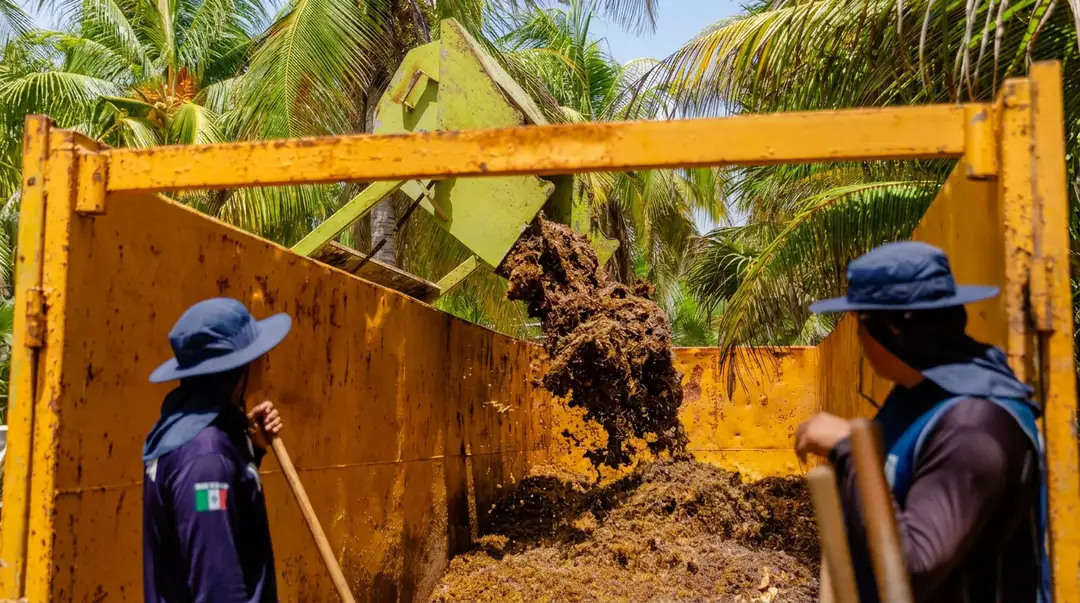
The office also maintains ongoing conversations with hotels about what happens after the seaweed leaves the waterline. Storage and transport are where sand disappears quietly, mixed into a container nobody weighed. When inspectors find a container carrying a noticeable load of sand, they go back to whoever is responsible and ask them to change the procedure.
"The first ones harmed are them, when they do it badly," Buchanan said.
A Caribbean study weighed the sand that left with the seaweed
Published research complicates that account. A study on sediment loss associated with the removal of sargassum deposits on Caribbean beaches, produced by academics based in the Dominican Republic and Spain, including the University of the Balearic Islands and the University of Girona, sampled material taken off 12 beaches in Mexico and the Dominican Republic, among them beaches in Tulum and Cancun.
According to reporting by PorEsto, the researchers measured 18,987.3 cubic meters of removed material and found that 61.23 percent of it was sand clinging to the algae. The share works out to roughly 9,872 tons of sand that never returned to the coastal dune as sediment and instead traveled inland to final disposal sites.
Esteban Amaro Mauricio, a hydrobiologist who coordinates the Quintana Roo sargassum and environmental monitoring center, told the same outlet that the loss of sand is not confined to this state. He described it as a problem across the Yucatán Peninsula, and framed the sargassum influx as one of the largest climate challenges Mexico is facing right now.

Neither figure has been contested publicly by Zofemat Tulum, and Buchanan did not address the study in his remarks.
Tulum beach erosion also moves with the currents
Asked about complaints of shrinking sand around Akumal, Buchanan said the cleanup cannot fully explain it. Beaches, he said, expand and contract through the year as marine currents change direction and move sediment along the coast.
He offered Playa del Pueblo as his example. Last year, by his account, the sand strip there measured about half the width it shows today.
"It grows, and it shrinks. It is normal, it is a seasonal matter," he said.
Akumal has its own paperwork on the subject. In July, Semarnat approved an environmental impact statement for a beach recovery project at a hotel there, a file that put annual sand loss at the site at up to 11.4 meters, PorEsto reported. The state project to restore 33.5 kilometers of public beach remains postponed to 2027.
Buchanan drew the line where the human part of the process begins. "In the cleanup, it is important that we try not to take the sand away, so we do not damage it from the start and so that we are not the ones to blame for that erosion," he said.
The sand recovery program waits for a season that has not ended
Once the sargassum stops arriving, Zofemat plans to resume its sand recovery program. How much sand it will be able to move remains open, Buchanan said, because the season has been atypical and the cleanup has stretched far past its usual calendar.
The distribution will not be improvised. Crews will first identify the areas with the worst damage, then spread the recovered material across several beaches rather than concentrating it in one place. Last year, work began where sargassum had been piled and stored, and the recovered sand was later carried to points near Kaan Luum, the hotel zone, and the national park.
The scale of the season explains the delay. Sargassum began landing on Tulum beaches in the first days of January, months ahead of the usual late March or early April start. By mid-July, Zofemat crews alone had collected more than 2,800 tons, nearly double the volume recorded in the same period of 2025, and completed more than 1,000 container trips to transfer stations. In March, Buchanan estimated the year could close near 10,000 tons, twice the record set in 2025.
The recovery program begins when the seaweed stops. As of the last week of August, it had not.
Should Tulum publish how much sand leaves the beach in each sargassum container? Join the conversation and share your perspective with us on Instagram and Facebook at @thetulumtimes.
This image was generated or enhanced using artificial intelligence to improve its quality.

The Tulum Times · Newsletter
The story continues in your inbox.
Essential Tulum news and local insight, a few times a week. Free.
No spam. Unsubscribe anytime.
Tulum Sargassum Updates and Beach Conditions
Live seaweed conditions, cleanup updates, forecasts, and practical beach planning across Tulum and the Riviera Maya.

“The best journalists reporting from paradise, highlighting the heroes that keep Tulum the most beautiful place in the world! THANK YOU!”