
The sargassum cleanup in Tulum has been easing off the heavy machinery this season, and the beaches have held on to most of their sand because of it, the municipality's shoreline director said.
David Buchanan, who runs the Zona Federal Marítimo Terrestre office in Tulum, said the beaches within the hotel zone and within Parque Nacional Tulum still have a considerable width of sand, and put that down to how the work has been coordinated with the Secretaría de Marina and the Comisión Nacional de Áreas Naturales Protegidas.
Width is the asset here. Tulum is midway through the heaviest sargassum year the Mexican Caribbean has on record; its hotels are in a poor occupancy stretch, and the municipal government spent last week filming the cleanest strips of shoreline to put them in front of visitors. A beach that narrows every August is a harder thing to film, and a harder thing to sell.
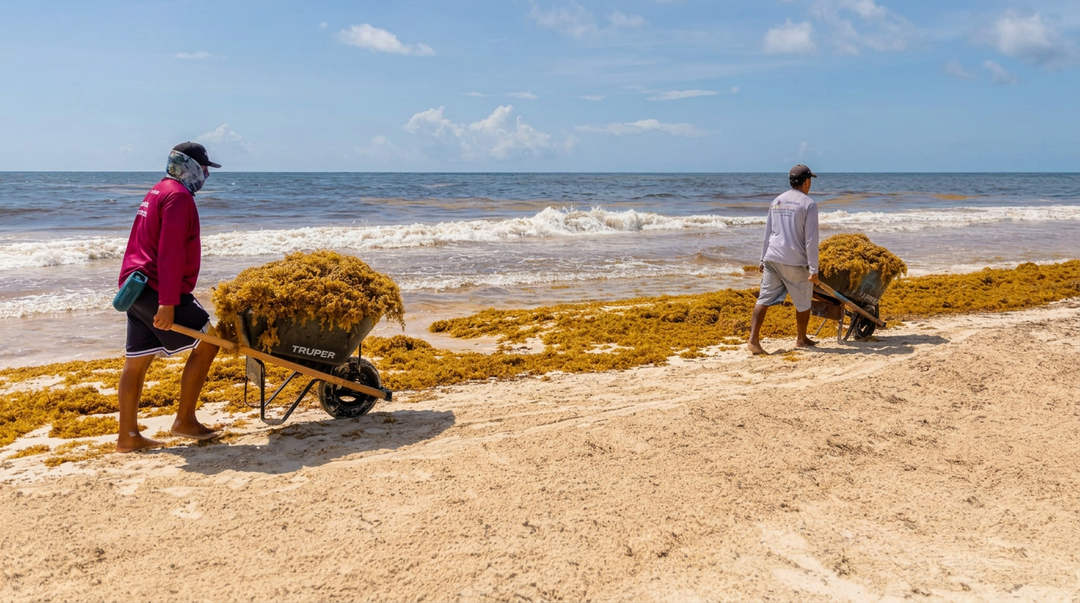
The instruction to crews is to lift algae, not sand
Buchanan's warning is about the equipment rather than the effort. A badly run cleanup wears the beach down on its own, he said, and the damage happens when machines pull large volumes of sand along with the macroalgae. Once that sand is in the container, it is loaded onto a truck and leaves the beach.

Avoiding that means more handwork and fewer passes with equipment, which is the slower option on a coast when taking this much material.
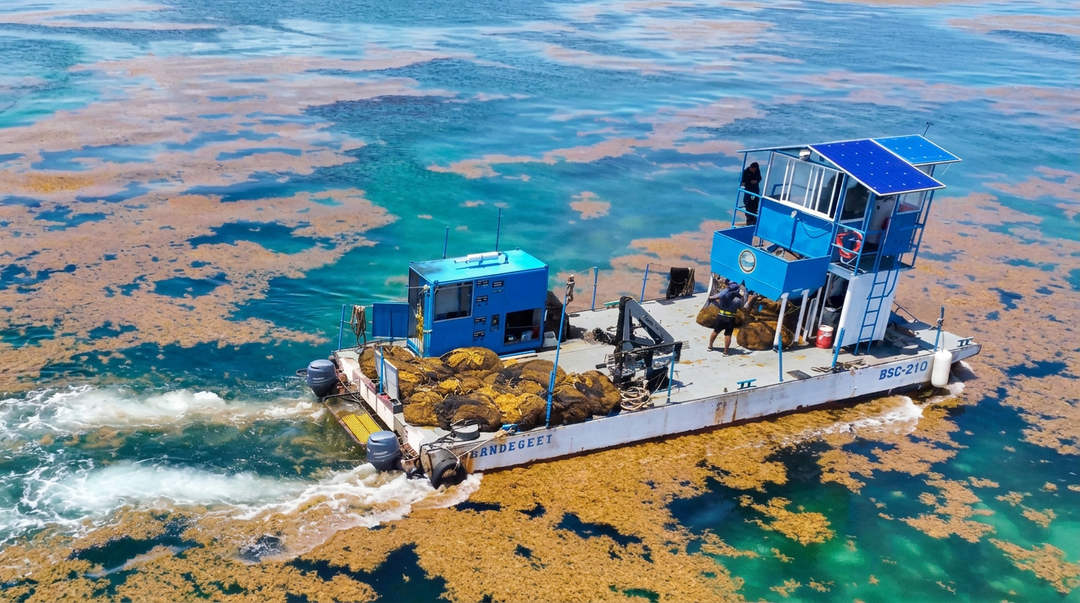
The machinery has not gone away. In June, the state government handed the municipality two tractors fitted with mechanical sweepers, three dump trucks, and four motorcycles with trailers, equipment meant for the stretches of coast where a container truck cannot get in. What the agencies changed is where the machines run and how hard they run.
Where the sargassum cleanup in Tulum still takes sand
Some sand goes regardless. Buchanan acknowledged in June that the work is split among several agencies and that part of the sand inevitably gets dragged off with the algae.
The municipality's answer sits downstream from the beach. Collected material is trucked to a disposal site lined with a geomembrane, spread out, and turned repeatedly to dry. Once it is dry, it is sieved, and the sand that passes through the sieve is returned to the shore.

The operation is running 17 containers, 10 of them in the hotel zone, serving more than 25 hotels, and the disposal site was enlarged this year after the 2025 season exceeded what the setup could hold.
2,800 tons and counting
By mid-July, Zofemat crews had removed more than 2,800 tons of sargassum from municipal beaches, nearly double the figure for the same stretch in 2025. That count covers only what municipal crews collect. Whatever hotels clear from their own frontage sits outside it.
A month earlier, the comparison was 2,458 tons against 1,378 in the same period of 2025, an increase of 78.3 percent.
The calendar moved as well. Arrivals here normally begin in late March or early April. This year they started in the first days of January, and that month alone passed 112 tons. By March, Buchanan was estimating up to 10,000 tons for the year, twice the record of more than 5,000 tons collected in 2025. Our season guide puts the heavy window between May and September, which leaves several weeks of it still to run.
Offshore, the figures are larger. Around 90,538 tons of sargassum were floating off Quintana Roo in early August, in what authorities and scientists have described as the most severe season on record. The federal environment secretary, Alicia Bárcena, said the 2026 volume is four times that of 2025 and 27 times the historical average.
Currents and swell move the sand at Akumal too
Buchanan also addressed places such as Akumal, where the beach has visibly receded. The loss there cannot be attributed to sargassum cleaning alone, he said, because currents, swell, and seasonal shifts move sand along this coast on their own and change how much of it sits on any given stretch.
He did not use that to close the argument. Public agencies and private service providers both need to take more care during collection, he said, so that poor machine work or excessive removal does not intensify an erosion process already underway.
What nobody has published is a measurement. There is no figure for how much sand Tulum has kept or lost this season, only the two areas Zofemat named as still wide.
A sand recovery program follows the end of the season
Once the heaviest arrivals stop, the authorities plan to restart a program to recover and redistribute sand in the areas that came off worst.
How much sand that would involve is not yet estimated. Buchanan put the gap down to the season itself, which has run longer than usual and behaved in a way he called atypical.
The town is meanwhile working the good week it has. On August 25, Mayor Diego Castañón Trejo said the recent rain had cleaned the beaches considerably, put them at 70 to 80 percent clear, and announced that the municipality would film the shoreline every two days to show visitors its current state. Conditions still vary by beach and by hour, and our sargassum tracker follows them through the season.
The recovery program has no start date, because the thing that triggers it has no end date. Zofemat has not said what level of arrivals it would treat as the close of the season, and it has not said how much sand the program is meant to put back.
Have you seen Tulum's beaches getting narrower, or is the sand holding where you swim? Join the conversation and share your perspective with us on Instagram and Facebook at @thetulumtimes.
This image was generated or enhanced using artificial intelligence to improve its quality.

The Tulum Times · Newsletter
The story continues in your inbox.
Essential Tulum news and local insight, a few times a week. Free.
No spam. Unsubscribe anytime.
Tulum Sargassum Updates and Beach Conditions
Live seaweed conditions, cleanup updates, forecasts, and practical beach planning across Tulum and the Riviera Maya.

“The best journalists reporting from paradise, highlighting the heroes that keep Tulum the most beautiful place in the world! THANK YOU!”