


Roughly 90,500 tons of sargassum were floating off Quintana Roo at the start of August, according to monitoring figures published this month. That volume is the most visible number in the Riviera Maya climate crisis.
It is about 27 times the historical average for the date and four times what the same waters carried in 2025. Crews had already pulled 96,151 tons out of the water and off the sand by early August, more than the 92,782 tons collected in all of last year, with weeks of season still ahead.
What sits underneath that number is harder to shovel. Water temperature off Quintana Roo now runs one to two degrees Celsius above normal on routine readings, with three to four degrees at some points. Sea level along this coast is climbing several times faster than in other regions. Both trends feed the algae, and neither stops when the barges go home.
Two degrees, and sometimes four
Esteban Amaro Mauricio, a hydrobiologist and coordinator of the Quintana Roo Environmental and Sargassum Monitoring Center, calls the anomalies considerable and says the damage is already evident in coastal ecosystems. Warmer water speeds the growth and reproduction of sargassum, the macroalgae that forms the Great Atlantic Sargassum Belt and that ocean currents push toward the Caribbean and the Gulf of Mexico.
Amaro has tied part of this year's intensity to El Niño. "It affects, obviously, the increase in sea temperature, and although El Niño develops in the Pacific, it has effects on the world's climate," he said.
The algae then does its own share of the warming. Floating mats darken the surface, and darker water absorbs more solar radiation.
"By darkening the water, the sargassum creates a surface that absorbs more heat from the sun and raises the temperature. So however we look at it, it has many negative consequences for the marine ecosystem, for human health and for the region's economy," Amaro said.
Tulum hauled 2,800 tons off its beaches by mid-July
The 2026 arrivals have reached almost the entire state shoreline, from Cancún in the north to Mahahual and Xcalak near the Belize border. Monitoring reports place heavy landings in Tulum, Puerto Morelos, Punta Nizuc and the eastern coast of Cozumel.
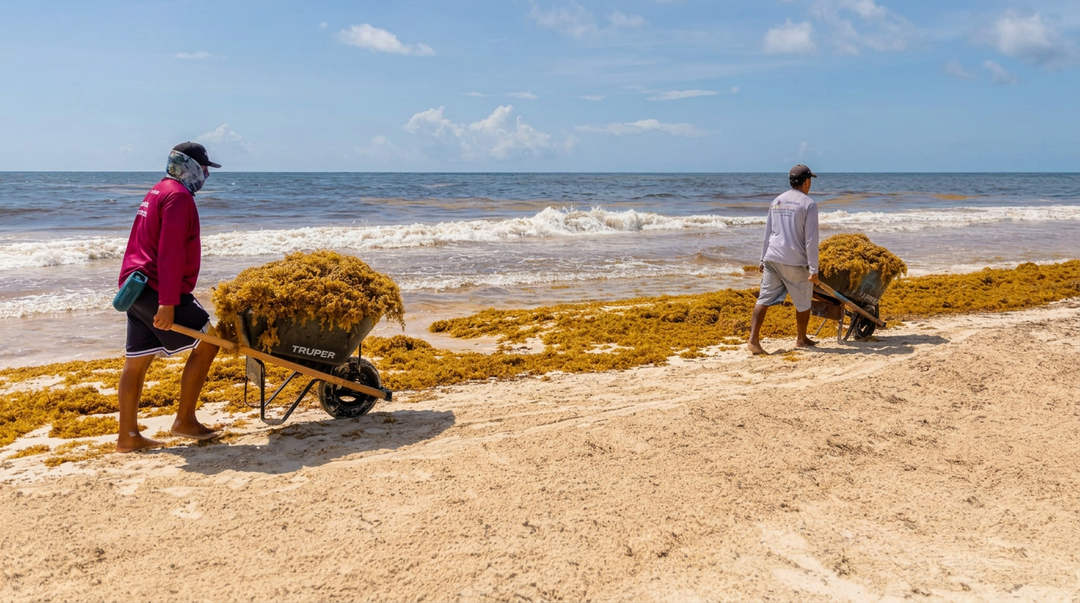
Tulum removed more than 2,800 tons from its municipal beaches before mid-July, nearly double the pace of the same period in 2025, through more than 1,000 container trips to transfer sites. The season also opened early. The first mats landed in January, three months ahead of the usual April start.

What rots on the sand releases hydrogen sulfide
At sea, the macroalgae feeds and shelters fish and birds. On land it decomposes. The U.S. Environmental Protection Agency has warned that piles left on the sand emit hydrogen sulfide and ammonia, gases whose exposure has been linked to respiratory, cardiovascular, and neurological effects.
The decomposition also strips oxygen from the water closest to shore, reducing it to concentrations that marine organisms cannot tolerate.
A slower risk sits inside the biomass. Sargassum absorbs contaminants as it floats, including pesticides and heavy metals such as arsenic, and releases them later. That turns every pile into a problem for the ecosystem, for the crews who spend their shifts shoveling it and for anyone who stays long hours where it accumulates.
Destinations that sell sand are losing it
Sea level is the second measurement Amaro flags. While other regions record increases of nearly two millimeters a year, he says this part of the Mexican Caribbean has registered almost seven or eight millimeters a year, which feeds erosion and speeds the loss of beach.
The retreat shows at points across the Yucatán Peninsula, not only in Quintana Roo. For towns whose economies rest on a strip of white sand, that reaches payroll, investment decisions, room rates and the number of shifts a restaurant can fill.
Where 768.7 million pesos go first
President Claudia Sheinbaum announced more than 2 billion pesos on July 30 for a sargassum strategy coordinated by the Environment Ministry and the Navy alongside the Quintana Roo government. The first phase carries 768.7 million pesos this year.
That money buys two tugboats, six coastal sargassum vessels, 1.5 kilometers of dynamic barriers and 50 kilometers of coastal containment, plus collection equipment for Cancún, Playa del Carmen, Puerto Morelos, Tulum and Mahahual. The goal is to lift daily capacity from 1,227 tons to 1,870, and to 4,000 tons in a second phase.
A separate project would build a circular economy hub in Puerto Morelos to convert biomass into industrial pellets, reducing the volume that ends up being dumped inland.
The Riviera Maya climate crisis the plan does not address
Even at 4,000 tons a day, the strategy works on what lands. The water that grows the algae keeps warming, the sea keeps rising, and the coast has less sand each year to absorb it.
Amaro puts the arrivals in that wider frame. "The arrival of sargassum is one of the great climate challenges Mexico faces at this moment," he said.
Environment Secretary Alicia Bárcena has set an international sargassum convention for October 1 and 2 in Cancún, backed by the European Union. By then, Quintana Roo will know whether the new vessels pushed daily collection past 1,870 tons, and whether the volume floating offshore came down or the season simply outlasted the fleet.
Has this year's sargassum changed how you use Tulum's beaches? Join the conversation and share your perspective with us on Instagram and Facebook at @thetulumtimes.

The Tulum Times · Newsletter
The story continues in your inbox.
Essential Tulum news and local insight, a few times a week. Free.
No spam. Unsubscribe anytime.
Tulum Sargassum Updates and Beach Conditions
Live seaweed conditions, cleanup updates, forecasts, and practical beach planning across Tulum and the Riviera Maya.

“The best journalists reporting from paradise, highlighting the heroes that keep Tulum the most beautiful place in the world! THANK YOU!”


