
Closing Tulum's beach hotels through the sargassum season is not a workable answer, according to the Asociación de Hoteles de Tulum, because the algae now reaches this coast eight or nine months a year.
Three weeks ago, the same association was weighing the opposite. Its president, David Ortiz Mena, said in late July that owners on the coastal strip were studying whether to open only outside the months of heavy arrivals. What closed that door was the calendar. A season that used to end in September now runs most of the year, and a hotel waiting for clean sand would be waiting for a window that no longer opens.
For the people who work that strip, the difference is a payroll. A seasonal hotel keeps a skeleton crew through the dead months and hires the rest back in November. A year-round hotel at 20 percent occupancy keeps paying everyone and absorbs the cleanup bill on top of it. Ortiz Mena argues that the second version is the only one that protects jobs and that hotels cannot finance it alone.
Permanent jobs are the first thing a seasonal calendar cuts
Normalizing temporary closures due to sargassum would have economic and social consequences, Ortiz Mena said, and he put permanent employment at the top of the list. Fewer operating months would mean less tourist activity and direct damage to the communities that live off the industry.

His second argument is definitional. A phenomenon that lasts for eight or nine months is no longer strictly seasonal, so a seasonal response cannot meet it. What the coast needs, in his account, is a permanent strategy rather than a run of emergency measures.
What sargassum costs a Tulum hotel beside its power bill
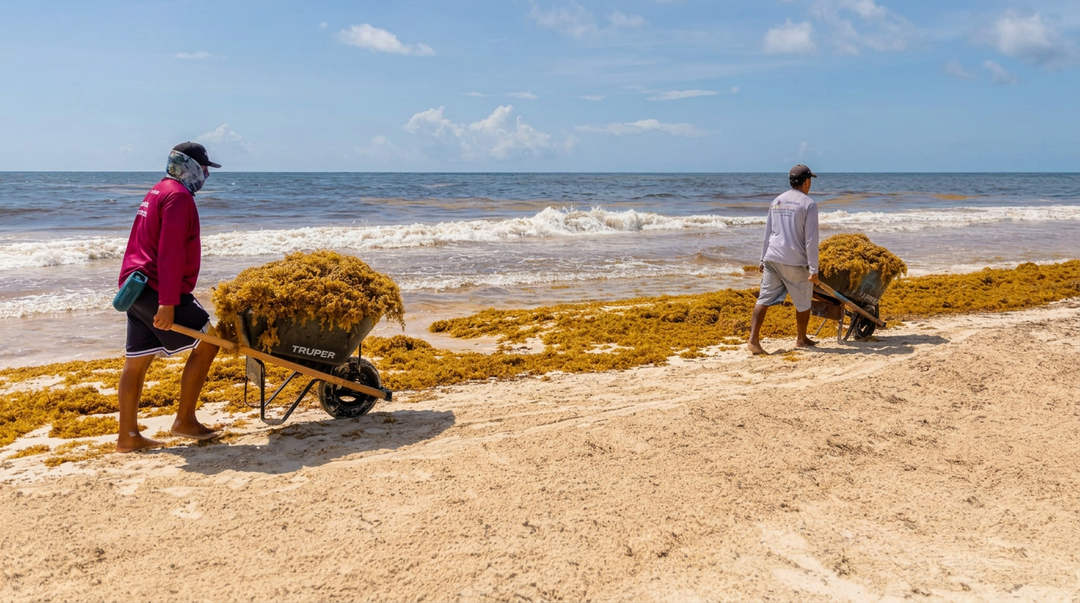
Some properties spend several million pesos a month clearing their beaches during the heaviest arrivals, he said, an amount that, in certain cases, runs to more than double what the same hotel pays for electricity.
That comparison has moved all year, which is part of the problem. In late July Ortiz Mena said a hotel could spend up to three times its electricity bill on removal. On August 12, he put the cost at up to 500,000 pesos per week for some properties and said occupancy was no longer covering payroll. Every one of those figures comes from the sector describing itself. None comes from an audited series.
Removal is only the visible part of it. The association counts cancellations and thinner reservations, discounted rates, damage to the destination's image, beaches left in poor condition, the purchase and upkeep of machinery and barriers, the extra crews hired to work the sand, and the job losses that follow when the arithmetic stops working.

Occupancy near 20 percent in the coastal zone
Ortiz Mena offered one measurement of where the sector stands right now. Hotels on the European plan along Tulum's coastal strip have registered occupancy close to 20 percent. All inclusive properties are running near 40.
Those are the sector's readings of the beach zone, not a municipal average, and the two numbers do not describe the same thing. State figures from the Sistema de Información Turística de Quintana Roo put Tulum at 69.88 percent between January and May, against 76.86 percent a year earlier, a steeper drop than Cancún, Playa del Carmen, or the Riviera Maya recorded. The lows sit in the coastal strip. So does the cleanup bill.
The sector expects the floor to hold through September, with recovery starting in the second half of October. December bookings already point higher, which is what makes the summer question urgent rather than academic. A hotel has to reach December to collect on it.
Ortiz Mena wants the losses measured
No integrated, consolidated figure exists for the cost that sargassum has exacted from the Mexican Caribbean. Not for the destination, not for the hotels, not for the people who work in them.
He wants one built, and he described what it would have to separate: how much the destination loses in total, how much of that the hotels absorb directly, and what the effect has been on employment and on the chain of services that runs behind the rooms. Hoteliers in the zone have put the regional cleanup bill at up to 150 million dollars a year, but that is an industry estimate rather than an official accounting, and it covers cleanup alone.
Four actions, and a bill split with the government
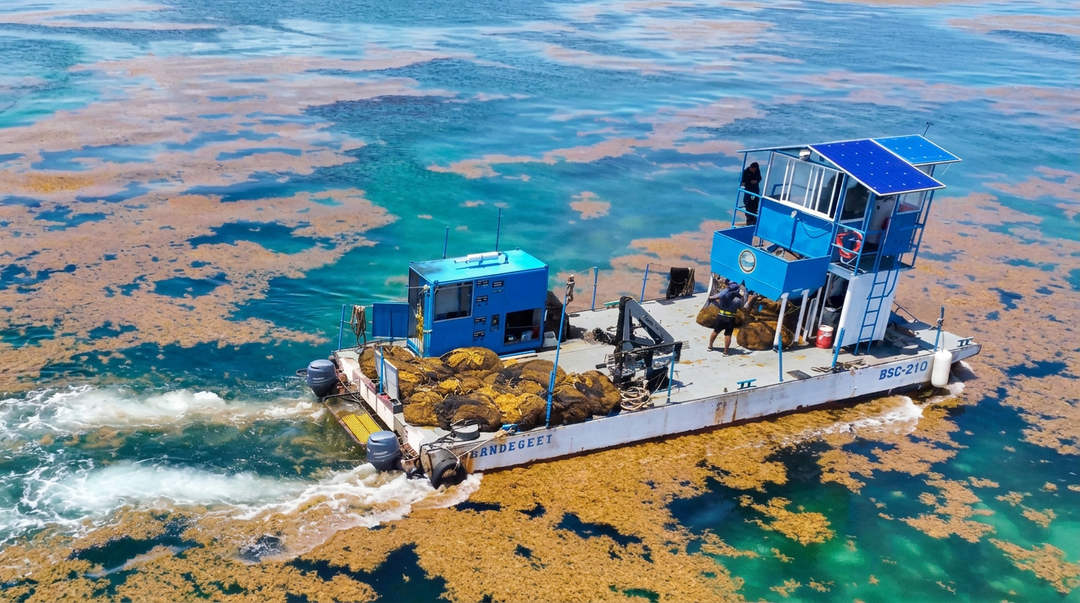
The measures he named are the ones the sector has pushed since the federal plan appeared. Collect the algae at sea before it lands. Protect the coastline. Dispose of what arrives properly. Find a use for the material instead of burying it.
Underneath sits the financial ask. Ortiz Mena called for support, coordination, and financing mechanisms between the public and private sectors, with the stated purpose of preventing these costs from leading to closures, operational cuts, or job losses. Hotels have invested heavily on their own, he acknowledged, but the private sector cannot bear the cost of a massive influx indefinitely and by itself, least of all in a season when rooms will not cover basic operating expenses.
The federal plan President Claudia Sheinbaum presented on July 30 commits 2,635.6 million pesos across two stages. The first carries 768.7 million and aims to increase daily collection capacity from 1,227 tons to 1,870 tons. The second targets 4,000 tons a day, the volume authorities estimate reaches the Quintana Roo coast on an average day, and it is scheduled for 2027.
That date is the difficulty. The Secretaría de Ecología y Medio Ambiente had logged 116,443 tons collected this season by late August, according to figures reported by 24 Horas Quintana Roo, already past the 92,782 tons the Secretaría de Marina removed in all of 2025, with a state projection of 130,000 tons by the close of the year. The open-water capacity that would change the arithmetic comes after that. Until it does, the bill stays where it is, and the count Ortiz Mena is asking for has no institution assigned to produce it.
Should the cost of clearing sargassum off Tulum's beaches sit with the hotels or with the public budget? Join the conversation and share your perspective with us on Instagram and Facebook at @thetulumtimes.

The Tulum Times · Newsletter
The story continues in your inbox.
Essential Tulum news and local insight, a few times a week. Free.
No spam. Unsubscribe anytime.
Tulum Sargassum Updates and Beach Conditions
Live seaweed conditions, cleanup updates, forecasts, and practical beach planning across Tulum and the Riviera Maya.

“The best journalists reporting from paradise, highlighting the heroes that keep Tulum the most beautiful place in the world! THANK YOU!”