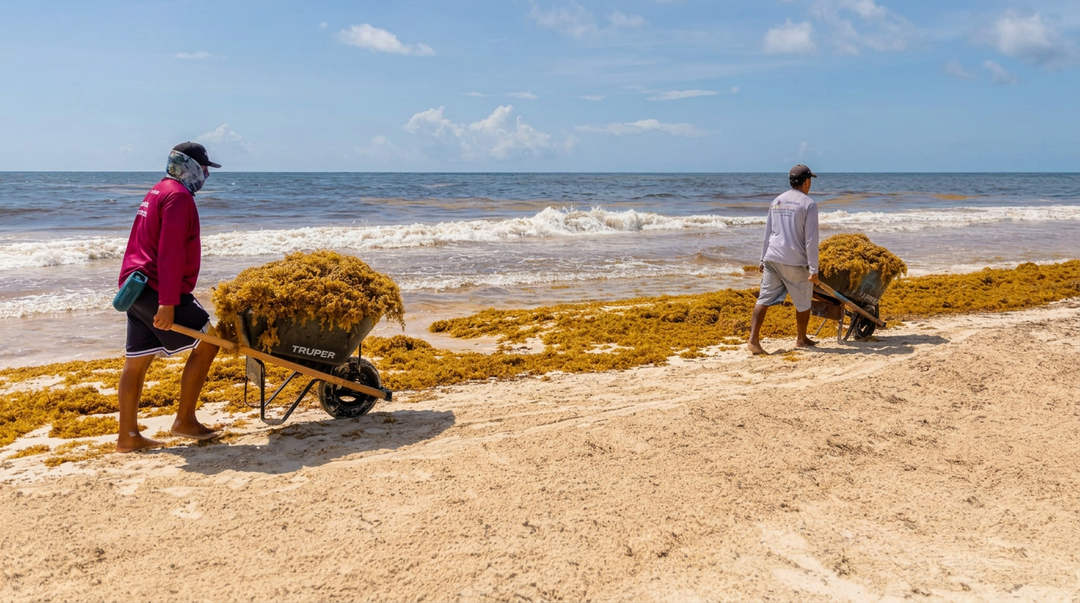
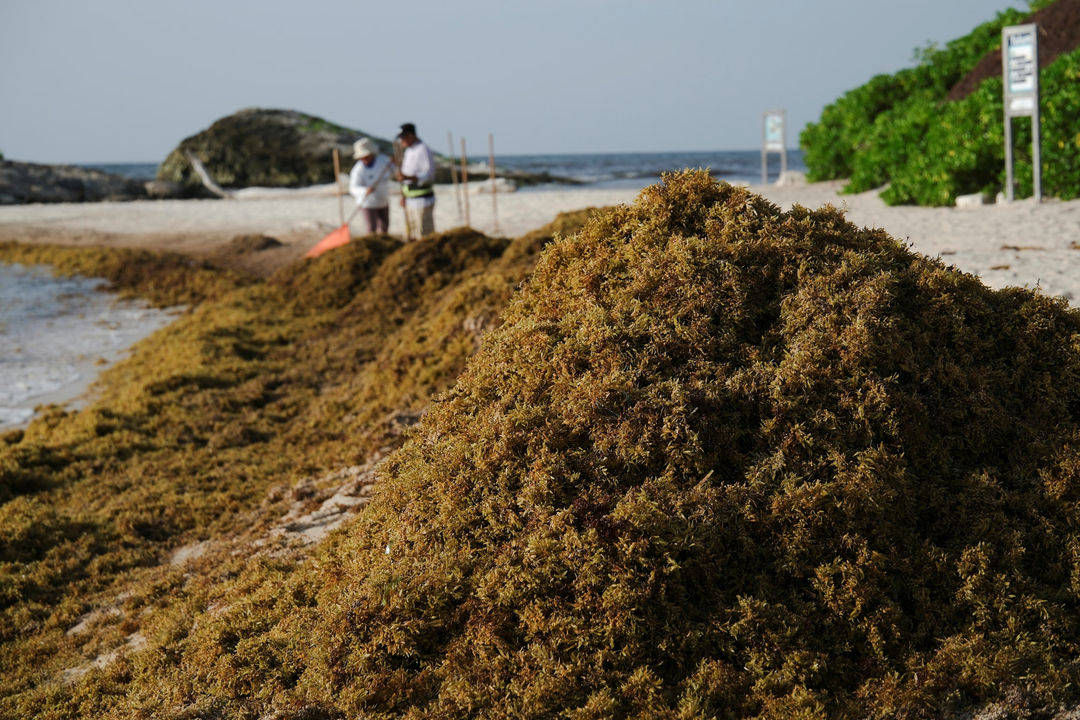
Hotel owners along Tulum's coast are studying whether to close during the sargassum season and reopen only when the beaches clear, a move that would pull rooms off the market for months at a time.
David Ortiz Mena, president of the Consejo Hotelero del Caribe Mexicano and of the Asociación de Hoteles de Tulum, said in late July that owners on the coastal strip are weighing that option to stop the losses generated by beach cleaning costs he described as unsustainable, in a year of low occupancy and an unfavorable exchange rate. No hotel has announced a closure, and the association has not formalized any decision.
For the people who work that strip, a seasonal calendar would rewrite the year. Hotel payrolls in Tulum carry through the low months on the assumption that rooms sell in July as well as in January. Laundries and transport operators plan against the same assumption.
Ortiz Mena says the cleanup bill no longer adds up
Hotels pay for the crews and the machinery that pulls sargassum off their own sand every day, whether or not the rooms behind the beach are full. The Asociación de Hoteles de Tulum has said the daily collection can cost a property roughly what it pays for electricity, and hoteliers in the zone have put the regional bill at up to 150 million dollars a year.

Ortiz Mena has argued that intercepting the algae in open water is more viable than scraping it off the beach, where accumulation drives up costs and demands an operating capacity most hotels cannot sustain permanently.
Occupancy has given them little cover. The Asociación de Hoteles de Tulum reported 53.2 percent in the last week of April and a slight recovery to 59 percent in early May. Annual occupancy in Tulum ran near 40 percent in 2025, the weakest level in a decade, according to industry and state figures reported at the end of that year.
A sargassum season that now opens in January
Levi Williams Manzanares, national president of the Asociación Mexicana de Agencias de Viajes, said the historic window of two or three months now runs four or five, and frequently holds through August.
Ortiz Mena's account goes further. Quintana Roo took in five times more algae in 2025 than in its worst previous year on record, he said, and the 2026 arrivals began in late January. A season that once closed in August or September could now run to the end of the year.

Federal figures track the same curve. The Secretaría de Marina reported 92,782 tons removed in 2025. By July 30 of this year, the count for 2026 had already reached 96,151 tons.
274,000 passengers gone from Cancún in a single June
Grupo Aeroportuario del Sureste moved 2.11 million passengers through Cancún International in June, 11.5 percent fewer than in June 2025. International traffic fell 13.1 percent, from 1.56 million to 1.35 million. Domestic traffic dropped 8.4 percent to 759,398. Together, that is close to 274,000 travelers who did not arrive.
The first half of the year closed at 14.76 million passengers, down 4.7 percent, a third consecutive year of decline.
Sargassum is not carrying that number alone. Airlines trimmed routes and frequencies this spring as fuel costs climbed, and the Centro de Investigación Avanzada en Turismo Sostenible recorded a 4.2 percent drop at Los Cabos and a 16.5 percent drop at Puerto Vallarta between January and May, coastlines where the algae never lands. What travel agents report is narrower and harder to price. The algae is the first thing buyers ask about.
Cenotes take the bookings
Agents affiliated with the AMAV say the question arrives before the itinerary does, and the answer moves clients inland. Cenote tours and beach clubs absorb days that were meant for the shoreline. Others cancel the coastal portion of the trip and keep only the archaeological stops.
The 2,635 million peso bet on catching algae at sea
President Claudia Sheinbaum presented the federal response on July 30 at Palacio Nacional. The Plan Integral para la Atención del Sargazo commits 2,635.6 million pesos across two stages, concentrated on Cancún, Playa del Carmen, Puerto Morelos, Tulum, and Mahahual, close to 50 kilometers of shoreline.
The first stage carries 768.7 million pesos and aims to raise daily collection capacity from 1,227 tons to 1,870. The second targets 4,000 tons a day by 2027, the volume authorities estimate reaches the Quintana Roo coast on an average day.
Navy Secretary Raymundo Pedro Morales Ángeles said the package adds sargassum vessels and tugboats, 35 kilometers of new containment and redirection barriers on top of the 16 already installed, 1,500 meters of dynamic barriers to concentrate the algae offshore, an early warning system, and a dock at Puerto Juárez.
Governor Mara Lezama said Quintana Roo has spent more than 770 million pesos of its own on monitoring, containment, and collection. The state tracks more than 140 beaches with imagery from 10 European Space Agency satellites and publishes a daily status alert for each one.
The AMAV welcomed the federal intervention and said the same thing the hotel sector said. The results are medium-term. That is the part that lands hardest on an owner deciding now whether to keep the doors open in September.
Ortiz Mena has called the plan a turning point, and he has been consistent about what would make it one. Catching the algae in open water, rather than lifting it off the sand, is the step that changes the economics, and that capacity does not reach its target until 2027. The hotels on Tulum's coast will cover the rest of this season, and most of the next, with the boats and barriers already in the water.
Would a seasonal opening calendar protect Tulum's beach hotels or damage the destination's standing as a year-round option? Join the conversation and share your perspective with us on Instagram and Facebook at @thetulumtimes.

The Tulum Times · Newsletter
The story continues in your inbox.
Essential Tulum news and local insight, a few times a week. Free.
No spam. Unsubscribe anytime.
Tulum Sargassum Updates and Beach Conditions
Live seaweed conditions, cleanup updates, forecasts, and practical beach planning across Tulum and the Riviera Maya.

“The best journalists reporting from paradise, highlighting the heroes that keep Tulum the most beautiful place in the world! THANK YOU!”