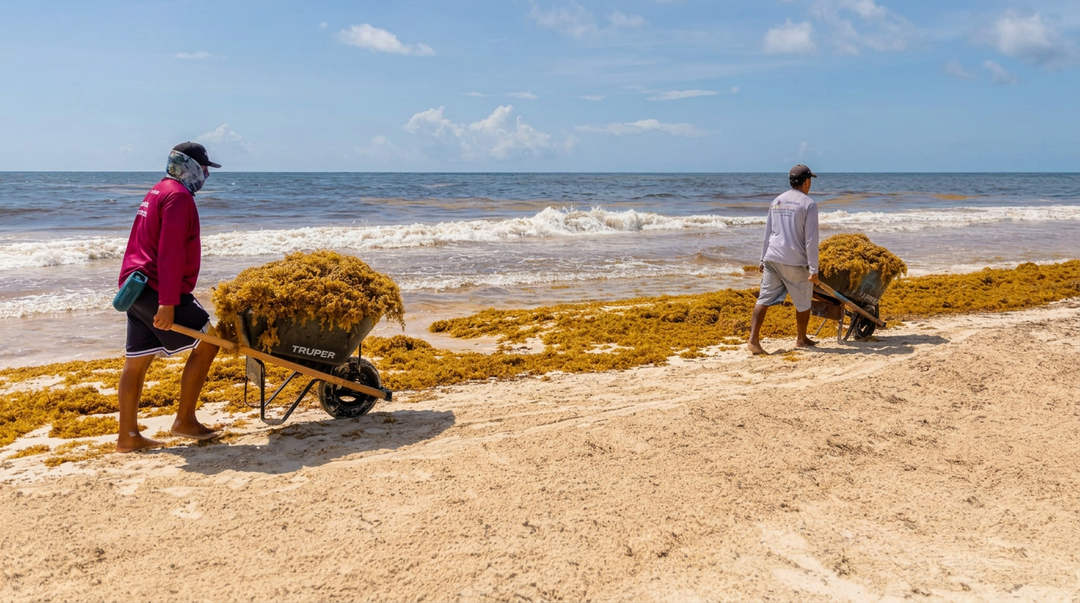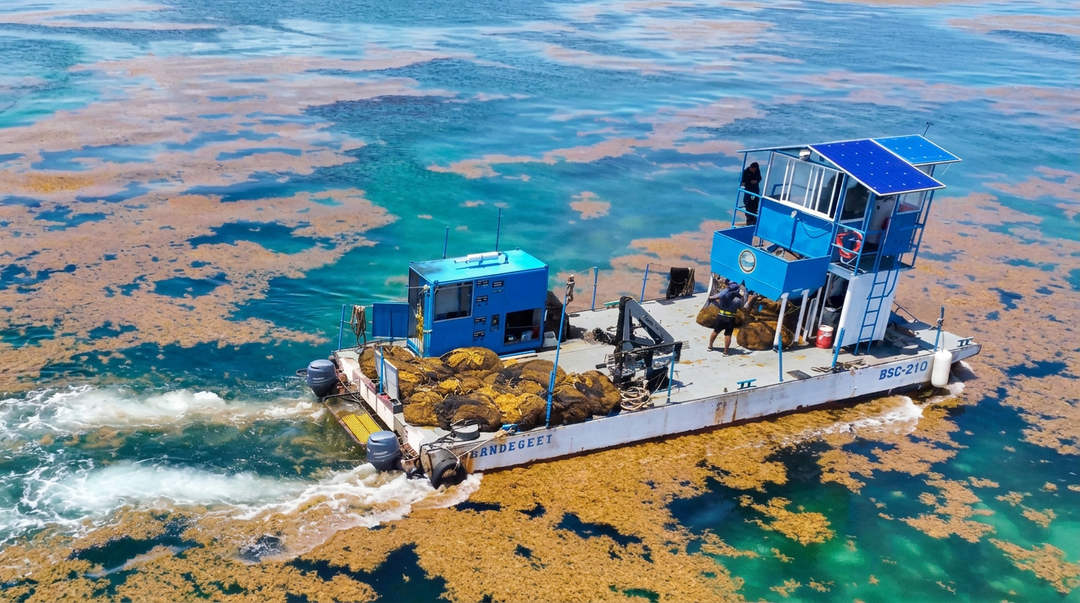

Mexico's two federal development banks are studying sargassum plan financing that could pay for new collection vessels and for beaches losing sand to erosion along the Caribbean coast.
Marian Aguirre Nienau, who heads the Financial Institutions Unit at both Nacional Financiera (Nafin) and Banco Nacional de Comercio Exterior (Bancomext), said the algae problem must be addressed immediately and that both institutions are already working with the federal government and the government of Quintana Roo. Her comments followed the federal announcement that Mexico would buy vessels to intercept sargassum at sea and reduce the beach erosion that follows heavy landings.
For Tulum, the question is not theoretical. The town is one of five destinations named in the federal strategy, alongside Cancún, Playa del Carmen, Puerto Morelos, and Mahahual, and its hotels, beach clubs, and small service operators absorb the cost of every ton that reaches the sand.
New vessels and eroded beaches are the two ideas on the table
There is no specific credit line yet. Aguirre Nienau said the banks are already participating in the initiative and see room to enter beach recovery projects for shorelines damaged by erosion linked to sargassum landings, and to help finance new boats that would make offshore collection more efficient.

The numbers involved explain why development banking is being asked to step in. At the July announcement, federal officials put the average cost of a sargassum vessel at around 250 million pesos, depending on size. A single boat, in other words, costs more than the entire annual budget of many municipal cleanup operations on this coast.
Sargassum plan financing would sit on top of two billion pesos already committed
President Claudia Sheinbaum announced on July 30 that the federal government would put two billion pesos, roughly 117 million dollars, into an integrated sargassum strategy built on three actions: capturing more algae at sea with additional vessels, installing more containment barriers, and improving collection on the beach itself.
What the first phase pays for
The Secretariat of the Navy set out a two-stage rollout. The first stage, worth 768.7 million pesos, is intended to increase maritime collection capacity from 1,227 to 1,870 tons per day through two tugboats, six new coastal sargassum vessels, additional dynamic barriers, and about 50 kilometers of containment barriers in the most affected stretches. A second stage targets 4,000 tons a day.
Alicia Bárcena, the environment secretary, described 2026 as an atypical year, with sargassum presence in the Mexican Caribbean running 27 times above the historical average and an estimated 10 percent of the floating mass reaching the Quintana Roo coastline. That is the scale of the problem the banks are now being asked to price.

Big hotels and corner restaurants sit in different credit lanes
In Quintana Roo, the banks are evaluating which segments they can realistically serve. Aguirre Nienau described two of them. On one side, large-scale industry and hotel groups. On the other, the micro and small enterprises that hold up the local economy and rarely appear in headline investment figures.
Bancomext already finances tourism along both tracks. The large-scale channel is the familiar one. The second reaches Pueblos Mágicos, small restaurants, and complementary services through dedicated MiPyme programs, and the bank has been placing small and medium-sized loans for specific projects in the state for several years.
How Impulso Nafin más Estados moves state money through commercial banks
The main instrument for the smaller end of that market is a program Nafin runs jointly with state governments. It operates through a fiscal and financial coordination agreement in which the state and Nafin each contribute resources to fund and guarantee the loans, which are then issued through participating commercial banks. Each state adapts the rules, the ceilings, and the size of the pool to its own economic priorities.
In practice, a business owner requests a validation certificate at the state window, takes it to a participating bank, and assembles the credit file there. Terms run up to 60 months.
In Quintana Roo, business chambers including the Confederación Patronal de la República Mexicana have drawn on these lines, attracted by the terms and by the state government's role as intermediary. The wider federal backdrop is more generous than it was a year ago. In February, Nafin and Bancomext said they would trigger up to 120 billion pesos in financing for MSMEs under Plan México, with guarantees covering 70 percent of loans up to 20 million pesos in priority sectors and 80 percent of first-time loans up to five million pesos.
A hard year for small businesses, and the wall at 24 months
Aguirre Nienau acknowledged that the year has been difficult for many small companies. Her read on the supply side was more optimistic. Banks and non-bank financial institutions, she said, still have an appetite to lend.
The obstacle she named is not liquidity. It is survival. The challenge, she said, is accompanying small firms so they professionalize and get past their first two years of operation, the stretch where most of them fail. On a coast where restaurants, tour operators, and beach services open and close within a single season, that is the difference between a loan that builds something and a loan that disappears.
Cancún's new financial district is in the same review
Sargassum is not the only Quintana Roo file on the desk. The banks are also reviewing the state's development poles and the financial district project, a plan that Governor Mara Lezama presented in March at the 89th National Banking Convention in Cancún and that state authorities have promoted abroad, with projected investment of up to 1.3 billion dollars.
In early August, the Diario Oficial de la Federación published the declaration that turns the Cancún Financial and Technological District into a Polo de Desarrollo Económico para el Bienestar, the first in the country to be tied to services rather than manufacturing. That declaration is what opens the door to the fiscal incentives and the development banking instruments now under discussion.
None of it moves until someone brings a project a bank can actually price. What Aguirre Nienau described was interest, coordination, and urgency. What has not been announced is an amount, a borrower, or a date.
Should hotels and municipalities borrow money to restore eroded beaches, or should sand recovery stay entirely on the public budget? Join the conversation and share your perspective with us on Instagram and Facebook at @thetulumtimes.
This image was generated or enhanced using artificial intelligence to improve its quality.

The Tulum Times · Newsletter
The story continues in your inbox.
Essential Tulum news and local insight, a few times a week. Free.
No spam. Unsubscribe anytime.
Tulum Sargassum Updates and Beach Conditions
Live seaweed conditions, cleanup updates, forecasts, and practical beach planning across Tulum and the Riviera Maya.

“The best journalists reporting from paradise, highlighting the heroes that keep Tulum the most beautiful place in the world! THANK YOU!”