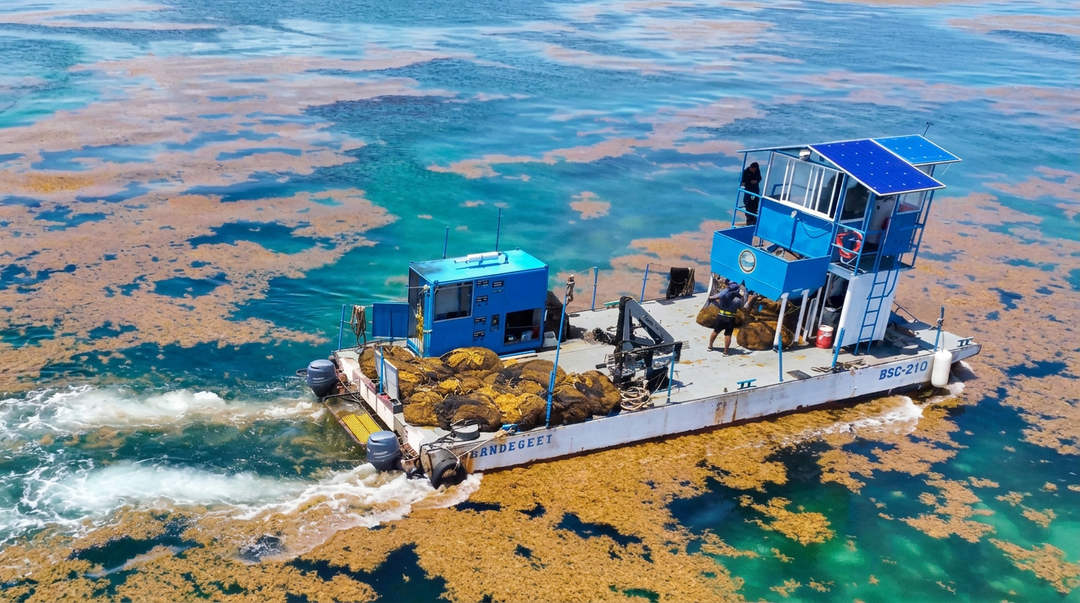
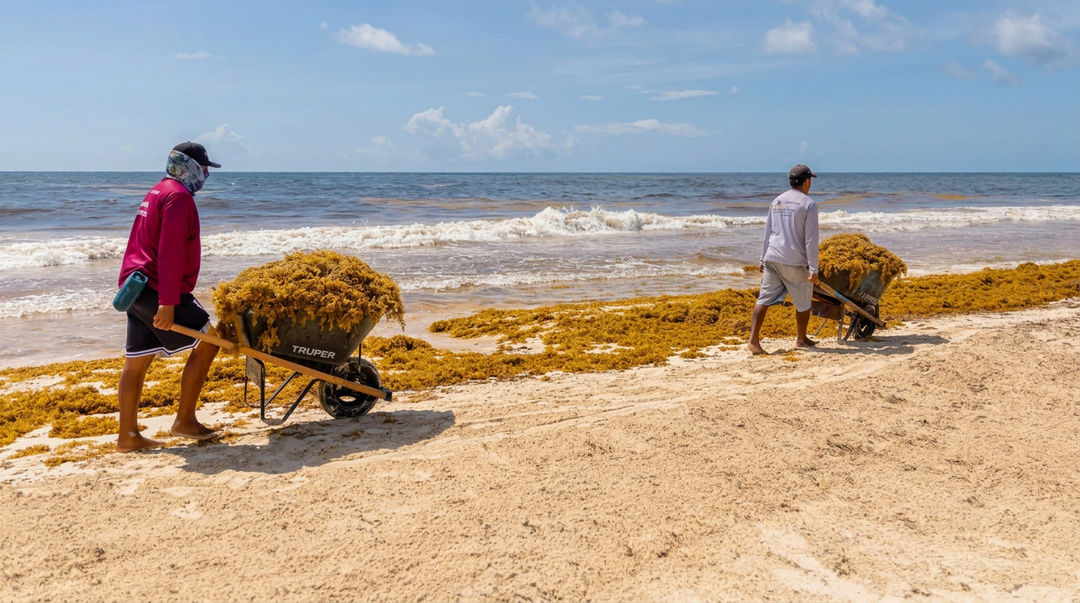
Municipal crews have hauled more than 6,500 tons of seaweed off Tulum's coast this year, and their director says the sargassum season in Tulum is still running. The forecasts point to November.
That month decides what the start of the winter high season looks like from the sand. It also sets how many more weeks the hotels on the coast road keep paying to clear their own frontage, separate from the municipal crews.
Two outlooks now bracket the answer. One comes from a satellite lab at the University of South Florida that monitors the entire Atlantic; the other from Quintana Roo's own monitoring network, which monitors the beaches. They agree that arrivals peaked in midsummer and have been falling since, with the low point around November. The local one adds a warning about how short the reprieve may be.
6,500 tons, and the crews have no end date
The latest municipal figure came on September 17. David Buchanan, director of ZOFEMAT, the office that manages Tulum's federal beach zone, said crews had collected more than 6,500 tons of sargassum since January and made more than 1,800 container trips to the disposal site. Those containers also carry seaweed gathered by the Navy (known in Spanish as Semar), the federal protected areas commission Conanp, and beachfront hotels.

Buchanan gave no date for the end of the season.
"The arrival season continues. We have had calm weeks, others not so much, and regardless of that, every day we put all our effort into the cleanup from very early."
He spoke in Spanish, and the translation is ours. On the instructions of Mayor Diego Castañón Trejo, the crews work every day, regardless of the size of the arrival, with priority given to the public beaches at Playa del Pueblo, Parque del Jaguar, Punta Piedra, and Conchitas. Last week's report on the container trips traces how that count climbed through the summer.
Statewide, the scale is larger still. The Navy said in early September that more than 123,400 tons of sargassum had been collected in Quintana Roo in 2026, the highest figure on record for the state and about a third more than the 92,782 tons removed in all of 2025. It identified Tulum and Othón P. Blanco as the two municipalities with the largest number of moderate-intensity arrivals this year.
The Atlantic sargassum belt, cut in half
The seaweed that reaches Tulum comes from the Great Atlantic Sargassum Belt, a band of floating weed that stretches from West Africa to the Gulf of Mexico. The Optical Oceanography Lab at the University of South Florida measures it by satellite and publishes a monthly outlook.
Its August 31 bulletin reported that sargassum had declined again in every region the lab monitors, and that the total within the belt had been halved. The amount in the Gulf dropped to a third of its July level. Every region except the eastern Atlantic still sat above the 75th percentile of historical values, which the lab said indicated beaching events would continue around the Caribbean through August.

The outlook is as close to an end date as the lab gives. It expects the amount to keep falling in every region until possibly November, with beachings around the Caribbean continuing but "not as severe as in the summer months." Brian Barnes, a researcher at the lab, told the St. Thomas Source in early August that the decline is usually rapid, with the low point somewhere around November.
The bulletin carries its own caveat. Its authors describe it as a general outlook for the Caribbean and the Gulf and warn against using it to predict conditions at any specific beach. Wind and currents still decide what washes up in Tulum on a given morning.
Monitors see the sargassum season in Tulum thinning by November
Closer to shore, Esteban Amaro Mauricio, director of the Red de Monitoreo del Sargazo de Quintana Roo, laid out a similar calendar. He told La Jornada in mid-August that arrivals peaked between June and July and began falling in August. He expects a considerable drop in September and October, with minimal arrivals in November and December.
He also called the decline erratic, and in the same interview he singled out Tulum and Mahahual as places still holding significant accumulations while Playa del Carmen had started to ease. A month later, Buchanan's calm weeks and heavy ones describe the same uneven pattern.
The Navy lowered its sargassum alert for Quintana Roo from red to yellow at the end of August, meaning arrivals were still high but no longer excessive.
Amaro expects more tonnage before the year closes. He put the state's total at about 110,000 tons in mid-August and estimated it could end the year near 150,000. He also said the tropical cyclone season, which runs through November 30, tends to push sargassum away from the coast, and recalled that three storm systems in 2020 left the state's beaches very clean.
January, the month that used to be quiet
The less comfortable part of the forecast is the length of the break. Amaro said the 2027 season could begin in January, as this one did, rather than the April or May start that had long been the norm. This year's early arrival was the first of its kind in the roughly 12 years since the mass landings began, he said.
The Tulum Times has followed this season since January, when the Navy confirmed the first sargassum clusters offshore months ahead of the usual calendar. By mid-April, the municipal office's count in Tulum stood at 1,224 tons, against 462 at the same point in 2025.
If that pattern repeats, the quiet stretch between one season and the next could shrink to about two months, November and December, in place of the winter-long reprieve the coast once counted on.
At sea, the Navy is adding capacity. Its new vessel, the Sargassum, is being fitted out and would raise the fleet's daily offshore collection capacity from 627 to 1,227 tons.
The next checkpoint comes at the end of this month, when the Florida lab issues its September outlook. A further drop across the Caribbean would hold November as the month arrivals bottom out. Until that reading arrives, the ZOFEMAT schedule stays as it is, with crews out early every day, whether it's a calm week or a heavy one.
When do you expect Tulum's beaches to run clear again this year? Join the conversation and share your perspective with us on Instagram and Facebook at @thetulumtimes.

The Tulum Times · Newsletter
The story continues in your inbox.
Essential Tulum news and local insight, a few times a week. Free.
No spam. Unsubscribe anytime.
Tulum Sargassum Updates and Beach Conditions
Live seaweed conditions, cleanup updates, forecasts, and practical beach planning across Tulum and the Riviera Maya.

“The best journalists reporting from paradise, highlighting the heroes that keep Tulum the most beautiful place in the world! THANK YOU!”