


The Sargasso Sea is real; it sits in the middle of the North Atlantic, and it is the only sea on Earth without a single meter of coastline.
No country borders it. Its edges are four ocean currents turning clockwise around Bermuda, and when those currents wander, the borders wander with them. Everything else strange about the place follows from that one fact.
For readers on the Quintana Roo coast, there is a more immediate reason to care. The golden weed that gave that sea its name is the same seaweed now arriving on Tulum's sand by the tens of thousands of tons, and the story of how it got here is not the one most people assume.
Four currents and no land in sight
The Sargasso Sea sits inside the North Atlantic Subtropical Gyre. The Gulf Stream forms its western wall, the North Atlantic Current the northern one, the Canary Current a looser eastern edge, and the North Equatorial Current closes it off to the south. Measured roughly, it runs about 1,100 kilometers wide and 3,200 kilometers long, with a core area of some two million square nautical miles wrapped around the Bermuda archipelago.
Inside that ring, the water behaves differently from the ocean around it. Warm, unusually salty, exceptionally clear, and poor in nutrients. Sailors called these latitudes the doldrums for a reason. Wind dies here.
Columbus thought the weed meant shallow water
In September 1492, Columbus's crossing ran into mats of floating weed thick enough that the crew read them as a warning. Weed meant rocks. Rocks meant running aground in an ocean nobody had charted. They kept sailing, found no bottom, and produced the first European account of the place that would carry the weed's name for the next five centuries.
The name came from Portuguese sailors, who called the plant sargaço after a grape they knew from home. Look closely at a frond and the comparison holds. The seaweed is studded with small round bladders that look exactly like berries.
Nearly everything else attached to the Sargasso Sea is folklore. The graveyard of ships held fast by tangled weed belongs to fiction. Vessels did stall here, in windless water, which is a different problem entirely.

The only seaweed on Earth that never touches bottom
Two species do almost all of the work, Sargassum natans and Sargassum fluitans. Both are holopelagic, a word that earns its place because nothing else in the sea does what it describes. These plants complete their entire life cycle floating. They never anchor to a rock, never root in sand, never spend a day of their existence attached to anything. They reproduce by breaking apart, and each fragment keeps growing.
What keeps them up are the pneumatocysts, the little gas-filled berries the Portuguese mistook for grapes. A mat of this stuff is effectively a drifting island with its own shade, its own shelter, and its own food chain.
Ten species live here and nowhere else
Ten species have adapted to the mats so completely that they exist nowhere else on the planet. The best known is the sargassum frogfish, an ambush predator patterned so precisely like the weed that it disappears from a few centimeters away. Flying fish build bubble nests in the fronds. Crabs and shrimp have evolved the same yellow and brown camouflage.
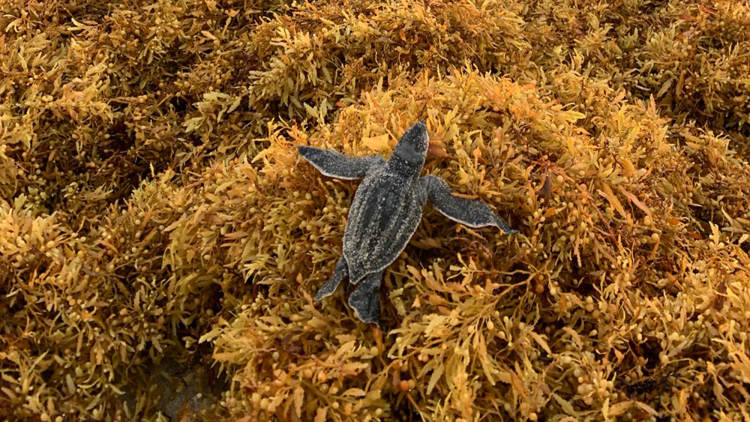
Every species of Atlantic sea turtle passes through. Hatchlings that leave Caribbean and Florida beaches vanish into open water for years, a gap biologists spent decades calling the lost years, and satellite tracking of young green turtles has since shown many of them actively heading for the Sargasso Sea rather than drifting passively around the gyre. They shelter under the mats, feed in them, and bask on top of them.
Dolphinfish, marlin, tripletail, and tuna use the same nursery. The scientific case assembled to justify protecting the region called it the golden floating rainforest of the Atlantic, which is not language anyone applies to a beach nuisance.
Eels crossed an ocean to spawn, and nobody could prove it
The strangest resident never really lives there. European and American eels spend their adult lives in rivers and estuaries thousands of kilometers away, then swim back across the Atlantic to breed, and the Sargasso Sea is the only spawning ground science has ever identified for either species.
How eels reproduced puzzled Aristotle. It puzzled a young Sigmund Freud, who dissected hundreds of them hunting for organs he never found. In the early 20th century, the Danish biologist Johannes Schmidt spent years hauling nets across the Atlantic and noticed that the smallest larvae always came from one region. He proposed the Sargasso Sea, and he was widely believed.
He was also unprovable. No egg or spawning adult has ever been sampled there. The gap closed only in 2022, when researchers who had tagged 26 female eels in the Azores reported that five of them reached the Sargasso Sea, the first direct evidence after roughly a century of trying. The European eel is now listed as critically endangered.
Something new appeared in 2011, far to the south
Then the satellites picked up something that had never been there before.
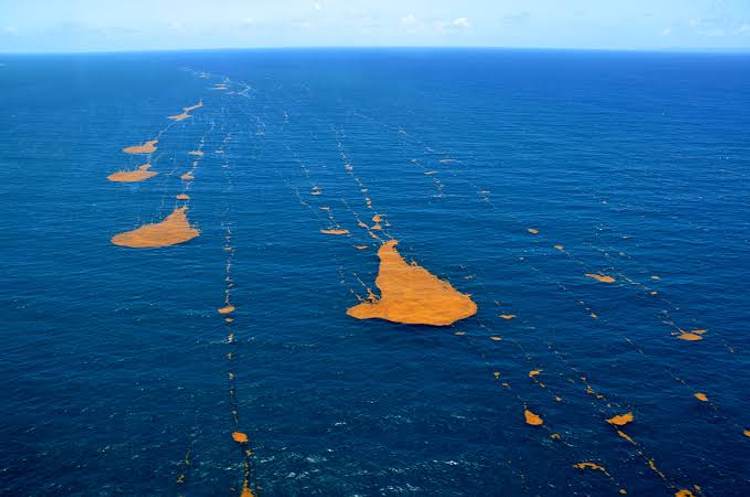
Beginning in 2011, imagery showed a new source region of floating sargassum well south of the Sargasso Sea, north of the mouth of the Amazon. It grew. By June 2018, researchers at the University of South Florida measured a belt running 8,850 kilometers from West Africa to the Gulf of Mexico and carrying more than 20 million metric tons of biomass. They named it in the journal Science. The Great Atlantic Sargassum Belt.
It has returned every year since, with one exception in 2013. And it is not the solid brown mass the maps suggest. Within the belt, sargassum covers less than 0.1 percent of the ocean surface on average, scattered in clumps and windrows that wind and current can pile onto one beach and leave the next one clean.
Why the Sargasso Sea is not what lands on Tulum
This is the part most coverage gets wrong. The weed arriving in Quintana Roo is not drifting down from the Sargasso Sea. It is growing in a separate, newer population roughly 2,000 kilometers farther south, in water with a completely different chemistry.
Sampling made the difference measurable. Sargassum pulled from the Atlantic belt carries more nitrogen and more phosphorus in its tissue than sargassum taken from the Sargasso Sea itself. Same plant, richer diet, far more of it.
What nobody has settled is where the diet comes from. The candidates have been argued for 15 years. Amazon discharge loaded with agricultural runoff. Winter upwelling off West Africa. Congo River outflow. Saharan dust falling on open water. A 2025 study pointed instead at an extreme negative phase of the North Atlantic Oscillation in 2009 and 2010, which would have shoved a seed population of sargassum south out of its usual recirculation zone, with vertical mixing rather than rivers feeding the blooms that followed.
Research published this year raises a harder possibility. The belt may no longer need an outside push. Nutrients recycled inside the mats themselves, by the seaweed and by the animals living in it, appear to be helping sustain the blooms, which would move the drivers from physical forcing toward something closer to self-maintenance.
Translated out of the journals, that means this may not be a bad decade. It may be the new shape of the Atlantic.
33.6 million tons floating in June alone
The measuring is done from orbit. USF's Optical Oceanography Lab runs the Sargassum Watch System, reads MODIS satellite data, and publishes a bulletin at the end of every month.
The 2026 numbers have moved in one direction. 9.5 million metric tons across all monitored regions in January. 13.6 million in February. 19.1 million by the end of March. 28.9 million in May. Then 33.6 million in June, with the Caribbean at a record high for the month and the Gulf of Mexico alone holding 5 million tons, close to double its previous record.
The all-time peak still belongs to 2025, at roughly 37.5 million tons. USF has said since spring that 2026 is likely to take it.
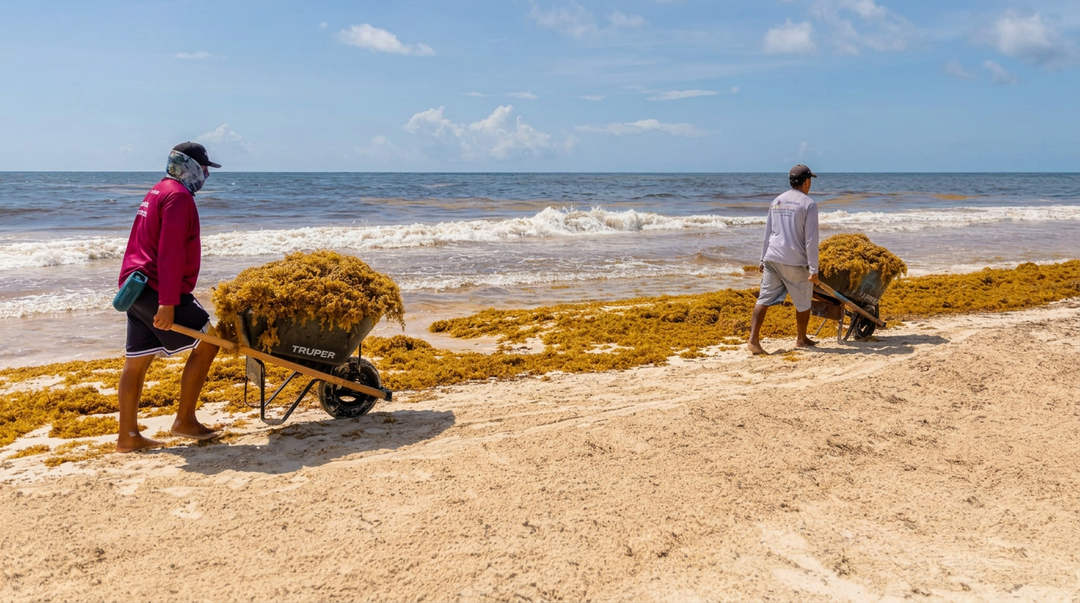
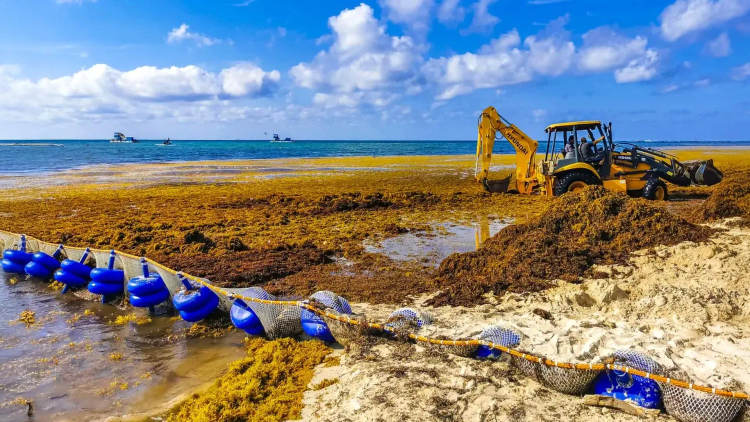
On the ground, the arithmetic gets heavier. Quintana Roo's environment secretariat counted 79,476 tons of sargassum removed statewide as of July 6. The Navy, which runs the offshore side of the operation with an oceangoing sargassum vessel and a fleet of coastal boats, reported 88,998 tons collected this season as of late July. The 2025 total was 92,783. Containment barriers cover about 9,450 meters of coast against a target of 16,030, and heavy surf keeps tearing out sections of them.
What a nursery does when it hits the sand
Sargassum in open water is habitat. Sargassum on a beach is decomposition.
Piled and rotting in tropical heat, it releases hydrogen sulfide, the rotten-egg gas that empties a beach faster than any headline, along with ammonia. Prolonged exposure brings respiratory and eye complaints. The pile blocks nesting turtles from reaching dry sand and traps hatchlings that make it out of the nest. The brown leachate running off it darkens the water, cuts the light reaching seagrass beds and coral, and can kill both.
There is also arsenic. Pelagic sargassum accumulates it naturally, which complicates every proposal to convert the harvest into fertilizer, animal feed, or building material, and it explains why the reuse industry has moved slower than the volumes would suggest.
The cost is not abstract. Miami-Dade County alone budgets around $35 million a year to clear its beaches.
A sea nobody owns
The ecosystem at the origin of this whole story has almost no legal protection, because most of the Sargasso Sea lies in international waters where marine protected area law does not reach.
On March 11, 2014, governments met in Bermuda and signed the Hamilton Declaration, creating the Sargasso Sea Commission, the first body ever asked to steward a high seas ecosystem. Ten governments have signed, among them the United States, the United Kingdom, Canada, the Bahamas, and the Dominican Republic. The declaration is non-binding. The Commission has no enforcement power. It works by persuading the international bodies that already regulate shipping and fishing.
It also carries a warning that sits awkwardly next to the Caribbean's cleanup effort. The Commission has cautioned that a fast-growing industry built on harvesting sargassum could put serious pressure on the population holding that entire ecosystem together. One coastline wants the weed gone. Another needs it to stay.
USF publishes its next bulletin at the end of this month, and it will show whether 2026 passes the 2025 record before the season turns. Quintana Roo needs roughly 3,800 more tons to break its own. At the rate the Navy has been hauling it off since May, that will not take long.
Has sargassum changed the way you plan a beach day in Tulum, and which stretches of coast have stayed clearest for you this season? Join the conversation and share your perspective with us on Instagram and Facebook at @thetulumtimes.
This image was generated or enhanced using artificial intelligence to improve its quality.

The Tulum Times · Newsletter
The story continues in your inbox.
Essential Tulum news and local insight, a few times a week. Free.
No spam. Unsubscribe anytime.
Tulum Sargassum Updates and Beach Conditions
Live seaweed conditions, cleanup updates, forecasts, and practical beach planning across Tulum and the Riviera Maya.

“The best journalists reporting from paradise, highlighting the heroes that keep Tulum the most beautiful place in the world! THANK YOU!”


