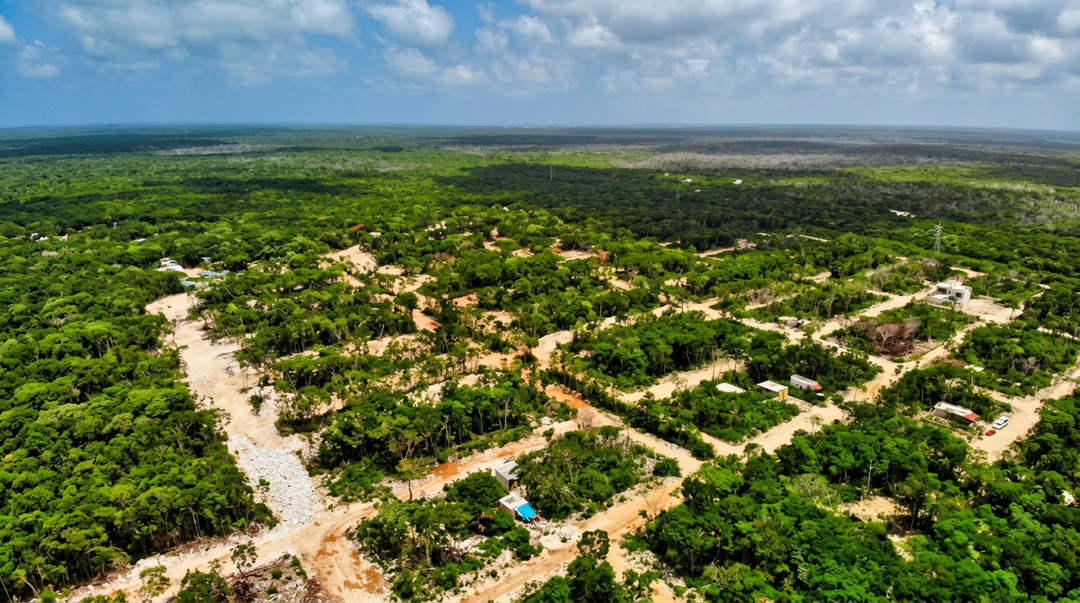

A federal judge dismissed the legal challenge to the Sac Actun road on Monday without deciding whether the project is lawful, and no court order now stands in the way of the work.
The Fifth District Court closed the case brought against the environmental exemption that let a paved road advance through the jungle of Tulum without an impact statement, for the project the federal government registers as Camino Jacinto Pat. According to the case file reported by Sol Quintana Roo, the complainant was Elijo por el Clima, a civil association affiliated with the environmental group Sélvame MX, and the complaint was filed on June 17.
What the association was trying to protect is the ground under the route. The road crosses the Sac Actun system, a network of flooded caves and cenotes that forms part of the aquifer supplying drinking water along this coast. Not quite three months of litigation ended without the machinery ever pausing.
The ruling ends the case without touching the exemption
An amparo is the constitutional challenge that Mexican law allows a citizen or an organization to bring against an act of authority, and this one is aimed at a single document. The federal environment ministry, Semarnat, had released the project from the obligation to submit an environmental impact statement, and that release was the act under challenge.

Monday's order does not say the exemption was correct. It does not say it was wrong either. A dismissal of this kind ends the proceeding for procedural reasons and leaves the underlying question unexamined, meaning the document the association went to court over remains in force and unread by a judge on its merits.
The practical result reads like a defeat. The legal result is narrower than that, and the difference is the whole reason an appeal exists.
Elijo por el Clima can take the ruling to a collegiate court
The association remains within the period to file a revision appeal. That appeal goes to a collegiate circuit court, which decides first whether to admit it and then whether the district judge was right to close the case.
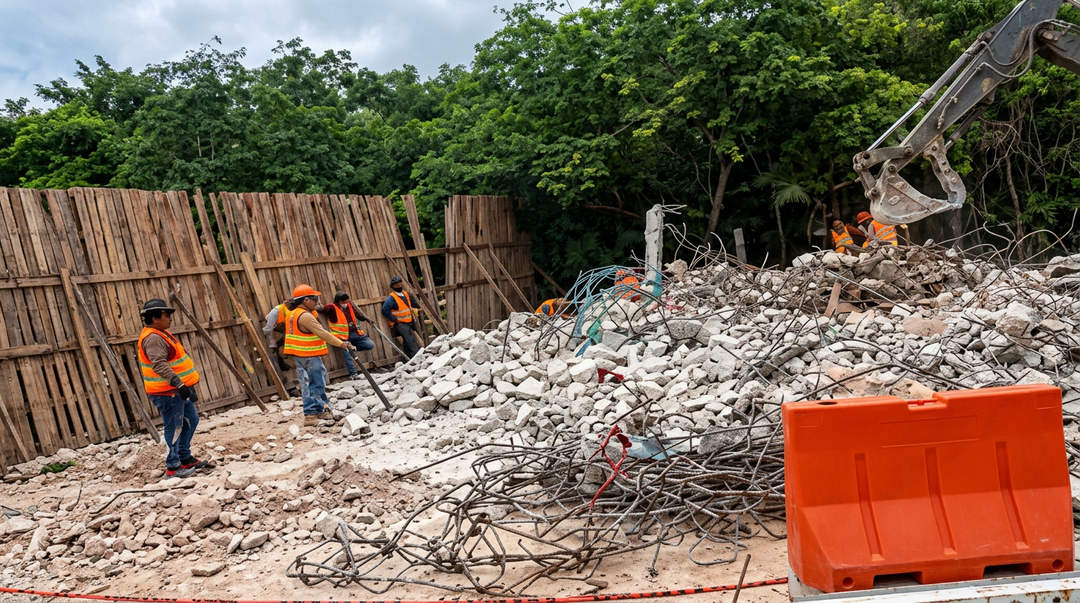
Filing it would not pause the road. A suspension is a separate request, and the judge in this case denied each one as the proceedings ran, according to the same case file. The clearing has therefore never stopped for a court, at any point since the amparo was admitted.
This publication has previously covered the gap between a federal order and what happens on the ground. Our report on how the Maya Train service kept running six months after a court ordered Profepa to inspect the same stretch follows the same pattern as in a different file.
How the Sac Actun road avoided an environmental impact statement
Sélvame MX has said its lawyers found the exemption through transparency requests, and that it was granted in favor of Tren Maya S.A. de C.V., the state company that runs the railway project and answers to the Army. Raúl Aldama Gavilán, the group's lawyer, has said the collective first noticed clearing on March 31 near the Cobá to Tulum highway and traced the work back through public records to a 2021 filing for a bypass called Libramiento Tulum.
The justification for the exemption, as described by the organizations challenging it, is that the work counts as the rehabilitation of a rural road. Sélvame MX, Greenpeace México, and the Centro Mexicano de Derecho Ambiental said in June that the opening measures seven meters across, above the six-meter ceiling that definition allows, and that it cuts standing forest rather than restoring an existing track.
None of that has been tested by a court. It is the complainants' account of the permit, and the ministry that issued the exemption has not published a reply to it.
Profepa sealed the route, and the Army came back
The clearing is not new, and neither is the enforcement. Local environmentalists reported the first cutting in early 2025 near the Dos Ojos cenote park, almost opposite Xel-Ha, and the federal environmental prosecutor, Profepa, placed closure seals on the works after the complaint was filed.
The seals did not hold. The Defense Ministry resumed the work earlier this year and has not stopped since.
The same trace had already been marked once before, when Profepa closed the earlier Libramiento Tulum project that ran along it. What is being built now follows that line, which is why the organizations describe it as the old bypass under a new name rather than a rural road being repaired.
Hoyo Negro, Otoch Há, and a route nobody measures the same way
Sac Actun holds more than 360 kilometers of mapped flooded passage connecting hundreds of cenotes. One of them is Hoyo Negro, the pit where divers recovered the skeleton known as Naia, among the oldest complete human remains found in the Americas. Sélvame MX has said the route passes near Hoyo Negro and the Otoch Há cenote, and that heavy machinery compacting the surface risks the ceilings of the passages below. Readers who want to see what sits under that terrain can start with our guide to the cenotes around Tulum, several of which open into the same system.
How much forest has actually been cut is one of the things nobody agrees on. The organizations' June statement described a 16-kilometer road. Reporting on the court case puts the cleared line at around 20. An account of the amparo filing in May said roughly 15. The bypass project that used the same trace was 26. The Tulum Times found no published figure from the Defense Ministry, the environment ministry, or Tren Maya S.A. de C.V., leaving every number circulating to come from the side that opposes the work.
The organizations' explanation for why the road exists at all is economic. Guillermo D'Christy, president of Sélvame MX, has argued publicly that the route does not function as a bypass because it does not wrap around Tulum, and that its real effect is to open a large block of forest above the aquifer to subdivision and sale. That is the group's reading of the project, not a finding by any authority.
Elijo por el Clima has not said publicly whether it will appeal. Until it does, the exemption stands, and the machines keep working, and the question the association carried into court remains the one thing the court declined to answer.
Should a road over the Sac Actun aquifer be built without an environmental impact statement? Join the conversation and share your perspective with us on Instagram and Facebook at @thetulumtimes.

The Tulum Times · Newsletter
The story continues in your inbox.
Essential Tulum news and local insight, a few times a week. Free.
No spam. Unsubscribe anytime.
Tulum Development, Permits, and Construction Watch
Reporting on permits, construction, regulation, and major development decisions shaping Tulum’s urban growth and investment climate.

“The best journalists reporting from paradise, highlighting the heroes that keep Tulum the most beautiful place in the world! THANK YOU!”