
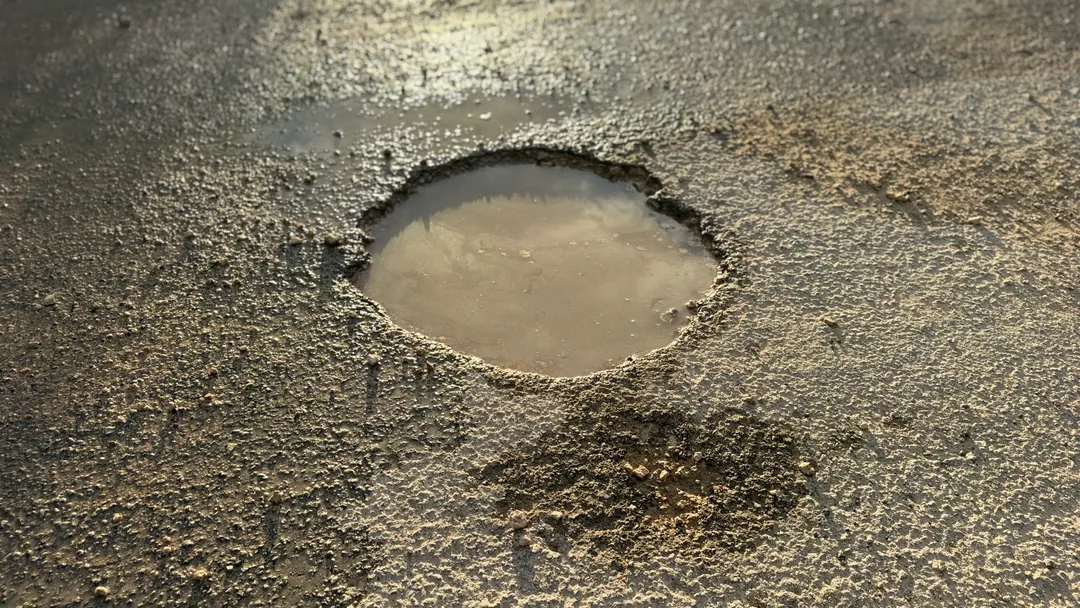
Tulum potholes reopen within days of heavy rain on many streets paved under the current administration, where the asphalt exposed at the broken edges measures only 2 to 3 centimeters thick.
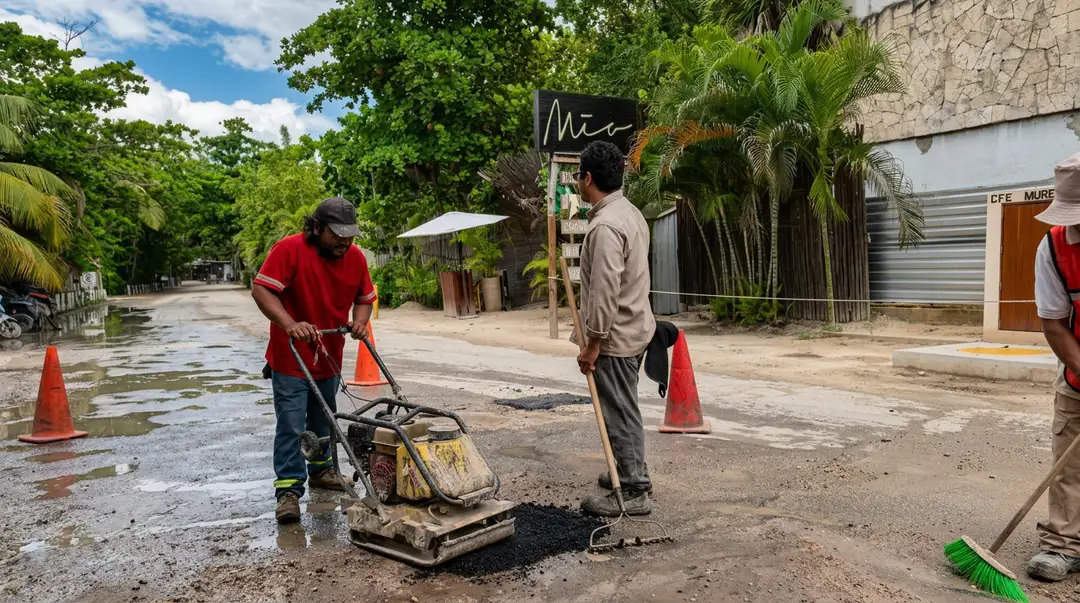
The cycle is running again this week. The municipality is in the middle of an emergency pothole repair program that has worked through the coastal zone, Centro, Ejido, Cancha Maya, and Lakín, with crews scheduled to reach Maya Pax on November 3, according to José Audomaro Pacheco Solís, the director general of Public Services.
Each storm carries two bills. One is paid by the people who ride these streets on motorcycles and bicycles. The other lands on the municipal budget, because every patch that fails is work that has to be paid for again. Neither cost will shrink while the city treats a construction problem as a maintenance problem.
Two centimeters of asphalt over a base that turns to mud
A paved street is a stack of layers. At the bottom sits the compacted natural ground. Above it, in this part of the Yucatán Peninsula, lies a base of crushed limestone or sascab, the pale local material that packs into a hard platform when dry. The black surface on top has one main job: keeping water away from everything underneath.
Thickness decides whether it can. Municipal specifications for urban streets in Mexico and abroad commonly call for hot-mix asphalt surface layers of four to five centimeters or more after compaction. Tulum has used that standard itself. A coastal zone repaving announced by the municipality years ago, reported by El Quintana Roo, specified five centimeters of asphalt.
At two or three centimeters, several things fail at once. Hot asphalt loses heat quickly when it is spread that thin, often before the rollers can press it to full density, so the finished surface keeps a network of tiny connected air pockets. Rain travels through them. Once water reaches the limestone base, the base softens, and each passing tire pumps a little more of it up through the cracks. A thin layer laid without a proper bonding coat over the old surface also tends to peel away in sheets. The asphalt, now resting on mud, breaks along its weakest line.
The potholes pictured with this story show the final stage. Each one holds milky, beige water and a scatter of loose white stones. That debris is the base layer, washed out from under a skin of asphalt so thin its broken edge barely casts a shadow.
Drainage adds pressure. Tulum has no storm sewer network to speak of, and rain that lands on a paved street either finds one of the city's absorption wells or stays where it fell. Water that sits for hours on a porous surface does more damage than a downpour that runs off in minutes.
Why Tulum potholes take down motorcycles and bicycles first
A car that drops into one of these holes usually comes out with a bent rim or a ruined tire. A motorcycle can come out without its rider.
Two-wheeled vehicles balance on two small patches of rubber. When the front wheel falls into a hole with sharp asphalt edges, it stops for a fraction of a second while the rest of the machine and the rider keep moving forward. The loose stones a pothole scatters across wet pavement remove what little grip was left. Bicycles, with narrow tires and no suspension, are even more exposed.
Rain hides the danger. A pothole filled to the brim looks like an ordinary puddle, and a rider cannot judge its depth until the wheel is already inside it. Pacheco Solís made the same point when the current program began, warning that standing water over potholes raises the risk of accidents.
Tulum runs on two wheels. Hotel and restaurant staff commute by motorcycle, delivery riders cross the center all day, and visitors rent scooters and bicycles to reach the beach and the archaeological zone. For all of them, a narrow street in the rainy season is a hazard with no warning sign.
Older streets downtown still hold their shape
The same storms fall on streets that were built years ago, and many of them come through intact. On stretches of the downtown grid paved under earlier administrations, many lined with concrete curbs on both sides, the surface shows an occasional repair and little else after rains that open holes a few blocks away.
If age decided the outcome, the newer streets would be winning.
Some earlier projects were documented as street-wide work rather than asphalt alone. Under former mayor Romalda Dzul Caamal, the municipality invested more than five million pesos in federal and local funds to resurface streets in the city center, including curbs, sidewalks, and about 8,000 square meters of asphalt, according to Palco Quintanarroense. Curbs do more than define a street. They lock the edges of the pavement so the asphalt cannot spread and crack sideways under traffic, and they guide water toward drains rather than letting it soak into the unfinished shoulder.
A well-compacted surface of adequate thickness, laid on a sound base, can go years with only spot repairs. That is close to what drivers see on older streets, and the opposite of what they see on many new ones.
A cold patch that lasts until the next storm
A pothole repair built to last follows a process that takes time and costs money. Crews saw-cut the damaged area into a clean rectangle, dig down to firm material, rebuild and compact the base, spray a bonding coat on the walls of the cut, then place hot asphalt and compact it in layers. Skip any of those steps and the patch rests on the same wet foundation that failed the first time.
The fast version is simpler. Cold-mix asphalt, delivered in bags or by the ton, goes into a hole that is often still holding water, gets tamped by hand or with a small plate compactor, and traffic returns within minutes. It works as an emergency measure. Used as standing policy, it schedules its own return visit.
Residents have watched both versions fall short. In April, Por Esto reported that municipal crews in the Villas Tulum subdivision cut into the pavement to prepare it for cold-mix patching, then left the work unfinished, leaving open trenches in the street. Neighbors pooled their own money and filled the holes with cement. In La Veleta, The Tulum Times reported in 2025 that Calle 8 was resurfaced with black gravel over tar, and residents said the gravel had shifted to the edges of the street within months.
The coastal road is the most expensive example. In April 2025, Mayor Diego Castañón Trejo launched the rehabilitation of 1.5 kilometers of the road at a cost of 9,950,000 pesos, and Christian Moguel, the municipality's director of construction monitoring at the time, said top-quality materials would be used to ensure the work's durability, according to Riviera Maya News. By March 2026, drivers and hotel zone workers told the same outlet that potholes had returned even after recent repaving in some sections, and some attributed the problem to the quality of work carried out by the municipal public works department.
The mayor said patching was not the plan
Castañón has described the trap himself. After Milenio published a report on the condition of Tulum's main streets, the mayor told the outlet that his government did not want to keep patching because the same potholes would return over time, and that the repaving of the streets was already scheduled.
Patching is still what arrives after each storm.
Money for paving has been budgeted. The municipality's 2024 investment program lists 7 million pesos for paving streets at several points in the city, 6 million for streets in La Veleta, 3.5 million for the streets leading to the Universidad Tecnológica de Tulum in the Cristal neighborhood, and 3 million for Avenida La Selva between Avenida 5 and Avenida 10 Norte.
Other figures have not been made public. The announcement of the current emergency program provided no total number of streets or potholes, nor any cost. Who supplies the patching material, at what price per ton, and how many times the same street has been patched since 2024 are questions the municipality has not answered in its public statements. Nothing in the public record shows who benefits from a cycle in which the same hole is filled again and again. Nothing in it shows what that cycle costs taxpayers, either, and that number is the one that would show whether patching is cheaper than paving a street properly once.
Complaints are not new. In January 2025, Por Esto reported anger among residents over the rising number of potholes and the lack of maintenance. What has changed little is the response. The streets get filled, the rain returns, and the holes reopen in the same places.
Maya Pax on November 3, then the next cold front
If the weather holds, crews reach Maya Pax on Tuesday, the last date on the current calendar, with La Veleta and other neighborhoods with pending reports to follow. The real test comes later, when the first cold fronts of the season push rain across the coast in the weeks ahead. Streets patched in October will either hold through the rain or reopen. Residents will know which within days, and so will anyone keeping track of the bill.
One figure would settle much of the debate. It is the asphalt thickness specified in each paving contract signed since 2024, set beside what was actually laid on the street.
Which Tulum street on your daily route breaks open every time it rains, and how many times have you seen it patched? Join the conversation and share your perspective with us on Instagram and Facebook at @thetulumtimes .

The Tulum Times · Newsletter
The story continues in your inbox.
Essential Tulum news and local insight, a few times a week. Free.
No spam. Unsubscribe anytime.
Tulum Weather, Seasonality, and Best Time to Visit
Weather context, travel timing, seasonal changes, and planning guidance for visitors and residents.

“The best journalists reporting from paradise, highlighting the heroes that keep Tulum the most beautiful place in the world! THANK YOU!”