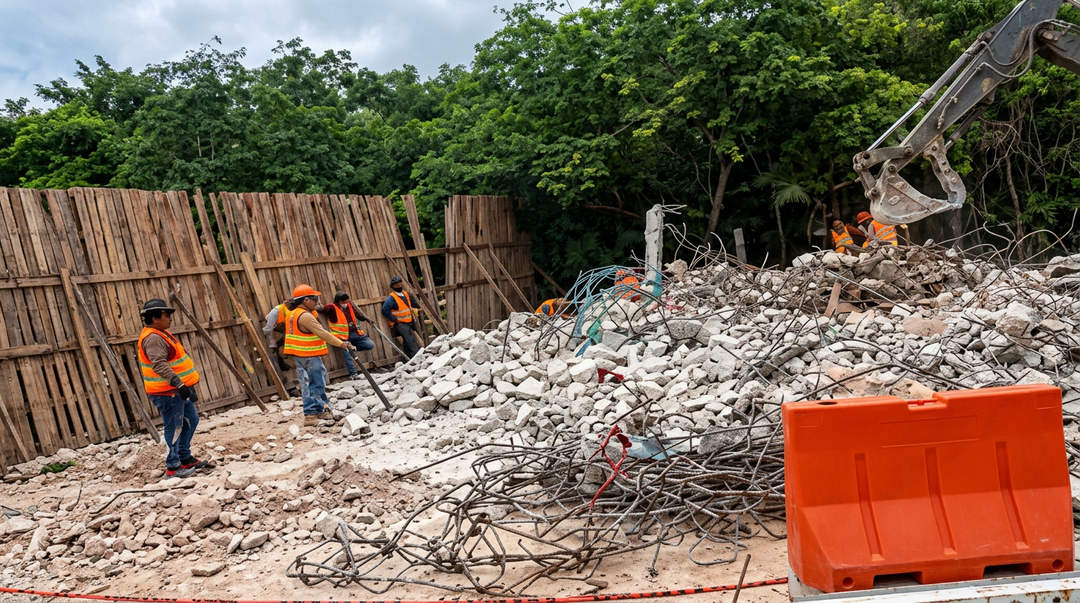

Tulum's municipal government is close to finishing 23 absorption wells, each 12 inches wide and 20 meters deep, drilled across town to pull rainwater off the streets as the year's two wettest months begin.
City hall announced the work on Calle Venus in the Centro neighborhood in a statement published Wednesday by Periódico Quequi and Poder y Crítica. The specifications came from Christian Moguel, the municipality's director general of infrastructure.
Tulum has no river and no storm sewer network to speak of. Rain that lands on a paved street either finds a well that carries it down into the limestone or stays where it fell, and the months that test that arrangement start now. On the 1991 to 2021 record compiled by Climate-Data.org, September averages 194 millimeters of rain in Tulum and October 188, the two heaviest months of the year, and both sit inside the peak of the Atlantic hurricane season on this coast.
Twelve inches wide, 20 meters down, Calle Venus first
Each shaft is 12 inches in diameter and 20 meters deep, dimensions Moguel said are meant to improve how much stormwater the ground captures and filters. Alongside the drilling, crews are dredging drainage canals to keep them clear and the water moving, work the municipality says is intended to prevent waterlogging and flooding in various sectors of the city.

The wells are going into points around the city that the municipality identified as priorities, chosen, it says, from requests residents made during city hall's walks through the colonias. Calle Venus is the only address in the statement. The work as a whole was described as almost finished, with no completion date attached.
Where absorption wells in Tulum send the water
The Yucatán Peninsula has no surface rivers. Rain soaks through porous limestone into the aquifer below, the same body of water that feeds the cenotes and the wells the town drinks from. An absorption well is a drilled shaft that provides street runoff a direct route into the rock rather than letting it pool on asphalt.
For most of Tulum's streets, that is the entire drainage system. It fails in two ways. The shafts silt up with sediment and debris, which is why the municipality spent this spring clearing them. And whatever the water picked up on the street goes down with it, into the rock the town draws its drinking water from.

A 12-inch opening is small in the face of a tropical downpour. The wells work by number and by placement, which is why the sites matter more than the count, and why the list of them is the part of the announcement that is missing.

One street named, no price attached
The statement provides no cost for the 23 wells or a contractor. It also gives no total for how many absorption wells the town now operates, new and old.
Three years ago, a batch of the same size came with a price. In July 2023, Santos Hipólito Tuz Chi, then the municipal director of public works, told La Jornada Maya that Tulum had contracted about 23 new absorption wells and the dredging of 17 existing ones for around 3.75 million pesos, with the work to be completed before hurricane season. In the same report, he acknowledged that the work sites lacked proper signage and promised tape, mesh, fluorescent markings and stone barriers around the open shafts.
Whether the 2026 batch runs on a similar contract, or is being done by municipal crews, was not stated.
Palmas, Villas Tulum, Tumben Kaa and Aldea Zamá got the crews first
The new wells add to a network the municipality has been clearing since spring. On April 10, Quintana Roo Hoy reported public services crews cleaning absorption wells in Tumben Kaa. By May 13, according to 24 Horas Quintana Roo, the cleaning had moved through Palmas, Villas Tulum, Tumben Kaa and Aldea Zamá, and Audomaro Solís, the municipal director general of public services, put it at 80 percent complete across the priority zones.
Those four names are the municipality's own map of where the water stands. Aldea Zamá is the one on that list that shows up in vacation listings, and a ground-floor unit there in October is a different proposition from one in July.
The damage on a bad afternoon is usually measured in intersections rather than rooftops. On October 7, 2025, as a tropical disturbance crossed the region, Quintana Roo Hoy reported water standing on Tulum's main roads and a tree down behind the Dos Aguas dome, with civil protection, firefighters and public services crews removing the tree and clearing absorption wells the same day. For the current forecast, our live Tulum weather page provides conditions and sea state, updated throughout the day.
The municipality has not said when the last of the 23 wells will be finished or where the rest are, only that the work is nearly done. The first heavy afternoon of September will run the test, on Calle Venus and on the streets the statement did not name.
Which Tulum street goes under first when the afternoon rain lands, and did it get one of the 23 wells? Join the conversation and share your perspective with us on Instagram and Facebook at @thetulumtimes.

The Tulum Times · Newsletter
The story continues in your inbox.
Essential Tulum news and local insight, a few times a week. Free.
No spam. Unsubscribe anytime.
Tulum Weather, Seasonality, and Best Time to Visit
Weather context, travel timing, seasonal changes, and planning guidance for visitors and residents.

“The best journalists reporting from paradise, highlighting the heroes that keep Tulum the most beautiful place in the world! THANK YOU!”