
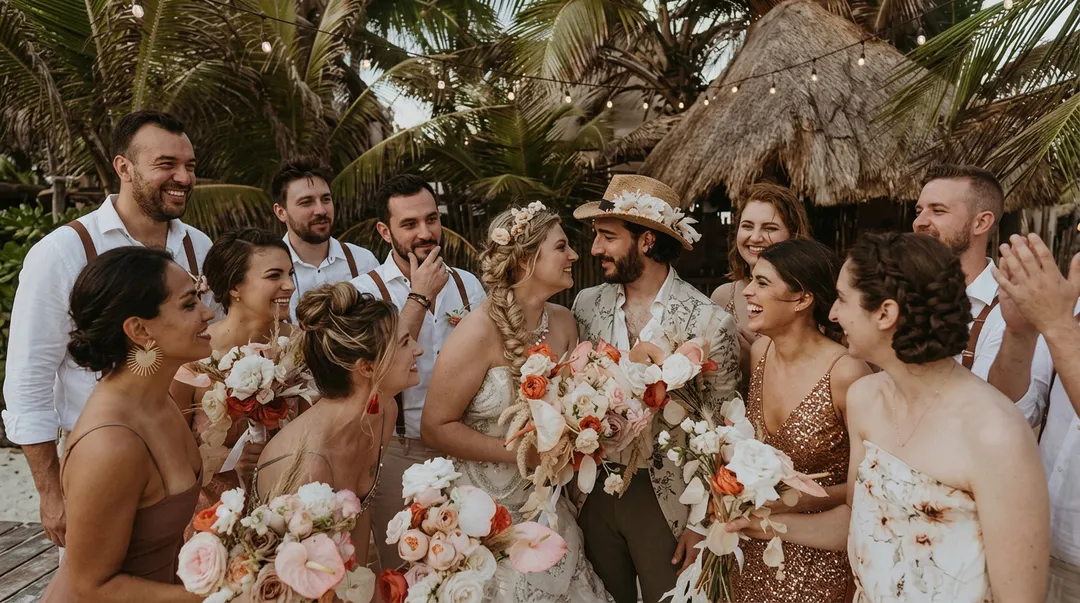
A wedding in Quintana Roo costs an average of 205,000 pesos. Tulum destination weddings are the segment the ayuntamiento spent late September courting, and October 2 was the opening move.
The courting took the form of a press conference for an event titled "The Art of Destination Wedding: Love, Art & Architecture." Haydee Hernández, general director of tourism, attended in the mayor's stead. Sofía García Cigala, the wedding designer who organized it, said the day would stage two wedding setups at once and bring together more than 100 professionals from the sector.
A destination wedding is a group booking placed months ahead, and it pays a long line of suppliers before it pays a hotel. For a town whose low season started in May, that is the most practical traffic available without a single new flight or a single new room.
Hernández carried the mayor's backing into the room
The support the municipality offered is institutional rather than financial. The official account describes an ayuntamiento willing to accompany events that diversify the tourism offer and strengthen the destination in national and international markets, and Hernández said the office was acting "on instructions from the municipal president."

She thanked the organizers and repeated that the government is open to projects that bring new opportunities to tulumnenses.
Institutional backing is the cheapest tool a municipality has, and for a private event built on contacts rather than contracts it is also the most useful one. An organizer trying to convince 100 suppliers to clear a Thursday has an easier call to make when the tourism director is in the room.
205,000 pesos, and the dollars behind the average
In January, Juan Pablo de Zulueta Razo, tourism secretary of Benito Juárez, put the average wedding in Quintana Roo at 205,000 pesos against roughly 155,000 in the center of the country, and said each ceremony leaves between 10,000 and 65,000 dollars depending on what the couple asks for. He also placed 70 percent of all weddings in the Mexican Caribbean inside Cancún and the Riviera Maya.
José Mac-Liberty, the event organizer who directs the Ruta del Romance in the south of the state, puts the statewide volume at near 100,000 ceremonies a year, including national and international couples.

Those figures describe a state and a corridor. Tulum's share of them is not published on its own, which is part of why a room full of planners is worth more to local suppliers than a statistic would be. The contacts are traceable even when the numbers are not.
Florists and taxi drivers sit on the same wedding invoice
Money from a destination wedding spreads further than most tourism spending. The Ruta del Romance groups more than 400 suppliers, from hotels and restaurants to tour operators, florists and taxi drivers, and that list is a fair map of who gets paid when a wedding lands anywhere on this coast.
Guest counts vary by who is counting. Mac-Liberty puts 100 to 300 guests behind each wedding in the south. Christian del Río, one of the organizers of Expo Destination Wedding, has put the average closer to 80-100 for the Riviera Maya. Either figure is a block of rooms, airport runs, and restaurant covers arriving on dates fixed far in advance.
The invoice shows where it lands. Two companies costing the same 50-guest Tulum wedding this year came out 18,600 dollars apart: one at 16,000 to 24,000 dollars and the other at 42,600 dollars. Inside those budgets, photography ran 2,500 to 6,500 dollars and catering 155 dollars a head, with separate lines for a DJ, lighting, hair and makeup. Most of that is work a Tulum business can do.
Chetumal counted 1,500 weddings, a model Tulum destination weddings could copy
The southern part of the state has already built the measurable version of this. Mac-Liberty reported more than 1,500 weddings celebrated in 2025 around Chetumal and Bacalar, a target of 2,000 for this year, and 400 suppliers signed up for the route.
Those are industry numbers rather than audited ones. They are still numbers, published, with a year attached and a target anyone can check next January. Tulum has the hotels, the cenotes, the beach and the planners. The count is the piece that has yet to be built.
An attendance figure from October 2 would be the first line of one. Neither the organizer nor the tourism office has published that figure so far, and the September announcement was still circulating in Mexican outlets on October 5, three days after the event itself.
Sargassum sets the calendar
The variable nobody in this business controls is the seaweed. On March 27, Mac-Liberty told Por Esto! that about 10,000 weddings booked for 2026 in the Mexican Caribbean had been canceled as sargassum reached the beaches. On September 17, Octavio de la Torre de Stéffano, president of Concanaco Servytur, said that at least 10,000 wedding reservations had been affected and that hotel spending on removals exceeded 150 million dollars a year.
Six months apart, two industry leaders used the same round figure, so it reads as a sector estimate rather than a measurement. What it does establish is that dates decide outcomes here. Heavy arrivals run through spring and summer, leaving the clearest beach months within the same winter window hotels already price as high season.
That window is where the October 2 contacts will either show up or not. The Sistema de Información Turística de Quintana Roo publishes a weekly occupancy figure for Tulum: 45 percent for the week of September 5 to 11, while David Ortiz Mena of the Asociación de Hoteles de Tulum puts the coastal zone at under 20 percent for the same period. If a wedding showcase held in October works, January and February are where that table will show.
Does Tulum have the supplier base to take a bigger share of the region's wedding business? Join the conversation and share your perspective with us on Instagram and Facebook at @thetulumtimes.

The Tulum Times · Newsletter
The story continues in your inbox.
Essential Tulum news and local insight, a few times a week. Free.
No spam. Unsubscribe anytime.
Transportation in Tulum: Taxi, Bus, Transfers, and Mobility
Taxi fares, buses, transfers, road changes, mobility updates, and practical transport guidance for Tulum.

“The best journalists reporting from paradise, highlighting the heroes that keep Tulum the most beautiful place in the world! THANK YOU!”