
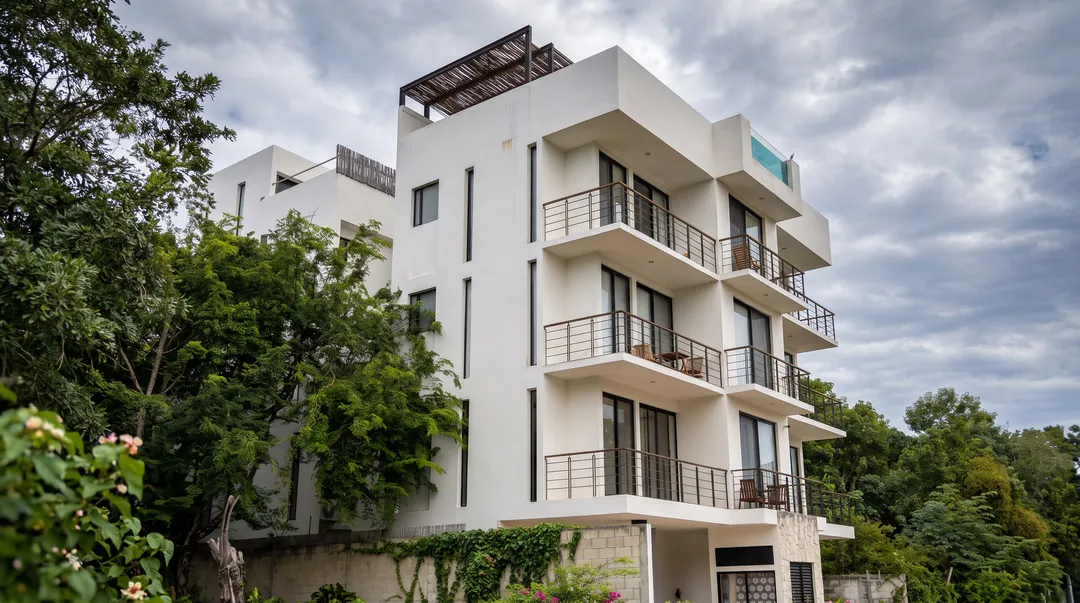
Vacation rentals in Tulum are now operating inside the municipality's irregular settlements, the local hotel association says. Its president will not put a number on how many, because nobody has counted them.
The refusal is the news.
David Ortiz Mena, who leads the Asociación de Hoteles de Tulum, said there is no official, georeferenced census that can show how many rentals operate within irregular settlements, and that citing a figure without verifiable information would be irresponsible. The gap matters now because Quintana Roo is assembling the first common set of rules for platform lodging that its municipalities must apply, and Tulum is the town with the most listings to bring under its jurisdiction.
The figure the association quotes, and the one it will not
The association puts Tulum at roughly 4,500 vacation rental registrations. In remarks published by Quintana Roo outlets this month, Ortiz Mena gave a narrower reading of the same market: 4,295 active rentals, about 95 percent of which are entire properties rather than spare rooms in occupied homes.
Cancún, with roughly four times Tulum's hotel supply, has 6,273 hotels. Puerto Morelos has around 800.

None of those totals carry an address. A registration confirms that a property exists somewhere in the municipality. It says nothing about whether that somewhere is Aldea Zamá, the beach road, or a block whose ownership is still working its way through a state program.
Nothing in Ortiz Mena's statements suggests most of Tulum's rentals fall into that last category. His argument is narrower and harder to dismiss. Nobody can say what the share is.
Five registries that have never been laid on top of each other
He set out what an actual diagnosis would require. Cross the state registry against the data held by the digital platforms, then against Catastro (the property registry), the urban development office, and Protección Civil.
Each answers something the others cannot. The state registry shows who declared themselves. The platforms show who is selling nights. Catastro shows who holds title. Urban development shows whether the land use permits lodging at all. Civil protection indicates whether anyone has inspected the building for conditions a guest might never think to ask about.

That cross has not been published. Until it is, every figure in the argument is an estimate, including the association's own.
What a listing photograph cannot show a guest
Ortiz Mena listed the stakes in an order that puts unfair competition last: visitor safety, civil protection conditions, the availability of public services, the legal certainty of the properties themselves, and the image of Tulum as a destination.
Guests draw on the same water, drainage, power, and garbage collection as the streets around them, he said in remarks published by El Sureste, and those services strain where the infrastructure was never built to receive visitors. He also pointed to buildings left unfinished by owners who counted on platform income that never arrived, which he described as points of insecurity.
A booking page carries none of that. It shows a plunge pool, a rooftop, and a short walk to the beach. It does not show a land title or a civil protection inspection, and there is no public registry where a traveler could go to check.
Occupancy near 20 percent, and a levy the platforms do not pay
The association represents the businesses that compete with these listings, and it is making the case in the worst summer its members have had in years.
Ortiz Mena told state outlets in mid-August that occupancy held near 20 percent through May, June, and July, below the same months of 2025, and that some hotels would open only seasonally until demand returns in the second half of October. Sargassum removal has cost some properties more than 500,000 pesos a week.
Rentals sold through platforms, he said, do not contribute to the Derecho de Saneamiento Ambiental, the state environmental levy that helps fund that cleanup and that hotels collect from their guests. Our reporting on the rental oversupply found that supply was still expanding even as demand flattened, with roughly 100 further projects under construction specifically aimed at the platforms.
Vacation rentals in Tulum enter a rulebook the state is still writing
Andrés Aguilar Becerril, undersecretary of tourism for Quintana Roo, said federal tax obligations and state licensing requirements have already been incorporated, and that the next step involves municipal regulations and updated urban development plans. The state tourism council created a working table for this purpose, aiming to produce a single criterion that each city hall then adapts.
The instrument they intend to build on is Retur-Q, the state tourism registry, which had 3,500 registered providers in 2026 across 52 business categories, up from 3,300 the previous year.
Put the two numbers side by side. The registry covering every registered tourism business in Quintana Roo holds fewer entries than the vacation rentals the hotel association counts in Tulum alone.
For a model, Ortiz Mena has looked to Spain, where guests' identities in this kind of property are registered, and to Paris, where the rules depend on whether the home is the owner's primary residence.
Behind the rentals, 370 settlements nobody has finished mapping
The counting problem is larger than lodging. In June, Sedetus created a state committee to regularize human settlements and put the preliminary tally at 370 irregular settlements across Quintana Roo, a number its head, José Alberto Alonso Ovando, said could double once a detailed review is complete.
The same agency has flagged 118 irregular real estate developments between 2025 and this year, concentrated in Tulum, Isla Mujeres, Playa del Carmen, and Benito Juárez, marketed without the state urban congruency certificate. In March, Agepro signed purchase contracts with Tulum families occupying state land, the slow legal exit from the same condition.
A map of rentals within irregular zones must be overlaid on a map of the zones. The second one is not finished either.
The next move belongs to the city halls. Until the state criterion lands in a municipal regulation and an updated urban development plan, Tulum has roughly 4,500 rental listings, an unknown number of them on ground the state is still trying to define, and a hotel association that would rather say so than guess.
Should Tulum publish a public map of which vacation rentals are registered and where they operate? Join the conversation and share your perspective with us on Instagram and Facebook at @thetulumtimes.
This image was generated or enhanced using artificial intelligence to improve its quality.

The Tulum Times · Newsletter
The story continues in your inbox.
Essential Tulum news and local insight, a few times a week. Free.
No spam. Unsubscribe anytime.
Tulum Development, Permits, and Construction Watch
Reporting on permits, construction, regulation, and major development decisions shaping Tulum’s urban growth and investment climate.

“The best journalists reporting from paradise, highlighting the heroes that keep Tulum the most beautiful place in the world! THANK YOU!”