


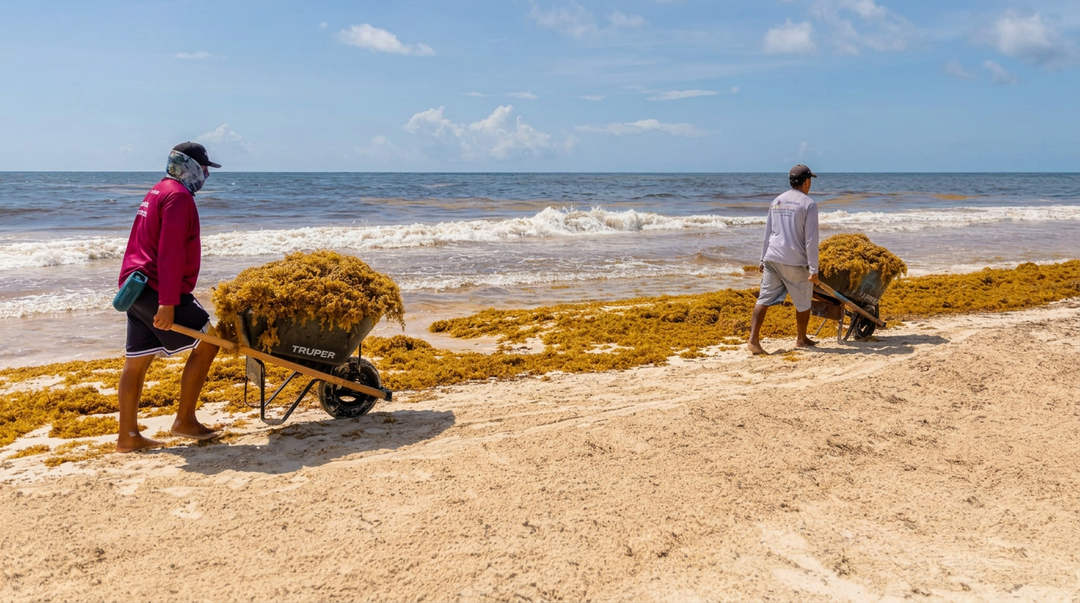
A Tulum sargassum season that now starts in January and may run to December has hoteliers on the coast studying whether to open only in the months the algae stays away.
The idea comes from David Ortiz Mena, president of the Consejo Hotelero del Caribe Mexicano and of the Asociación de Hoteles de Tulum, who said seasonal operation is being weighed against a run of low occupancy and an exchange rate working against the sector. The losses, in his description, are driven by a cleaning bill that no longer behaves like an emergency expense.
A hotel that closes for four or five months does not stop at its own payroll. The restaurants outside the gate, the drivers waiting at the entrance and the tour operators who fill their boats from those rooms all run on the same calendar.
Three times the power bill
Ortiz Mena said the private sector has handled most of the removal work along the Mexican Caribbean for years, and has absorbed costs that have become close to permanent for the industry.

"A hotel invests large amounts of money in cleaning operations. It can end up spending up to three times more removing the algae than it pays for electricity," he said.
Air conditioning in a beachfront property in Quintana Roo is not a minor line item. That is the comparison he chose to make.
Hotels have put millions of pesos of their own money into the beaches over the past several years, he said. The figures come from the hotel council itself, which has spent successive seasons arguing that beach cleaning cannot stay a private expense. What makes the seasonal-closure calculation possible is that the cleaning invoice does not shrink when occupancy does.
The Tulum sargassum season now runs toward December
Quintana Roo received five times more sargassum last year than in its worst previous year on record, according to Ortiz Mena. This year the arrivals began at the end of January.
The calendar is the part that changed. A season that used to wind down in August or September can now stretch to the end of the year, which puts cleanup crews on the sand during months hotels once counted as clean and sellable. Ortiz Mena also said there is now a direct relationship between the volume of algae reaching the coast and the drop in hotel occupancy.
Ortiz Mena says the state has to meet the algae offshore
The efficient place to stop sargassum is not the beach, he argued, but the open sea, and that work sits beyond what hotels can finance or operate.
"We can clean our beaches, but stopping the algae at sea requires the participation of the Mexican state. That is the importance of the comprehensive plan announced by the President."
He called President Claudia Sheinbaum's decision to bring the federal government in directly a turning point on a problem the business sector had faced almost alone. As Ortiz Mena described it, the plan strengthens collection capacity, expands the Secretaría de Marina's role, installs new containment barriers, and creates a permanent program with money attached for operation and maintenance. It also sets up a working group seating authorities, scientists, specialists, and hotel representatives at the same table.
The sector remains willing to invest, he said. What it wants is the bill divided.
Photographs of brown water are doing the marketing
His second argument has nothing to do with boats. Competing Caribbean destinations run permanent campaigns showing what their beaches actually look like during the season, and the Dominican Republic is the case he named. Mexico's Caribbean, by contrast, reaches travelers abroad mostly through images of the algae, which he said damages international perception of the destination.
Ortiz Mena credited the Consejo de Promoción Turística de Quintana Roo, funded by the state lodging tax, for what it has managed on a state budget. His position is that a state budget cannot answer an international image problem on its own, and that the federal government needs to return to a national promotion scheme built around the Mexico brand, one capable of responding quickly when a contingency such as this one arrives.
He did not name a date for the working group's first session, and no hotel on the Tulum coast has publicly said it will shut for the sargassum months. What he did attach a number to is the calculation managers are running before the next season opens: the cleaning invoice set against the light bill, month after month, with the algae now arriving in January.
Would you still book a beach week in Tulum during the heaviest sargassum months? Join the conversation and share your perspective with us on Instagram and Facebook at @thetulumtimes.
This image was generated or enhanced using artificial intelligence to improve its quality.

The Tulum Times · Newsletter
The story continues in your inbox.
Essential Tulum news and local insight, a few times a week. Free.
No spam. Unsubscribe anytime.
Tulum Restaurants, Beach Clubs, and Nightlife Guide
Food, dining, beach clubs, and nightlife coverage for visitors looking for practical choices, current openings, and the mood of Tulum after dark.

“The best journalists reporting from paradise, highlighting the heroes that keep Tulum the most beautiful place in the world! THANK YOU!”


