


Anyma brings ÆDEN to Zamna Tulum on January 4, four months after Turkish authorities pulled the same show out of Istanbul over clips the producer says were altered with AI.
The date falls within Zamna's tenth-anniversary season, which the festival's own calendar lists as running from December 31 to January 10 and closing with Adam Port. January 4 goes to Anyma alone, billed under the ÆDEN name rather than the Afterlife nights that brought him to the same jungle in earlier Januaries.
What is machine-made in that show has trailed the tour all year, and in September it reached a government desk. Anyone buying a ticket for January 4 is buying into that argument, which makes it worth knowing how the figures on the screen are actually built.
Gemini sits at the front of the pipeline, not the end
The first stage has nothing to do with software. Matteo Milleri, the Italian-American producer who records as Anyma and founded Afterlife with Carmine Conte in 2016, starts from a concept, and for ÆDEN, the concept was classical antiquity colliding with machines. Marble, columns, a Medusa figure, a body out of Michelangelo, all of it finished in chrome and particle smoke.

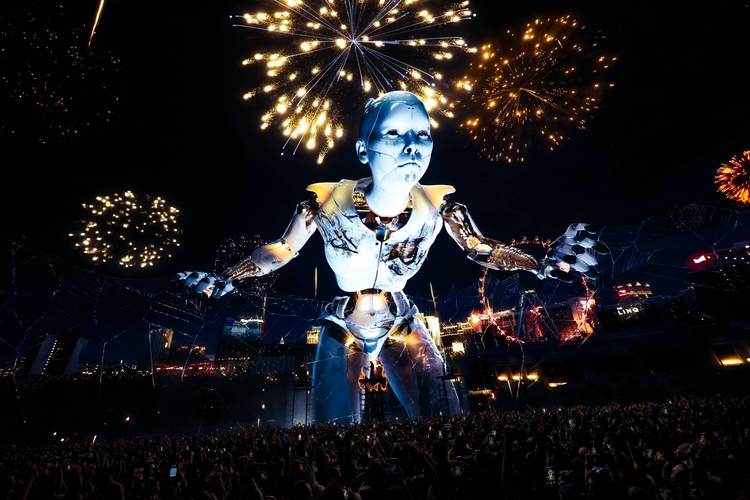
Milleri is also half of Tale of Us with Conte. ÆDEN replaced Genesys, the earlier chapter that gave him the giant chrome robot standing behind the booth and carried his residency at the Sphere in Las Vegas.
Google Gemini entered at the concept stage and stayed there. In a short documentary made with Google about the build of his Coachella set, Anyma describes using the generative tool to push early concepts through thousands of iterations of form, angle, and perspective before anything was modeled. The modeling, motion capture, simulation, lighting, and rendering came afterward, from human artists using commercial 3D software.
The toolset is mixed rather than branded. Pablo Reche, the Spanish visual effects instructor behind AuraProds, a YouTube channel with more than 790,000 subscribers, went through the making-of material and counted scenes built in Houdini, Maya, and Unreal Engine, as well as some work done in Blender. His read is that the choice falls to whichever studio took the job rather than to any capability only one program holds, with Houdini earning its place on the heavier simulations. The animation comes from keyframe work and motion capture, and the capture sessions used professional dancers so the movement would carry intention rather than just displacement.
That Google partnership also handed his critics a weapon. Reche, who went to the Madrid stop of the tour and published a technical breakdown afterward, points to comment threads under the collaboration where viewers walked away convinced the entire show had been generated by a machine.

Istanbul pulled the permit nine days before the show
The ÆDEN date at Ataköy Marina Arena, scheduled for September 12, did not take place. Religious groups online described the show's imagery as a satanic ritual, and Billboard reported that petitions to the Turkish Ministry of Culture led to the approved permits being withdrawn. The Istanbul Governor's Office confirmed the cancellation on September 3, and the promoter, Only You Live, began refunding tickets on the 7th.
Milleri answered on Instagram on September 6. Darker moments from the show had been lifted out of context, cut to other music, and circulated to manufacture what he called a "false sinister narrative". Then he added the line that governs anything he puts on a screen in Tulum: "None of my visuals are AI-generated." He said he intends to appeal.
A camera placed where the crowd stands
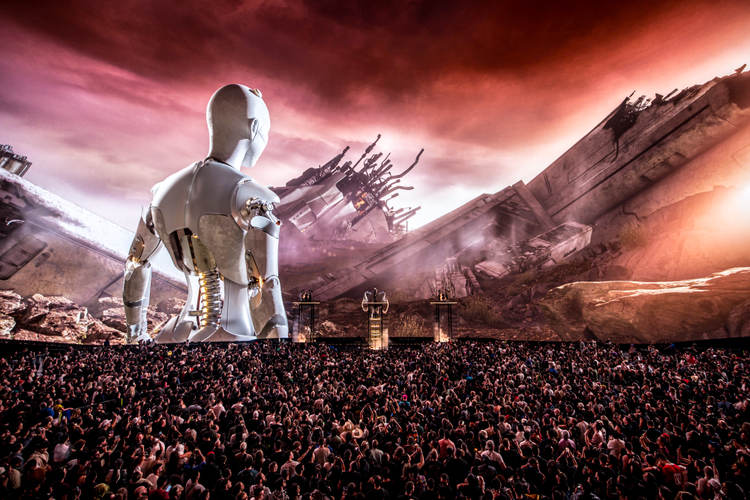
Strip away the production, and the trick that makes those figures feel physically present is the camera position. After two hours in Madrid, Reche concluded that the illusion has almost nothing to do with render quality. Every scene is framed from below, at roughly the eye level of a person standing in the middle of the floor, looking up.
That one choice is what makes a flat LED wall read as something standing behind the DJ. The perspective matches what the audience's own eyes would deliver if a figure that size were really there, and the lighting does the rest. Most scenes hold a single hard-lit subject against a black or near-black background, with very little depth behind it.
The figures also move slowly, which is a physics decision rather than a cheap one. Giant objects carry inertia, so animating one at human speed breaks the illusion faster than any missing detail would. Reche's reading is that most scenes are technically simple: a near-static subject, one simulation layer, hard light, none of the sprawling environments the scale implies.
One scene carries his argument. A Medusa figure turns her head one way, then the other, while snakes pour out of her back, which sounds like the hardest shot in the set until you notice that the camera never sees her back. The emitter can sit anywhere and obey nothing. Whatever is not visible does not have to be solved.
He pushes that further than most artists would, estimating that about 90 percent of what he saw in Madrid could be rebuilt in Blender, free software, inside a day, the Medusa shot included with a handful of geometry nodes in roughly half an hour. He attaches his own caveat, that the point is to demystify the work rather than diminish the people who made it. Nobody from production has responded to that estimate.
The files are finished before the night starts
Reche found no sign that any ÆDEN visual plays in real time. The files are video, rendered long before the trucks arrive, and they run in timecode against the music, lighting, and stage effects. A digital twin of the venue is built first, with the screen included, and the whole night is designed inside it.
The upside is a show that lands exactly as drawn, in every city. The cost is flexibility, and Reche is blunt about it. A set locked to timecode sits closer to a theatrical cue sheet than to a DJ reading a room, whatever the performer layers on top.
The mix of tools shows on the wall. Watching in Madrid, Reche noticed a drop in fidelity in certain scenes and matched those afterward to the Unreal Engine work, which runs closer to a game than to a film render when side by side with the pre-rendered material. He still rated them as holding up.
Resolution explains the rest of the schedule. The trade magazine Y.M. Cinema reported in January 2025 that the Sphere residency was rendered using Unreal Engine 5 and custom pipelines feeding cloud render farms, for a screen running at 16 K resolution. A 16K frame of 15,360 by 8,640 pixels carries 64 times as many pixels as a 1080p frame, arithmetic that is ours, and at 60 frames per second, the only practical route is to split the job across hundreds of machines.
What an Anyma Tulum ticket actually buys on January 4
Expect less animation than the clips promise. At the Madrid show, Reche timed most visuals at roughly a minute to a minute and a half, running from the opening of a track to the drop, holding fifteen or twenty seconds at full intensity, then fading to black while the track finishes on a dark screen.
He read the pacing as deliberate, on the grounds that two hours of continuous animation would flatten an audience, and offered two explanations that have nothing to do with taste. Half the animation is half the production bill. A dark screen is also a comfortable window for loading the next file to the servers feeding the wall.
One more detail is worth carrying into the jungle.
The widely shared Coachella clip of a figure stepping past the edge of the screen was an augmented-reality layer added to the video feed. According to Reche, nobody standing in that crowd saw any of it. The claim is his analysis rather than a production statement, and it is the kind of thing worth checking before buying a ticket on the strength of a clip.
The timing is also unsettled. Published start times for January 4 disagree, with one listing giving 7 p.m. and another 9 p.m.
Zamna turns ten with the season already booked
The anniversary run spans 10 days and falls in the middle of Tulum's high season, with the festival brand woven into broader plans for the town. As The Tulum Times reported in August, Zamna is named as a collaborator in the alliance behind the UMusic Hotel and Beach Club Tulum, a 57-room property with recording studios and an 800-person beach club that the partners placed at the center of the federal Tulum Renace plan.
Milleri's appeal in Türkiye is still open. The Tulum date has not moved. By January 4, the files will be finished and the timecode written, and the one number still missing is the size of the screen Zamna puts behind him.
Does a show locked to timecode still count as a live set to you? Join the conversation and share your perspective with us on Instagram and Facebook at @thetulumtimes.

The Tulum Times · Newsletter
The story continues in your inbox.
Essential Tulum news and local insight, a few times a week. Free.
No spam. Unsubscribe anytime.
Tulum Development, Permits, and Construction Watch
Reporting on permits, construction, regulation, and major development decisions shaping Tulum’s urban growth and investment climate.

“The best journalists reporting from paradise, highlighting the heroes that keep Tulum the most beautiful place in the world! THANK YOU!”


