
CFE told Quintana Roo's mayors this month that the state has 2,057 MVA of installed transformation capacity. Power outages in Tulum did not stop because capacity upstream was never the part that failed.
What fails is closer to the house. It is the medium-voltage line strung on poles down a street in La Veleta, the transformer feeding a block of new apartments, the branch that grew into a conductor during a wet July.
The pattern points one way. Tulum's chronic interruptions are mainly a distribution problem, produced by a town that built faster than its network could be rebuilt and sits atop a peninsular system that has always run close to its limits. Generation shortfalls explain the rare, region-wide blackouts. They do not explain the Tuesday morning when one colonia goes dark and the next one does not.
Who sells you the electricity, and why there is no one else to call
Every household meter in Tulum belongs to the same company. The Comisión Federal de Electricidad supplies the power, issues the bill, and maintains the line that reaches the gate. That is not a market outcome. Under the Ley del Sector Eléctrico published in March 2025, basic supply is a strategic activity reserved to CFE, and the public service of transmission and distribution is an exclusive area of the State.

The practical consequence is the one residents feel every week. There is no competing distributor to switch to, no alternative number to call when the neighborhood goes quiet, and no commercial penalty a customer can impose. Reports go to 071. Regulation now sits with the Comisión Nacional de Energía, the body that absorbed the functions of the former Comisión Reguladora de Energía when the 2025 package took effect.
Private generation exists in Mexico, and the law keeps a place for it, with the State required to hold at least 54 percent of the energy injected into the national grid each year. None of that changes who owns the pole outside your door.
The peninsula runs like an island at the end of one long wire
Quintana Roo, Yucatán, and Campeche sit at the far end of the national system. An analysis published in August by the financial daily El Cronista described the peninsula as an energy island, with peak demand above 2,400 MW, local generation near 1,800 MW, and heavy dependence on a single transmission link.
Demand has been climbing faster here than anywhere else in the country. The federal system development program for 2024 to 2038 recorded a 10.2 percent rise in energy demand for the peninsula, the highest of any region, according to coverage of the program by Diario Cambio 22.

When that system breaks, it breaks loudly. On September 26, 2025, more than 2.2 million users across Yucatán, Campeche, and Quintana Roo lost service simultaneously, and CENACE and CFE attributed the failure to a high-voltage transmission line in the southeast. On June 20 of this year, parts of five southeastern states went dark after two private plants shut down, according to CFE.
Those are the events that make national news. For Tulum, they are the minority of the problem.
What actually causes power outages in Tulum when it rains
CFE's own account of why the lights go out nationally lists storms, lightning, wind, high temperatures, contact between the network and vegetation or wildlife, damage caused by third parties, and equipment due for maintenance or replacement. In Quintana Roo, one item on that list does most of the work.
Cristina Torres Gómez, the state government secretary, said in June that the recurring failures do not come from a shortage of generation but mainly from jungle vegetation growing quickly after early rains, until branches and trees touch the overhead medium and high-voltage lines and the circuit protections open automatically.
The moment the circuit shuts itself off
A protective device is doing its job when it cuts your power. Rain loads a branch with water and bends it toward a conductor. Wind pushes it the last few centimeters. The moment a phase finds a path to ground, the protection at the head of the circuit opens and everything downstream goes dark in a fraction of a second. Lightning does the same thing faster. Humidity and accumulated dust or salt on an insulator can create a surface path that ends the same way.
That is why the failure is so often local, so often short, and so hard to stop. An overhead network running through regrowth in a rainy, lightning-heavy climate will keep finding new branches.
The maintenance figures give a sense of the scale. In a single fortnight at the start of this rainy season, according to the state government, crews reviewed 154 kilometers of overhead medium-voltage network in Quintana Roo, corrected 6,523 physical anomalies in the cabling, pruned 4,932 trees whose branches bordered the lines, cleared 121 hectares of right-of-way, and replaced 22 damaged concrete poles. In the underground and transformation network, they inspected 28 kilometers, replaced 55 kilometers of power cable, fixed 30 loose contacts, serviced 32 transformers, and swapped out 17 critical distribution units.
Read that list twice. It describes a network being caught up with, not a network being maintained.
La Veleta grew faster than the network that feeds it
The municipality counted 46,721 residents in the 2020 census, an increase of 65.3 percent over 2010. In 2022, the head of Sedatu, Román Meyer Falcón, placed Tulum among the five fastest-growing municipalities in the country and said the destination lacked basic infrastructure including sewerage, drinking water, and paved streets.
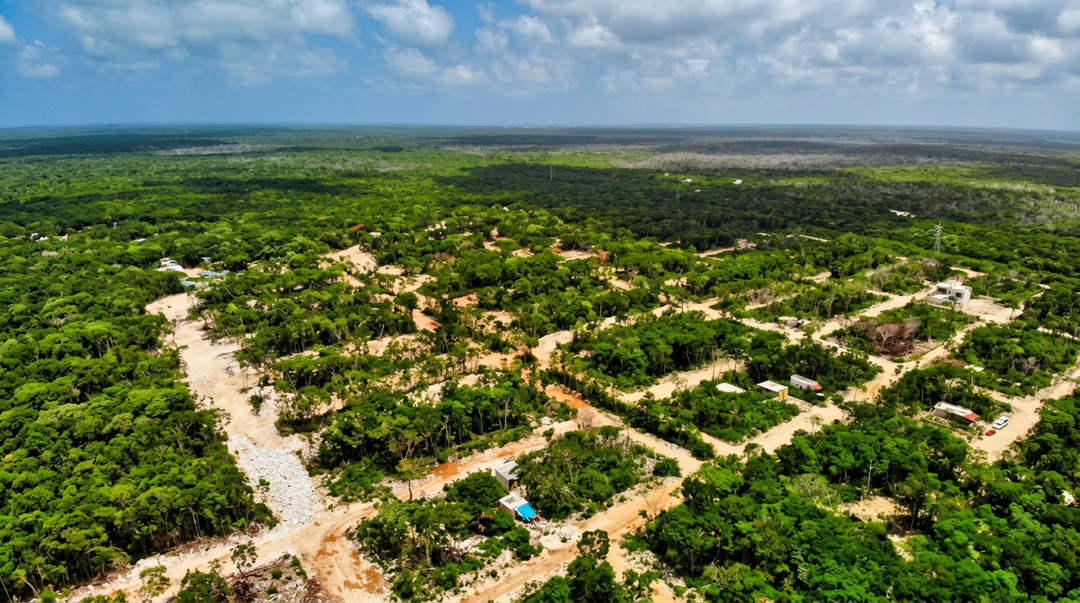
La Veleta absorbed a large share of that growth. A neighborhood of scattered houses and jungle became a dense mix of condominiums, boutique hotels, short-term rentals, and cafés full of people working remotely, and every one of those uses draws power at the same hours.
The complaints track the construction. In August 2025, residents of Villas Tulum, Tumben Kah, and La Veleta told La Jornada Maya that failures and voltage drops were repeating weekly at any hour, with some outages reported on social media running as long as 24 hours. A month later, CFE was carrying out planned daytime cuts in La Veleta to install new poles, upgraded transformers, and a medium-voltage line, and a technician told this publication there is no way to reinforce a system without switching it off first.
The pattern held into this year. On August 19, Mayor Diego Castañón Trejo said he had met with the CFE superintendent, Guillermo Peredo, handed over a list of the worst-affected colonias, and secured crews for three of them: La Veleta, Cristal, and the center of town.
One caution belongs here. No published, circuit-level record shows that La Veleta loses power more often than anywhere else in the municipality. What exists is a consistent pattern of residents naming it and officials naming it back.
Voltage swings do the expensive damage
Residents quoted in local coverage last year made a distinction worth keeping. The outage itself is an inconvenience. The instability around it, the sag before the cut and the spike when service returns, is what kills refrigerators, air conditioners, and the compressors small businesses run on. Merchants interviewed by Quintana Roo Hoy described losing product to the heat and buying generators to stop it happening again.
How a claim for a burned appliance works
CFE runs a free claims process, and almost nobody uses it. Report the failure to 071 with the date, the approximate time, and a description of what happened. Go to a Centro de Atención a Clientes and fill out the reclamation form for damage to electrical appliances or other property. Bring official identification, the supply contract, photographs of the damaged equipment, and proof of purchase. A technical opinion decides whether the company repairs the appliance, replaces it, or pays. If the answer is no, Profeco acts as conciliator.
Timing matters. Eleazar Fontes Acuña, a lawyer with the Barra Sonorense de Abogados, has pointed to clause 25 of the supply contract registered with Profeco and said claims should be filed within 15 days of the incident. The burden of proof sits with the customer. The record of what the circuit actually did that night sits with the company.
Prevention is cheaper than paperwork. A voltage regulator on the refrigerator, surge protectors on anything with a circuit board, and the habit of unplugging during an electrical storm will outperform most claims you could win.
Cancún got 551 million pesos; Tulum got three work crews
On August 16, CFE laid out its investment plan for Quintana Roo in a working meeting with Governor Mara Lezama and the state's 11 mayors, including Tulum. Benito Juárez was assigned more than 551 million pesos, Playa del Carmen 408 million, and Othón P. Blanco 166 million, all including new substations and capacity expansions. Cozumel is in tender for an 115 kV submarine cable rated at 130 MW, along with an additional 25 MW generating unit. The public account of the meeting attached no figure to Tulum.
The larger numbers are real and upstream. In June, CFE energized the Leona Vicario substation and 105.5 kilometers of transmission line at a cost above 2.15 billion pesos, work it says benefits 718,334 users in Cancún and the Riviera Maya. In May, it described seven strategic projects across Cancún, the Riviera Maya, and Mérida worth more than 11.2 billion pesos, adding 1,650 MVA of transformation capacity, more than 1,000 MVAr of reactive compensation, and 455 circuit-kilometers of line. Its 2024 to 2030 strengthening program allocates more than 15 billion pesos to transmission and distribution in Quintana Roo.
Here is the gap those figures leave. Transmission investment moves electricity into the region. It does not prune the tree on the corner or replace the transformer on the block, and the failure a Tulum household experiences almost always happens after the energy has already arrived.
The headline capacity figure deserves the same scrutiny. Transformation capacity is measured in MVA and includes reactive power. Peak demand is measured in MW. The 2,057 against 1,370 comparison presented at that meeting is not a like-for-like margin, and even a real margin at the state level says nothing about whether a single feeder in La Veleta is loaded to its limit at 8 p.m. in August.
The document that would settle the argument
At that same August meeting, CFE committed to something more useful than any figure announced that day. It agreed to produce a detailed diagnostic for each municipality, identifying the specific circuits and zones with the highest incidence of interruptions, as well as a work program targeting those points.
For Tulum, that document would answer in one page what residents have been arguing about for years. It would show whether La Veleta is genuinely the worst-served circuit in the municipality or simply the loudest, whether Cristal and the center belong on the same list, and how many hours a year each feeder spends open. It would also give anyone a way to check, next June, whether the crews changed anything.
No publication date has been announced for it.
How many hours has your colonia gone without power this month, and has anything changed since the crews arrived in La Veleta? Join the conversation and share your perspective with us on Instagram and Facebook at @thetulumtimes.
This image was generated or enhanced using artificial intelligence to improve its quality.

The Tulum Times · Newsletter
The story continues in your inbox.
Essential Tulum news and local insight, a few times a week. Free.
No spam. Unsubscribe anytime.
Tulum Weather, Seasonality, and Best Time to Visit
Weather context, travel timing, seasonal changes, and planning guidance for visitors and residents.

“The best journalists reporting from paradise, highlighting the heroes that keep Tulum the most beautiful place in the world! THANK YOU!”