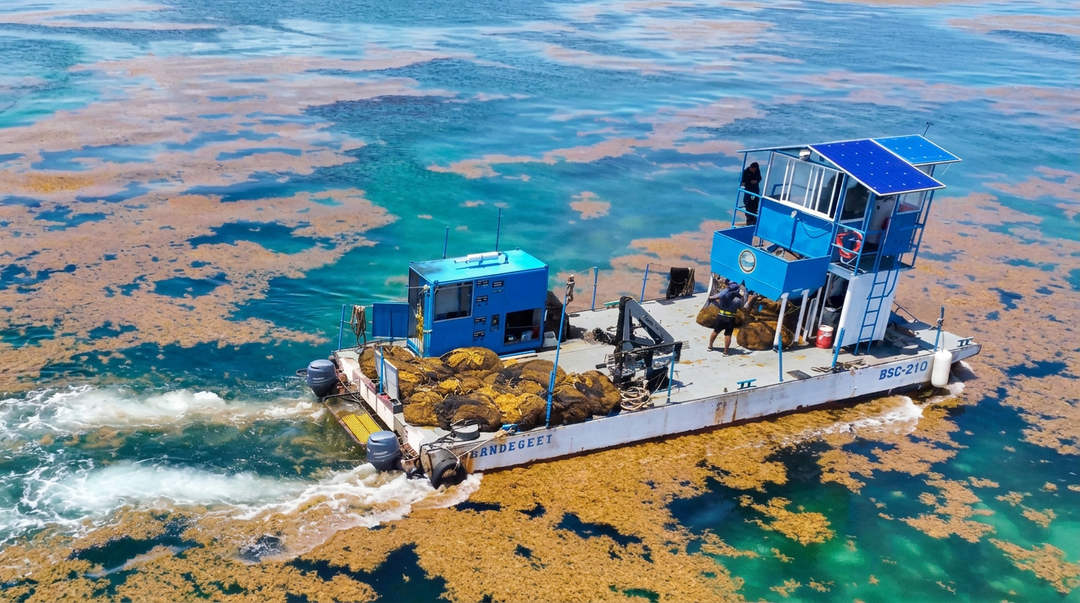

Mexico's Secretaría de Marina led a sargassum removal in Tulum that cleared roughly 140 tons in a single day, deploying more than 400 personnel and two vessels as peak season strains the coast.
The size of the haul reflects how hard the Caribbean's summer influx is hitting Tulum's shoreline. Sargassum that piles up and rots on the sand fouls the water, harms marine life, and pushes away the visitors the destination depends on. Removing it quickly, before it decomposes, has become a shared priority for federal, state, and municipal authorities.
Inside the one-day operation
The Navy carried out the cleanup in coordination with Tulum's Zona Federal Marítimo Terrestre, the agency known as Zofemat, spreading crews across several points of the national park's coastline. Two sargassum vessels worked offshore while personnel gathered macroalgae directly from the beach.
Municipal teams reinforced the effort on land. Zofemat sent mechanical sweepers to Playa Santa Fe and the Mangle area, two of the stretches hit hardest by recent landings. By the close of the operation, workers had loaded the collected algae into 14 containers for removal.

Parque Nacional Tulum covers a protected stretch of coastline just south of the town's archaeological zone, where beaches, dunes, and coastal jungle sit under federal management. That status makes cleanup there a joint federal and municipal responsibility, and it raises the stakes for keeping the shoreline clear through the busiest months of the year.
According to Zofemat Tulum, the roughly 140 tons rank among the largest quantities of macroalgae gathered in a single intervention this season. The volume, collected from one park in one day, underscores how uneven the problem can be from beach to beach.
Sargassum removal in Tulum gains federal backing
The operation followed a mid-July visit to Tulum by President Claudia Sheinbaum Pardo, who placed the sargassum problem near the top of her agenda for the Mexican Caribbean. During the trip, she reviewed the measures already in place and pledged that the federal government would keep the Navy involved in containment and cleanup.
Sheinbaum said the wider strategy would be strengthened. She has pointed to additional sargassum vessels and marine barriers as central pieces of a plan to intercept the algae at sea, before it settles on the sand. Federal officials describe that offshore approach as more effective, and less costly over time, than clearing beaches once the material has already washed in.

Zofemat credited the Navy's participation and singled out the coordination among federal, state, and municipal authorities as the reason cleanup along the national park beaches could be expanded. That layering of resources, local officials say, is what made a haul of this size possible in one day.
A regional problem measured in thousands of tons
The pressure on Tulum is part of a much larger pattern across Quintana Roo. Semarnat, the federal environment ministry, has estimated that the state receives thousands of tons of sargassum on its heaviest days, a load that concentrates on a handful of tourist beaches and quickly overwhelms manual collection.
The Navy has offered a different measure of the same challenge, saying only about 10 percent of the sargassum drifting through the Caribbean actually reaches Mexican shores. Even that share arrives in volumes large enough to bury stretches of coastline within hours, which is part of why the federal case for stopping it offshore has gained ground.
Heavy influxes have returned to the region nearly every year since the early 2010s, with the worst months usually falling between spring and late summer. Each season brings a familiar cycle of emergency collection, budget strain for coastal municipalities, and debate over whether barriers, vessels, or beach crews offer the best defense.
Why the timing matters
Sargassum season in the Mexican Caribbean generally peaks through the summer, and Tulum sits near the center of the belt where the algae tends to accumulate. For a destination whose appeal rests on clear water and open beaches, prolonged buildup is more than an eyesore. It threatens the reefs and seagrass that make the coast worth visiting, and it hits the residents and businesses that depend on a steady flow of tourists.
How long the current surge lasts, and whether the promised vessels and barriers reach the water in time to blunt it, will define the rest of the season for Tulum. The single-day haul at the national park shows what a fully coordinated response can move when federal, state, and municipal crews work the same shoreline at once. Sustaining that pace through the peak months, week after week, is the harder test still ahead.
Is intercepting sargassum offshore the right strategy for protecting Tulum's beaches this season, or should the focus stay on the sand? Join the conversation and share your perspective with us on Instagram and Facebook at @thetulumtimes.

The Tulum Times · Newsletter
The story continues in your inbox.
Essential Tulum news and local insight, a few times a week. Free.
No spam. Unsubscribe anytime.
Tulum Sargassum Updates and Beach Conditions
Live seaweed conditions, cleanup updates, forecasts, and practical beach planning across Tulum and the Riviera Maya.

“The best journalists reporting from paradise, highlighting the heroes that keep Tulum the most beautiful place in the world! THANK YOU!”