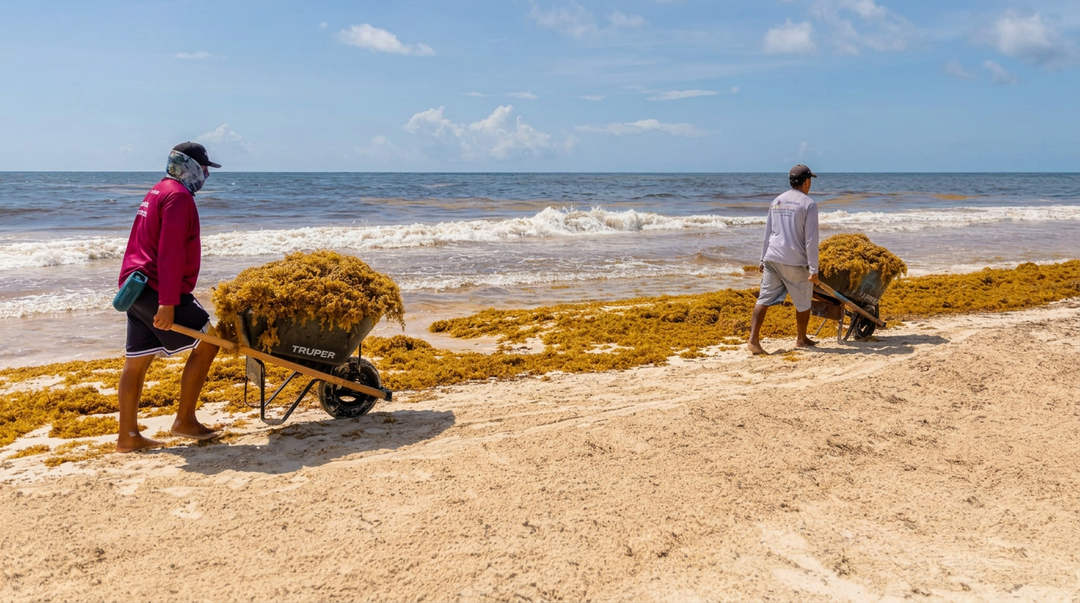

Quintana Roo ha removido más de 105,000 toneladas de sargazo de sus aguas y playas hasta ahora este año, superando el récord establecido en todo 2025 antes de que termine la temporada.
El conteo proviene de datos oficiales publicados esta semana. El total del año pasado de 92,783 toneladas había sido el récord estatal, y fue superado antes de mediados de agosto.
Para Tulum, el total estatal importa menos que el mapa. Esteban Amaro Mauricio, quien dirige la Red de Monitoreo de Sargazo en Quintana Roo, dijo que los arribaos tienen una tendencia a la baja en general pero siguen siendo erráticos, y que Tulum y Mahahual aún mantienen acumulaciones significativas.
Dos conteos, ambos arriba de 100,000 toneladas
El gobierno estatal lleva su propio registro. Brandon Mex Martínez, director de gestión de residuos especiales del gobierno de Quintana Roo, ubicó el total recolectado en el mar y en las playas en 104,700 toneladas. Ambas cifras fueron publicadas con pocos días de diferencia, y ambas están arriba de la línea de 100,000 toneladas que ninguna temporada anterior había alcanzado.

La proyección sigue moviéndose. Los funcionarios habían estimado anteriormente que alrededor de 119,000 toneladas llegarían a la costa durante 2026. Las cifras estatales reportadas este mes por Excélsior ahora ubican el total de fin de año en un mínimo de 130,000 toneladas. Eso dejaría cerca de 25,000 toneladas aún por llegar a tierra.
Óscar Rébora, secretario de ecología y medio ambiente de Quintana Roo, ofreció una salvedad a fines de julio, cuando el total en curso estaba cerca de 81,000 toneladas. Un número más alto en el registro no significa automáticamente más algas en el agua, dijo, porque la capacidad de recolección ha crecido mediante la coordinación entre la marina, el estado y los municipios. Más sargazo removido también puede significar más sargazo capturado.
Tulum y Mahahual siguen recibiendo las cargas más pesadas de sargazo
Amaro Mauricio describió una línea costera que cambia semana a semana. Playa del Carmen ha visto arribaos más ligeros. Puerto Morelos estaba limpio hace días y luego recibió un aribao significativo esta semana. Cancún se mueve entre verde, amarillo y naranja en la escala de monitoreo, a veces dentro del mismo lapso de días.
El reporte más reciente de la red, citado por La Jornada, divide al estado en dos.

- Zona norte: 22 playas en rojo, bajando de 30 a principios de agosto. Otras 17 están en naranja, 13 en amarillo y 45 en verde. Tres están libres del alga.
- Zona sur: las 30 playas que estaban en rojo hace 15 días siguen en rojo. Dos están en naranja, tres en amarillo, tres en verde y dos están limpias.
Rojo en esa escala significa llegada excesiva. La mitad sur del estado apenas se ha movido desde principios de mes.
La contención en el agua tiene sus límites. Rébora dijo a fines de julio que 9,450 metros de barreras anti sargazo estaban operando frente a Puerto Morelos, Playa del Carmen, Tulum y Mahahual, parte de un plan para 16,030 metros esta temporada, y que el oleaje fuerte había dañado parte de la infraestructura instalada frente a Cancún y Playa del Carmen.
Escurrimiento de fertilizantes desde tan lejos como Brasil
Los científicos atribuyen floraciones de este tamaño a corrientes ricas en nutrientes que transportan nitrógeno y fósforo de los fertilizantes, gran parte del cual se rastrea hasta productores agrícolas como Brasil, combinado con cambios en las condiciones oceánicas.
La escala en altamar explica la presión en la costa. Alicia Bárcena, titular de Semarnat, dijo este mes que aproximadamente 90,538 toneladas de sargazo circulan diariamente a través del Caribe mexicano, más del doble del promedio histórico, y que aproximadamente el 10% de esa biomasa llega a la costa de Quintana Roo.
Lo que sucede después de que llega es lo que los visitantes notan. El sargazo se pudre en la arena y libera sulfuro de hidrógeno, un gas que irrita las vías respiratorias. El olor por sí solo mantiene a la gente fuera de la playa.
Para las cuadrillas asignadas a la limpieza de playas, el trabajo se ha convertido en un empleo de tiempo completo. Durante la última década, el alga ha ensuciado repetidamente playas que solían estar limpias, y ha ejercido presión sobre la industria turística que sostiene la economía estatal.
El dinero público aún paga la limpieza, no por un mercado
Algunas empresas argumentan que la curva de costos solo se dobla si el alga cobra valor.
Sebastián Aguilar de Alba, director de tecnología e innovación en Carbonwave, dijo que una estrategia para mitigar el problema es crear valor a partir de él. Su empresa procesa sargazo en bioestimulantes líquidos y fertilizantes.
El ministerio de ambiente de México ya ha identificado docenas de proyectos viables para convertir el alga en fertilizantes, biocombustibles y bioplásticos. El financiamiento no ha llegado. La mayoría de los fondos públicos aún van a la recolección.
Las tormentas que limpiaron la arena en 2020
Amaro Mauricio espera que la temporada de ciclones tropicales ayude a empujar el alga lejos de la costa. Señaló el 2020, cuando tres eventos hidrológicos golpearon la costa de Quintana Roo durante la pandemia, dejando las playas muy limpias.
El alivio, si llega, viene con la temporada de huracanes.
La red de monitoreo actualiza sus lecturas diariamente en aproximadamente 140 puntos, que es la única forma confiable de planificar un día de playa para la semana cuando Puerto Morelos puede pasar de limpio a cubierto.
Rébora ubicó el fin de la temporada de arriba en algún punto de principios o mediados de octubre, luego agregó que los pronósticos permanecen inciertos. Esta es la posición honesta. El mapa se redibuja cada semana, y hasta que una tormenta o el calendario lo cambien, las cuadrillas se quedan en la arena.
¿Ha cambiado el sargazo cómo planificas un día de playa en Tulum este verano? Únete a la conversación y comparte tu perspectiva con nosotros en Instagram y Facebook en @thetulumtimes.
This image was generated or enhanced using artificial intelligence to improve its quality.

The Tulum Times · Newsletter
La nota sigue en tu correo.
Lo esencial de Tulum y contexto local, un par de veces por semana. Gratis.
Sin spam. Cancelá cuando quieras.
Tulum Sargassum Updates and Beach Conditions
Live seaweed conditions, cleanup updates, forecasts, and practical beach planning across Tulum and the Riviera Maya.

“The best journalists reporting from paradise, highlighting the heroes that keep Tulum the most beautiful place in the world! THANK YOU!”