

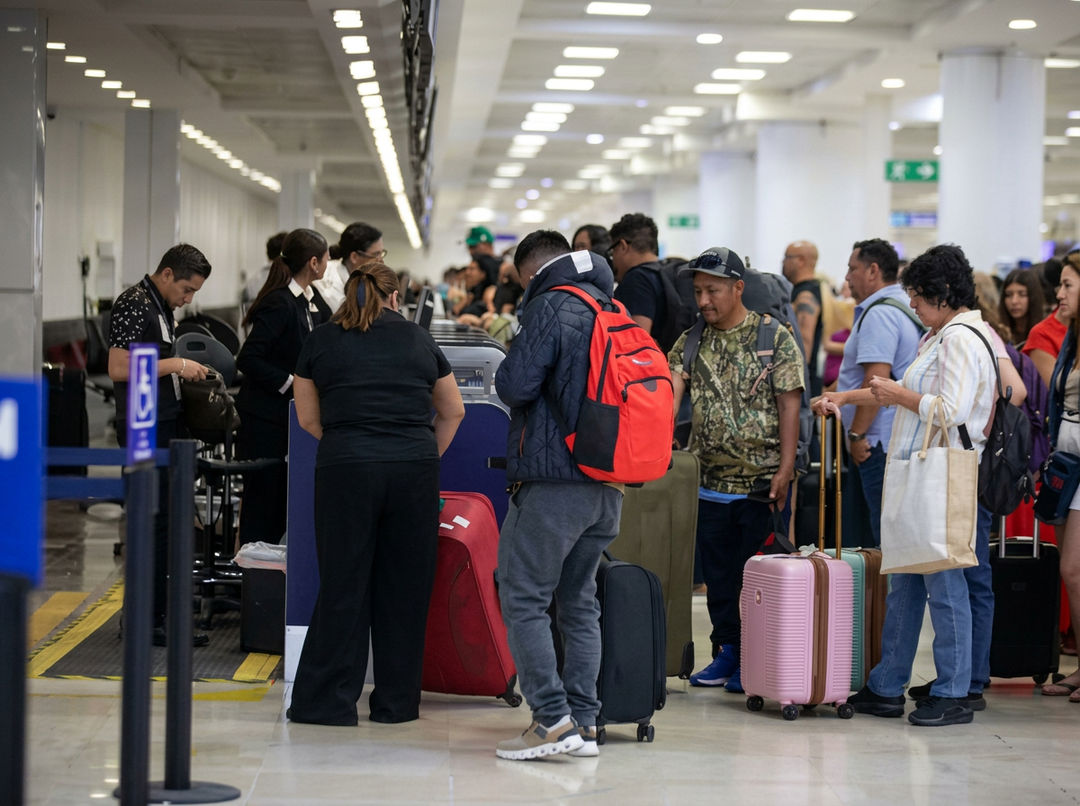
Tulum airport deportation flights brought at least 150 Mexicans back from the United States over two days last week, most of them carrying nothing and some without identification documents.
Five of the men gave their first names to reporters: Moisés, David, Santiago, Óscar, and Ulises. They come from different states, and none of them lives anywhere near Quintana Roo. All five said they had been held at an Immigration and Customs Enforcement detention center in Texas, some for more than two weeks, others for only a few days, before being put on a plane south.
Tulum's Felipe Carrillo Puerto International Airport opened in December 2023 to move international tourists into the Riviera Maya. It now serves as one of the 10 airports in Mexico designated to receive repatriation flights from the United States, meaning the terminal handles both arriving vacationers and Mexicans arriving with nothing.
Weeks in a Texas detention center before a flight south
The men described the transfer as abrupt. They were moved without their possessions and, in several cases, without identity documents, which complicates everything from boarding a domestic flight to opening a bank account once they reach their home states.

Getting out of Tulum was the immediate problem. According to the men, relatives and friends pooled money for onward plane tickets because none of them landed with the fare in hand.
The group interviewed at Cancún International Airport said the flight carried people from Oaxaca, Puebla, Veracruz, Zacatecas, Chihuahua, and Monterrey.
A 16,000-dollar debt repaid, and a return with no savings
David, who is from Querétaro, said he borrowed 16,000 dollars to make the trip north, a sum equal to more than 260,000 pesos at the current exchange rate. He worked in the United States for more than two years and cleared the debt. He came back with no money and no job.
Santiago's arithmetic ran the other way. The Oaxacan father said four years of remittances covered his children's schooling, and one of them recently graduated with a specialty in gastronomy.

The deportees ranged from men in their twenties to men past 50. Interviewed separately, they described the same broken sequence: families waiting in their home states, and half-built plans for those families now abandoned in Texas along with their belongings.
Tulum airport deportation flights are one node in a 10-airport network
The scale of the return is federal, not local. Sergio Salomón Céspedes, commissioner of the National Migration Institute, reported that 271,193 Mexicans were repatriated from the United States between January 20, 2025 and August 13, 2026, all of them processed through the government program México te abraza.
Of that total, Céspedes said 171,508 crossed by land, mainly through border points in Baja California, Sonora, Chihuahua, and Tamaulipas. Another 99,685 arrived on 816 flights from the United States to 10 receiving airports, including Tulum alongside Tapachula, Villahermosa, Mérida, Morelia, Campeche, San Luis Potosí, Oaxaca, Mexico City, and Felipe Ángeles.
The commissioner also said 95 percent of those repatriated come from Chiapas, Guanajuato, Guerrero, Veracruz, Oaxaca, Michoacán, Puebla, and the State of Mexico. Not one of those states is within a short domestic flight of the Quintana Roo coast.
Bienestar cards cover 2,000 pesos; relatives covered the rest
México te abraza coordinates 34 federal agencies and 14 state governments. Interior Secretary Rosa Icela Rodríguez reported that the program has delivered more than 1,567,000 services since January 2025, including 453,685 food rations, more than 79,700 medical and psychological consultations, 138,669 CURP and birth certificate procedures, and 180,042 Bienestar Paisano cards loaded with 2,000 pesos to cover transportation costs.
The men interviewed did not say whether they had received the card. What they did say is that the plane tickets were paid for by family and friends.
Ulises left a wife and two sons in the United States
Ulises spent 30 years north of the border. He is from Veracruz, but his wife and two children are still in the United States, and he is now on the wrong side of a border he crossed three decades ago.
He said he intends to apply for a passport and the corresponding visa so he can go back to them legally. That process runs through Mexican and United States consular offices with no fixed timeline, and until it resolves, his family stays where it is.
Should Tulum's airport be handling repatriation flights, and what does the town owe people who land here with nothing? Join the conversation and share your perspective with us on Instagram and Facebook at @thetulumtimes.
This image was generated or enhanced using artificial intelligence to improve its quality.

The Tulum Times · Newsletter
The story continues in your inbox.
Essential Tulum news and local insight, a few times a week. Free.
No spam. Unsubscribe anytime.
Transportation in Tulum: Taxi, Bus, Transfers, and Mobility
Taxi fares, buses, transfers, road changes, mobility updates, and practical transport guidance for Tulum.

“The best journalists reporting from paradise, highlighting the heroes that keep Tulum the most beautiful place in the world! THANK YOU!”


