

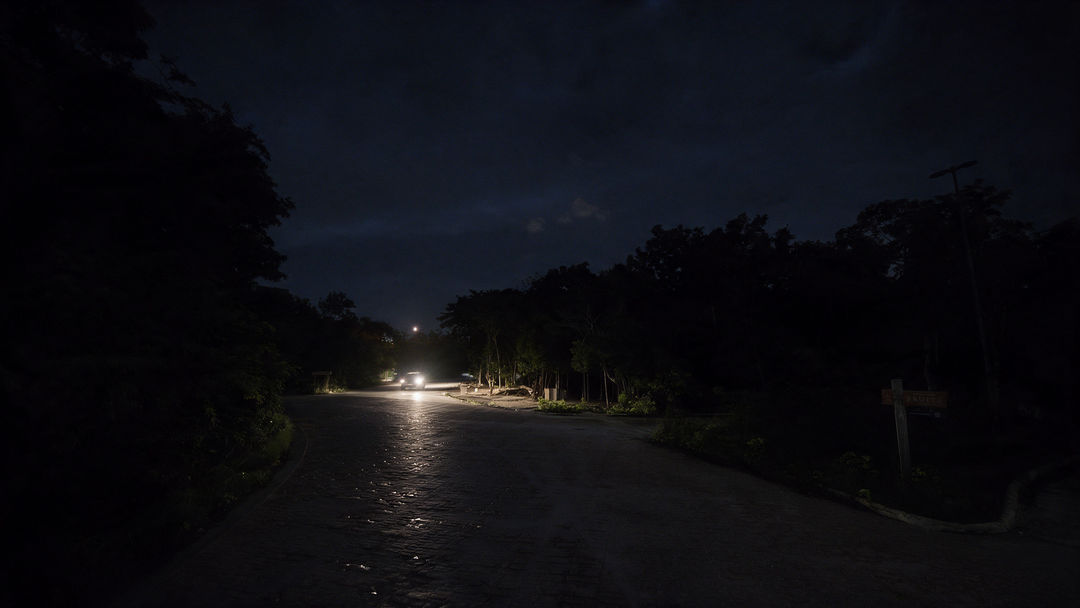
Each of the street lighting repairs Tulum's government announced this year began the same way, with a neighbor reporting the lamps had gone out. The 2026 revenue law expects 36.4 million pesos from the charge.
The Congress of Quintana Roo approved that line on December 3, 2025. Three months earlier, the Supreme Court had invalidated the formula the charge was built on.
What replaced that formula has not been published. Neither has the amount actually collected, nor a date for the lamps promised to Aldea Zamá in July. What residents have instead is a repair model that starts with a phone call and moves one colonia at a time, through the wettest months of the year.
The 36.4 million peso line the Court did not remove
The Ley de Ingresos del Municipio de Tulum for 2026, published in the Periódico Oficial del Estado on December 10, 2025 as Decreto 162, sets out the municipality's expected income line by line. Item 26 under rights for the provision of services is the derecho de servicio y mantenimiento de alumbrado público, and the figure beside it is 36,395,275 pesos.

Against the 1,408,647,182 pesos the law projects in total, that is 2.58 percent. Our arithmetic.
It is also a larger number than the previous year. Two outlets published Tulum's 2025 lighting figure within two weeks of each other, 29.8 million pesos in one and 29.9 million in the other. On either of them, the 2026 line is about 22 percent higher.
The ruling came first. Acción de inconstitucionalidad 19/2024, brought by the Comisión Nacional de los Derechos Humanos against the Ley de Hacienda de Tulum, approved in December 2023, was resolved by the Court's plenary under the presidency of Minister Lenia Batres Guadarrama. Charging a percentage of a household electricity bill, the Court held, is a tax on electricity consumption and that power belongs to Congress. The first two paragraphs of Article 143 Quáter were declared invalid, as reported by Por Esto and Quintana Roo Hoy on September 22, 2025. Six municipalities in the state were running versions of the same scheme, together worth more than 480 million pesos a year.
Vicente Aldape, then the municipal treasurer, said afterward that Tulum would adjust its collection mechanism and that Article 143 Bis of the same law remained in force, allowing the municipality to continue charging under a different, lighter scheme for residents. No document published since says what that scheme is.

Aldea Zamá was promised 100 lamps on July 27
The municipal president, Diego Castañón Trejo, toured the colonia that day with residents and officials. Crews were pulling new cable, he said, and 100 luminaires would be replaced once the wiring was finished. The work resulted from a request from the neighborhood committee, whose president, Manuel Cano, was there to receive it.
No completion has been announced since.
Four days later, the same crews were in Maya Paax, swapping out lamps in poor condition, where the mayor said they would keep touring to find the ones that had burned out. In March they had been in Tumben Kaa, after residents reported blown lamps in the park. Every one of those announcements names the citizen report that set it off.
The municipality's own paperwork shows how long this has been running. In its first quarter 2025 transparency report on lighting maintenance, the Dirección de Alumbrado Público logs crews tensioning overhead lines to feed lamps in Aldea Zamá during the first days of January 2025, eighteen months before the July announcement. The same log records daily entries for manually switching lamps on and off in sectors without automatic control. The equivalent report for the first quarter of 2023, filed by the previous administration, lists 172 luminaire rehabilitations across fifteen colonias, including La Veleta and Aldea Zamá.
Reports go to the Dirección de Alumbrado Público, listed in the municipal directory under Secundino Canul Dzib, at alumbradopublico@tulum.gob.mx and (984) 106 2660.
Street lighting competes with payroll in a budget that tourism is draining
On September 18, the ayuntamiento's secretario general, Jhonny Monsreal, confirmed to Noticaribe that Tulum is facing a financial deficit due to a decline in tourism and economic activity. He could not say how large it is. "There is effectively no revenue when there is no tourism," he said. Every department would draw up a plan to fit municipal operations to the situation, he added, with priority, above all, going to security. Short-term credits and an advance on state participaciones had not been discussed.
The reason a tourism slump reaches the street lamps sits in the revenue law itself. Of the 1,408,647,182 pesos it projects, 435,883,124 come from federal participaciones, aportaciones and agreements. That is 30.94 percent.
The remaining 69.06 percent Tulum has to raise inside Tulum. The two largest local lines are the property transfer tax at 320,085,400 pesos, and the predial at 211,672,452, and both move with a property market that has slowed and a hotel sector that put the municipality at 41.8 percent occupancy in the first week of October, against a state average of 50.4.
Service fees do not cover the services either. The waste collection line in the same law is 27,359,300 pesos, while the treasurer told Grupo Cantón in January that the outside contractor hauling Tulum's garbage to Playa del Carmen costs around 108 million pesos a year, close to four times what the fee is expected to bring in.
The year started with borrowing. A 50-million-peso bank credit was contracted on December 15, 2025, most of it for aguinaldo and employer obligations for municipal workers. Azteca Quintana Roo reported in July that modifications to the 2026 budget removed more than 100 million pesos from public works, leaving that investment at around 123 million.
Potholes get patched when somebody sends the location
On February 19, the municipality launched an emergency bacheo drive using cold asphalt, a material chosen because it can be laid while it is still raining. A second batch arrived in March. Crews worked on Villas Tulum in May and Calle Alfa in the Centro in August, each time answering reports sent through the ayuntamiento's social media accounts or handed to the mayor during his walks.
Avenida Cobá has been on the list of damaged roads for years. When La Jornada Maya documented the holes the rains opened in June 2022, Cobá led the list of affected avenues, alongside Satélite and the coastal road.
José Audomaro Solís Pacheco, director general of Servicios Públicos, laid out the arithmetic of it in February 2025, when he put the bacheo program at 85 percent complete. "The rains leave the appearance that we are not working," he said, describing old arteries that come apart quickly once water filters under them. Patching, he added, is a provisional remedy on streets with heavy traffic. The resurfacing of the worst roads that the mayor announced at the time has not been reported as underway, and no figure has been published for how much pavement has been patched this rainy season.
The fumigation trucks answer to the state, not to city hall
The trucks are not the municipality's to send. Vector control in Quintana Roo is under the Servicios Estatales de Salud, whose brigades work across the eleven municipalities, and the sanitary jurisdiction that reported the most recent nebulization rounds, Number 2, selects its targets from ovitrampa readings in the zones it classifies as hot.
The state's dengue count is climbing. Quintana Roo had 361 confirmed cases in 2026 as of October 12, with 51 added in a fortnight, putting it sixth nationally by incidence rate, against a national total of 6,798 cases and 26 deaths. At the September 26 cut, the state had 310 cases and two deaths, an increase of 84.5 percent over the 168 recorded at the same point of 2025, with serotypes 2, 3 and 4 circulating at the same time. Playa del Carmen and Othón P. Blanco account for more than half the reports, and the age group carrying the most cases is 10 to 19.
No 2026 case count for the municipality of Tulum has been published. Neither has a nebulization calendar naming Tulum colonias for October. The last statewide operation that named the municipality ran from June 8 to 12, and health authorities keep repeating that nebulizing kills adult mosquitoes while eggs and larvae survive in whatever the rain has filled.
December 31 decides whether the lighting line carries over
Last year the sequence moved fast. Tulum handed its revenue initiative to the Congress on November 20, the deputies voted it on December 3, and the law was published on December 10. The same calendar would put the 2027 initiative before state deputies before this November is out.
The fourth transitory article of the law now in force covers the other outcome. If no 2027 revenue law has been approved by December 31, 2026, the concepts in the 2026 law will continue to apply, including the 36,395,275-peso lighting line.
Whether that line comes back, under which formula, and with what number beside it, is the first measurable answer Tulum is going to get about its street lights.
Which street in your colonia has been dark the longest, and did reporting it to Servicios Públicos bring a crew? Join the conversation and share your perspective with us on Instagram and Facebook at @thetulumtimes.

The Tulum Times · Newsletter
The story continues in your inbox.
Essential Tulum news and local insight, a few times a week. Free.
No spam. Unsubscribe anytime.
Tulum Neighborhoods, Growth Corridors, and Area Guides
Context and practical guidance around Aldea Zama, La Veleta, Region 15, Selva Zama, and the urban geography shaping Tulum.

“The best journalists reporting from paradise, highlighting the heroes that keep Tulum the most beautiful place in the world! THANK YOU!”


