

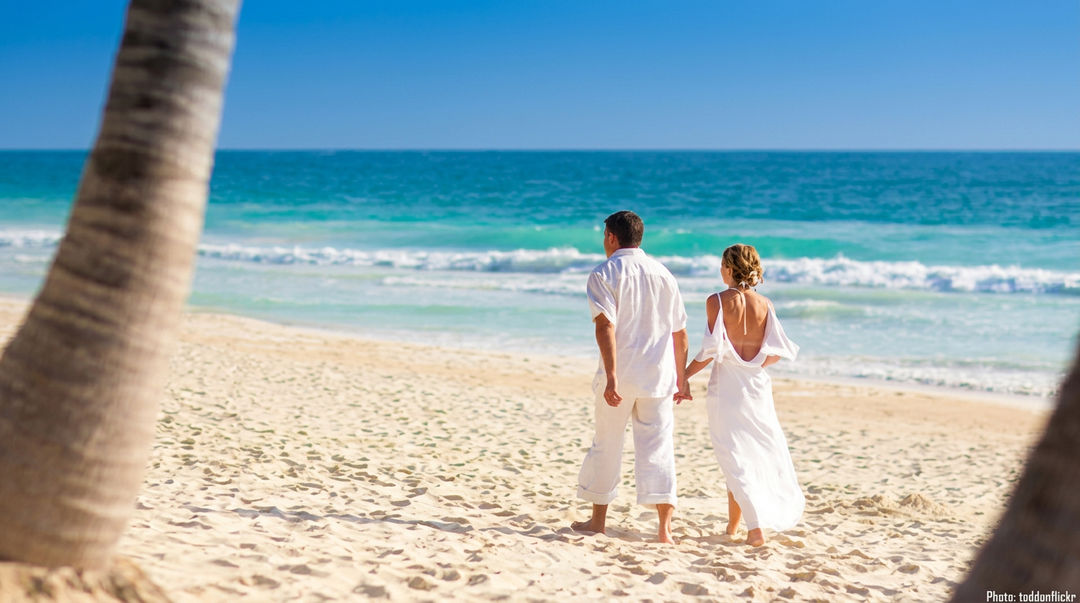
For about two weeks in August, none of Tulum's four civil registry offices performed any marriages. The official who keeps those books says wedding demand has not been this low in a decade.
Clarisa Pat Maza, an officer of the Tulum Registro Civil, supplied the comparison herself. In April and May of 2014, she said hotels of that scale, Bahía Príncipe among them, were hosting around 40 weddings a month. This year those same months produced one or two. In 2023 they produced about five.
A destination wedding is not a room night. It is a block of rooms and a group of guests who arrive together, on a date fixed months before any of them boards a plane. That is why the drop reaches well past the registry counter, and why the registry and the municipal tourism department are now putting together a plan to get couples back on the calendar before the October high season.
September's book is thinner, and most of it is indoors
September reads slightly better than August. Pat Maza said ceremonies are scheduled at hotels including Bahía Príncipe and Dreams, and that the registry offices themselves expect two or three weddings a week.
Those office ceremonies are the cheapest version of the transaction, and the gap is written into municipal law. Under the Ley de Hacienda del Municipio de Tulum, a couple marrying inside an oficialía pays 36 UMA, about 4,223 pesos at this year's unit value of 117.31 pesos. Two foreigners who ask the judge to come to a beach pay 90 UMA, or 10,558 pesos. A foreigner marrying a Mexican outside the office pays 40 UMA. Every ceremony that moves from the sand to the counter is worth less to the municipality, and a good deal less to everyone the beach version employs. Our guide to the paperwork and the fees behind a Tulum wedding lays out the full table.
Pat Maza's figures come from the registry's own records and the references it keeps, not from a survey of the wedding industry. Neither the municipality nor the state publishes a monthly count of ceremonies by venue, so what exists is an official describing her own four counters.
The resorts doing the counting sit north of town
The properties behind those numbers are not on the beach road that carries Tulum's name abroad. The Bahía Príncipe complex sits at kilometer 250 of the federal highway, at Akumal, roughly 20 kilometers north of the ruins. Dreams Tulum, the other property named for September, is at kilometer 236. Both are all-inclusive resorts within the municipality the registry serves, and both sell the packaged version of a beach wedding, with a price list and a coordinator included.
That is worth holding onto when the 40 gets quoted. The fall Pat Maza described belongs to the volume end of the market. What the small hotels on the coastal strip south of town are booking never entered her account, and nobody has published it.

Brown water peaked in June, and the bookings had already gone
Quintana Roo had collected around 110,000 tons of sargassum by the middle of August, and the state monitoring network expects the year to close with a total near 150,000 tons. Esteban Amaro, who directs that network, placed the peak of the arrivals in June and July.
The coast has since cleared. David Buchanan García, head of the federal maritime zone office in Tulum, said in early September that the water was regaining its color and that no significant stretch of sand had been lost, with a sand-recovery program planned once the season closes. Mayor Diego Castañón Trejo had put the beaches at 70 to 80 percent clean in late August.
None of that brings back an August wedding. A couple comparing destinations in June was looking at photographs of brown water, and the date they were choosing sat months further out.
The wider numbers moved in step. Bernardo Cueto Riestra, the state tourism secretary, acknowledged in late August that Tulum hotel occupancy had fallen to 15 percent, the lowest in the destination's history, compared with 30 percent in Playa del Carmen. By the second week of September, the state system read 45 percent for Tulum, while the hotel association put its beachfront members at under 20, a gap we broke down this week.
Cenotes and haciendas, where Tulum weddings go next
Elena Rodríguez, a wedding planner working the destination, said the municipality holds venues that never depended on the shoreline. She named haciendas, golf courses, cenotes, and the grounds inside the hotels themselves. Her reading of the calendar is that the sector is already preparing for the high season, which runs from October to December, when couples and groups return to the Mexican Caribbean.
The official plan points the same way. The Registro Civil and Tulum's Dirección General de Turismo are working on a strategy to recover romance tourism through closer coordination with hotels and promotion inside and outside the country. The stated aim is to show couples that a wedding here need not take place on a beach.
What has not been published is the rest of it. There is no budget on paper and no campaign calendar, and neither office has said which fairs or markets the promotion will reach.
April is the real test
October to December is what the trade is waiting for, and it is the stretch of the year Tulum has least trouble filling.
The number that settles the argument lands later. Pat Maza reached twice for April and May as her benchmark, and those are the months this year's sargassum had already claimed. The hotel association put the start of the 2026 arrivals in late January, earlier than the historical pattern. Couples choosing an April date are choosing it now, with this summer's photographs in front of them, and four registry counters in Tulum will have the answer long before any promotion campaign reports one.
If you planned a wedding on this coast this year, did the sargassum change your venue or your date? Join the conversation and share your perspective with us on Instagram and Facebook at @thetulumtimes.

The Tulum Times · Newsletter
The story continues in your inbox.
Essential Tulum news and local insight, a few times a week. Free.
No spam. Unsubscribe anytime.
Tulum Cenotes, Ruins, and Practical Visitor Guides
Guides, access updates, regulations, and practical planning around cenotes and the Tulum archaeological zone.

“The best journalists reporting from paradise, highlighting the heroes that keep Tulum the most beautiful place in the world! THANK YOU!”


