

Mexico's Culture Ministry will inspect the ceremonial pole at Tulum's archaeological zone before bringing back the Voladores de Papantla, the Totonac flying ritual that left the site in March after more than three decades.
No date has been set. Marina Núñez Bespalova, the federal undersecretary of culture, said the ministry first needs to know the condition of the pole and its infrastructure, and she insisted the return must happen this year.
For Tulum, the announcement would restore one of the few cultural experiences that, for a generation, thousands of visitors to the ruins saw for free just outside the gate. It also puts a federal promise with a year-end deadline on a destination still trying to win back the visitors whose absence pushed the flyers out.
The Voladores de Papantla's Tulum return hinges on a pole
According to remarks reported Monday by Quintana Roo media, Núñez Bespalova said the Secretaría de Cultura will review the existing infrastructure and the state of the ceremonial pole before deciding when the ceremony can resume.

The inspection is a practical step, not a formality. The flight depends entirely on the pole: four men hang from ropes wound around a rotating frame at its top, and a fifth stands on a small platform above them. A trunk that has stood unused through a rainy season needs to be checked before anyone climbs it.
The undersecretary framed the return as part of the ministry's contribution to Tulum's recovery, on instructions from President Claudia Sheinbaum.
"Within our scope, we are helping to improve conditions in Tulum so that people can once again enjoy these spaces," she said.
She also described what visitors can expect once the ceremony is back. "It is a tradition recognized worldwide. Whoever comes to Tulum will be able to see it, with all its dances, its ritual and the flight itself," Núñez Bespalova said.
Thin crowds ended a three-decade run
The flyers did not leave because of a ban or a dispute. They left because too few people were watching.
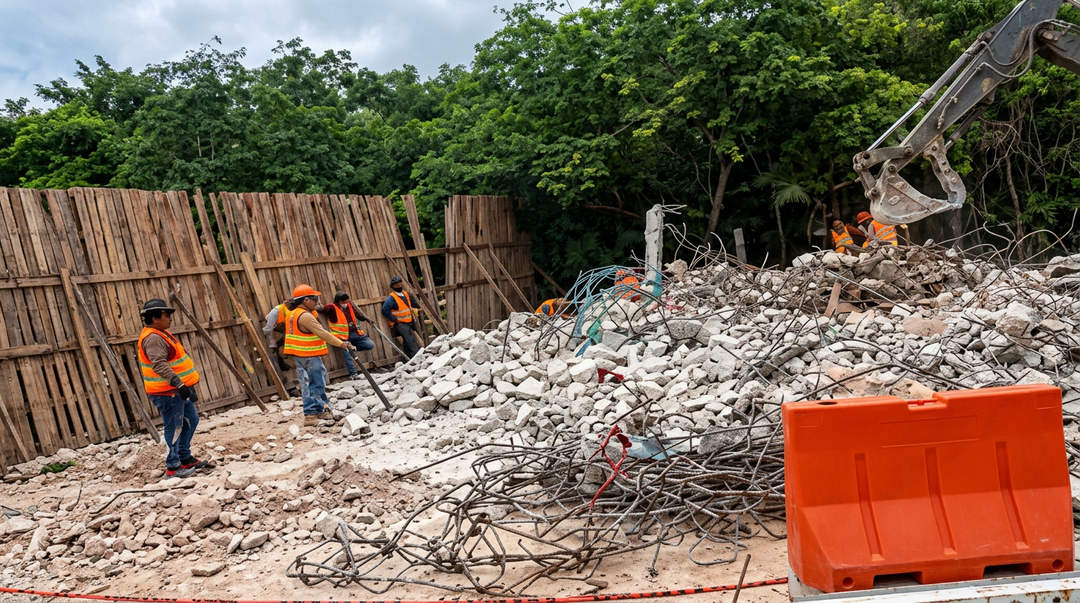
On Monday, March 16, Juan García, a volador from Papantla, returned to the site with other members of his group to finish removing the ropes and frames from the pole, according to La Jornada Maya. He told the paper there were no longer enough spectators to justify staying, and that the performers still had to cover their own rent and food.
The group's income depended on voluntary contributions from the audience after each flight. When visitor numbers at the archaeological zone fell, so did that income. Local outlets reported at the time that the performers planned to seek other venues where they could continue working.
A drought and a felled tree
For readers who have never seen it, the ceremony can look like an acrobatic show. Its origins are religious.
Totonac oral tradition tells of a severe drought that brought hunger to the region, which the people understood as a sign that the gods felt neglected. In the most common version, village elders chose five young men to carry a plea for rain. They went into the forest, cut down the tallest and straightest tree they could find after asking permission from the god of the mountain, stripped it of its branches, and raised it in the village. Four of them threw themselves from the top while the fifth played music, and the rains returned.
Many versions name Xipe Totec, a Mesoamerican deity associated with fertility and renewal, as the god the ritual was meant to reach. The exact date of the ritual's creation is unknown, and scholars note that versions of the flight were performed across a wide area of Mexico and Central America before the Spanish conquest. The Totonac people of Papantla, in northern Veracruz near the ancient city of El Tajín, are the community most closely identified with it today, which is why the ceremony carries the town's name.
Four ropes, 13 turns, 52 years
The modern ceremony keeps the structure of the legend. According to UNESCO, four young men climb a wooden pole between 18 and 40 meters high, traditionally cut fresh from the forest with the forgiveness of the mountain god.
The fifth participant, known as the caporal, stands on the platform at the very top. Playing a flute and a small drum at the same time, he performs songs dedicated to the sun, the four winds, and each of the cardinal directions, turning to face them one by one.
Then the four voladores drop backward into the air.
Tied by the waist to ropes wound around the frame, they hang head down as it spins, descending in widening circles as the ropes unwind. Each flyer completes 13 turns before reaching the ground. The four together make 52, the number of years in the Mesoamerican calendar cycle. The four men also represent the cardinal points, and the descent is read as a link between the sky and the earth.
What most visitors at Tulum saw lasted only a few minutes. For the performers, it is a prayer, and the flight is its final act.
A Totonac rite protected by UNESCO since 2009
UNESCO inscribed the Voladores ritual on its Representative List of the Intangible Cultural Heritage of Humanity in 2009, describing it as a fertility rite performed by several ethnic groups in Mexico and Central America, especially the Totonac people of Veracruz.
The Culture Ministry says the practice survives because its knowledge and ritual rules are passed from one generation to the next. That transmission is formal in the Totonac region, where a school for child voladores operates at Takilhsukut Park, next to El Tajín, teaching the Totonac language and the ritual's meaning alongside the climb itself.
Groups of voladores from Veracruz and Puebla now perform at tourist sites across Mexico, and for more than 30 years one of those stages was the entrance to Tulum's ruins. Their return would bring a ritual born in the rainforests of Veracruz back to a Maya coastal site, with a federal agency now responsible for the conditions that make it possible.
A promise with a December deadline
The sequence the ministry described is short. First, the inspection of the pole and the site; then any repairs it reveals; then a date. None of those steps has a published timeline yet.
What exists is a commitment from the undersecretary that the flyers will return to Tulum before the end of 2026, and an open question the announcement did not address: whether the audience that disappeared in March will be there to watch them.
Did you ever watch the Voladores de Papantla at the Tulum ruins, and would their return change how you plan a visit to the site? Join the conversation and share your perspective with us on Instagram and Facebook at @thetulumtimes.

The Tulum Times · Newsletter
The story continues in your inbox.
Essential Tulum news and local insight, a few times a week. Free.
No spam. Unsubscribe anytime.
Tulum Cenotes, Ruins, and Practical Visitor Guides
Guides, access updates, regulations, and practical planning around cenotes and the Tulum archaeological zone.

“The best journalists reporting from paradise, highlighting the heroes that keep Tulum the most beautiful place in the world! THANK YOU!”