
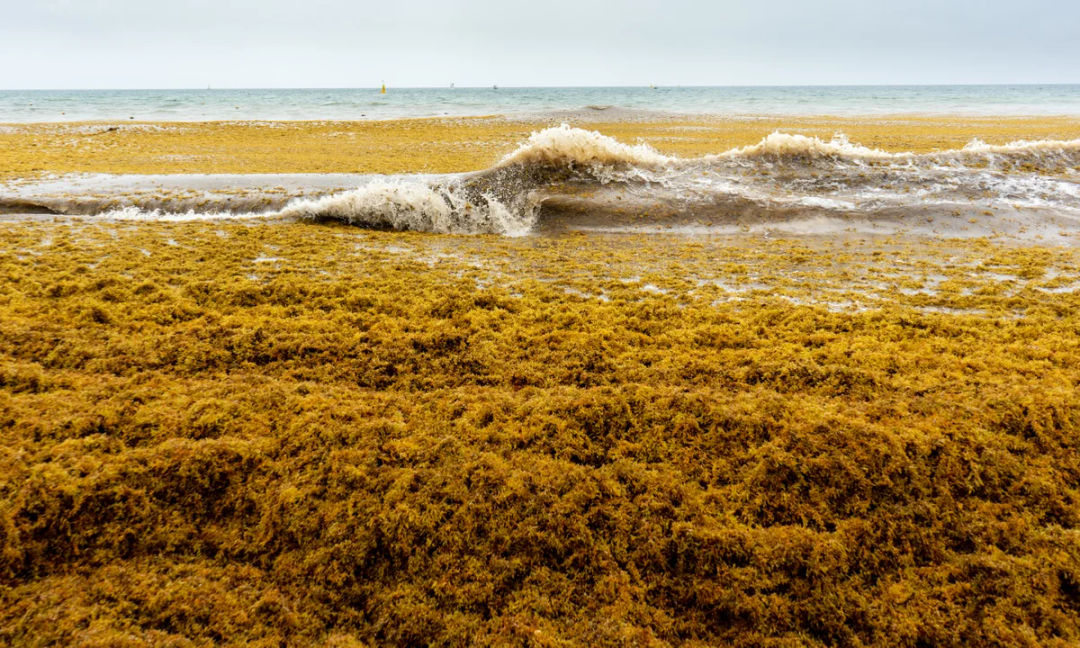
The sargassum belt reached its second-highest level ever measured this June, and the two basins that feed Mexican Caribbean beaches, the western Caribbean and the Gulf of Mexico, broke their own records.
NASA's Earth Observatory published the June figures on July 29, drawing on the monthly outlook of the University of South Florida College of Marine Science. Across the full Great Atlantic Sargassum Belt, only 2025 has produced more of the brown algae since satellite tracking began.
The basin-wide ranking softens what this coast is facing. The record water is the water offshore from Quintana Roo, where state crews had already hauled more than 93,000 tons off the sand by late July and officials expect the heaviest arrivals between August and October.
Nine million tons packed into the eastern Caribbean
The belt stretches from West Africa to the Americas, pushed along by currents and wind. Seen from orbit it looks like a continuous ribbon, but the structure is really a scatter of separate floating mats, and its density peaks each year around June.
The June outlook put 9 million metric tons in the eastern Caribbean, 3.6 million in the western Caribbean, and 5 million in the Gulf of Mexico. The Caribbean and Gulf figures are all-time highs, and the Gulf total nearly doubled its previous record, set only a year earlier.
Brian Barnes, a marine scientist at USF's Optical Oceanography Laboratory, described the belt as a basin-scale phenomenon capable of "devastating local-scale impacts throughout the Caribbean and Gulf," and said daily satellite observation is the only method that captures both scales at once.
The same mats that shelter turtles can smother a reef
In open water, sargassum works as a floating ecosystem. It gives turtles, fish, seabirds, crabs, and other drifting organisms shelter and food, and it releases oxygen through photosynthesis along the way.
The trouble starts in the shallows. When large volumes pile into beaches, mangroves, coral heads, and seagrass meadows, the mats block sunlight and drain the oxygen from water that no longer circulates. Organisms underneath can be covered outright.

Decomposition adds a second problem. Rotting sargassum releases hydrogen sulfide, the gas behind the sharp rotten-egg smell that hangs over heavy accumulations, and exposure is associated with eye and respiratory irritation. The algae can also carry arsenic and heavy metals, which complicates every later step: hauling it, storing it, and turning it into anything useful.

Quintana Roo's cleanup is already chasing last year's total
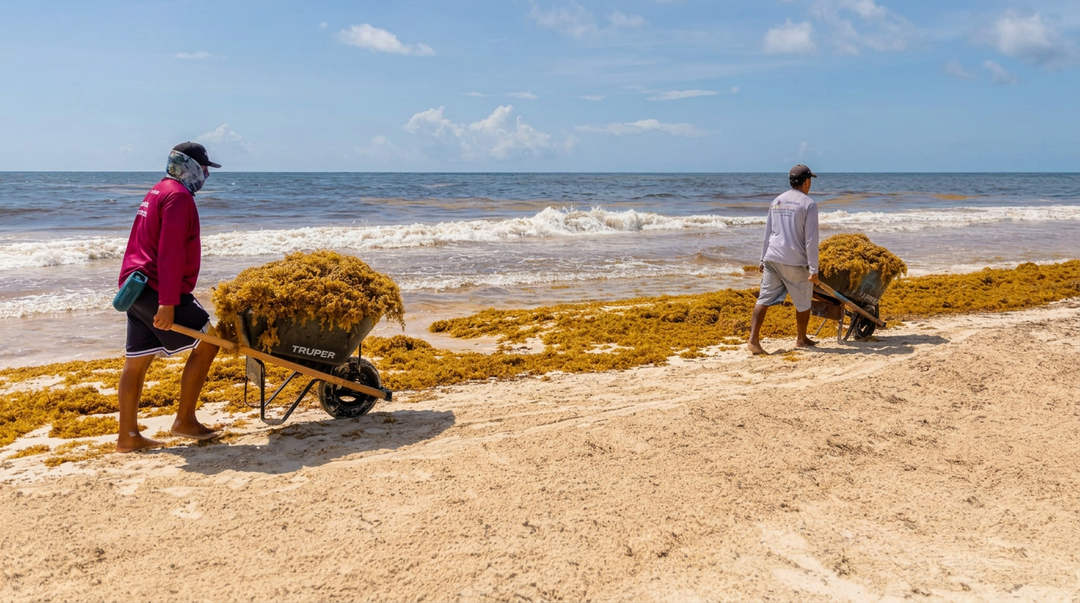
What the satellites measure offshore, cleanup crews measure in truckloads. The state Ministry of Ecology and Environment, known as SEMA, reported 93,238 tons of sargassum collected across Quintana Roo's eight coastal municipalities through late July. Playa del Carmen accounts for about 36 percent of that total and Cancún for 23 percent, while Tulum has removed close to 12 percent, roughly 10,943 tons.
Quintana Roo environment secretary Óscar Rébora Aguilera has said the strongest arrivals of the season are expected between August and October, which puts 2026 on track to pass the roughly 92,500 tons collected in all of 2025.
The bill for keeping beaches usable falls on the people who depend on them. Hotels, restaurants, fishing cooperatives, and tour operators need clean sand and open water, and removal at this scale demands crews, heavy machinery, floating barriers, and vessels that intercept the mats before they land. Mexico's Navy has kept around 350 personnel working beach and open-water collection off Quintana Roo through the summer.
The federal government moved in late July. President Claudia Sheinbaum's administration presented a national sargassum strategy backed by 2 billion pesos, with more containment barriers, expanded harvesting at sea, and a circular-economy park in Puerto Morelos meant to turn the algae into fertilizer and other products. The legal groundwork came earlier, when sargassum was added to the Carta Nacional Pesquera, Mexico's national fishing registry, as a resource rather than waste.
Why the sargassum belt keeps growing
Satellite sensors identify the algae by the way it reflects light off the ocean surface, and the record of those readings reaches back to 2000. Since 2011, the pattern has shifted, with sargassum thinning in the North Atlantic's Sargasso Sea and multiplying across the tropical Atlantic instead.
Since 2024, NASA's PACE mission has sharpened the picture. Its Ocean Color Instrument maps concentrations daily and can tell sargassum apart from other algae drifting in the same water.
The cause of the growth remains an open question. Researchers point to warmer water, nutrients carried out by rivers, Saharan dust, and nitrogen-fixing bacteria as likely contributors. Mexico's environment ministry has singled out nitrogen and phosphorus flowing into the Atlantic from rivers such as the Amazon, loaded with fertilizer runoff and wastewater, as food for the bloom itself.
Rébora's window runs to October. USF publishes a new outlook every month, and the next one will show whether the mats now offshore keep breaking regional records or begin to thin, and whether the expanded offshore harvest can intercept a meaningful share before it reaches the beach.
Has sargassum reached the beaches you use this month, and how are you dealing with it? Join the conversation and share your perspective with us on Instagram and Facebook at @thetulumtimes.

The Tulum Times · Newsletter
The story continues in your inbox.
Essential Tulum news and local insight, a few times a week. Free.
No spam. Unsubscribe anytime.
Tulum Restaurants, Beach Clubs, and Nightlife Guide
Food, dining, beach clubs, and nightlife coverage for visitors looking for practical choices, current openings, and the mood of Tulum after dark.

“The best journalists reporting from paradise, highlighting the heroes that keep Tulum the most beautiful place in the world! THANK YOU!”