
Quintana Roo declared its own cooking a state heritage on Friday at a museum in Tulum, and the recognition extends well beyond the restaurants. It covers the milpa, the markets, and the people who fish.
The same session fixed a date on the calendar. August 28 is now the Día Estatal de la Gastronomía Quintanarroense, established by a decree Governor Mara Lezama Espinosa signed at the Museo Regional de la Costa Oriental, inside Parque del Jaguar.
What separates this from an award is that it comes with instructions. The state culture institute has a deadline to register the declaration, two secretariats have work assigned to them, and the document names producers, fishers, and traditional cooks as the people it exists to protect. In a municipality that sells dinner as a cultural product, who ends up on that list is not a decorative question.
The Quintana Roo gastronomy decree reaches past the kitchen door
The state government's account of the session sets out the scope. The declaration covers the traditional Maya, mestiza, coastal, and Caribbean kitchens, along with their ingredients, utensils, ancestral techniques, festivals, markets, and community practices.
Almomento, describing the decree itself, reported that the protection extends to endemic ingredients, cooking implements, communal agricultural practices, including the Maya milpa, and popular markets and regional festivals. The same account says the decree names local producers, fishers and traditional cooks as guardians of a biocultural heritage, and states what it is guarding against. Homogenization, and the loss of knowledge between generations.
That is a wider net than a restaurant guide throws. A milpa is not a menu.
 Registration puts the cooking on a list, not on a budget
The mechanism Lezama named is the Registro Estatal del Patrimonio Cultural, and the Instituto de la Cultura y las Artes is the body responsible for making the entry.
The Ley del Patrimonio Cultural del Estado de Quintana Roo sets out what that involves. Article 42 requires the declaratory decree to order the inscription. Article 44 defines the registry as a control and record of the goods declared state heritage, holding a classified and statistical account of them, public and private, tangible and intangible.
Read together, the two articles describe exactly what the registry is. A record. It produces an official entry and an official file, and by itself it moves no money toward a market stall in Tulum or toward a cook in one of the municipality's Maya communities.
Three agencies, and a 30-working-day clock
The obligations have owners, and one of them has a date associated with it.
Almomento reported that the measure sets a maximum of 30 working days for the Instituto de la Cultura y las Artes to formally inscribe the manifestation in the state registry. Yucatán a la Mano, reporting the same day, described that deadline as falling on the culture institute together with the education and tourism secretariats.
The rest of the assignments run wider. Sedetur and the state education secretariat are to work with universities and the private sector on educational programs, research, publications and festivals, and state authorities are to coordinate with the 11 municipalities on campaigns aimed at passing the knowledge down.
No budget figure appears in any of it. The state's own bulletin from the session names none, and neither of the two accounts of the decree's text names one either. Lezama said the culture institute would handle the registry and that educational institutions would carry much of the preservation and dissemination work.
The gazette carried the decree a day before the signing
Friday in Tulum was not this decree's first appearance.
On August 27, the day before the session, Almomento reported that the state government had published the declaratory decree in the Periódico Oficial and wrote that the culinary traditions were already covered by it. Yucatán a la Mano published its own account of the legal obligations that same day. We did not obtain the gazette edition ourselves, so the publication date here is reported rather than verified against the source document.
That does not make the ceremony ornamental. Publication in a gazette and presentation to a sector are separate steps, and the second is the one at which the cooks were present. What Friday added was an audience, a venue, and the signature on the second decree, the one that puts August 28 on the calendar every year.
Michelin plaques and a heritage decree in the same room
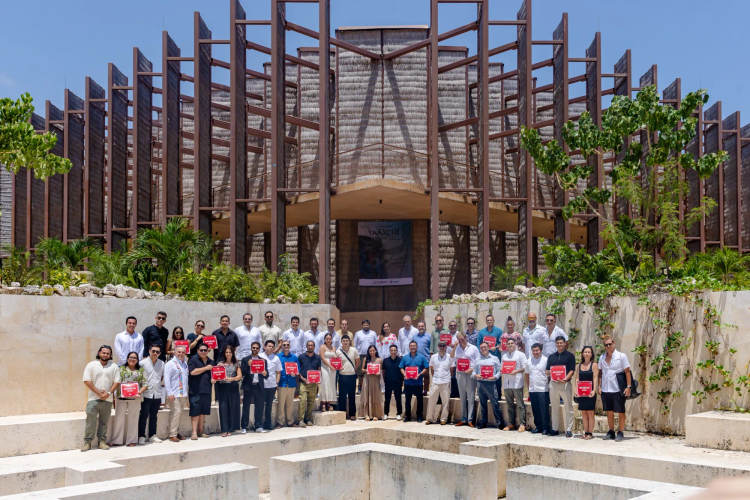
The same afternoon, in the same museum, 19 restaurants from across Quintana Roo collected MICHELIN Guide plaques, eight of them from Tulum. We covered that list in full, including the two Bib Gourmands and the absence of a star.
The two categories are not opposites. Cetli, one of the town's Bib Gourmands, built its reputation on Maya cooking, and traditional cooks were among the guests the state listed at the session, alongside CANIRAC officials, university rectors and the president of the Colectivo de Cocineros de Quintana Roo, Marcy Bezaleel Pacheco Mendoza. The venue itself, the regional museum that opened in 2024, holds more than 300 Maya pieces.
Even so, the two things handed out in that room were of different kinds. One was a plaque with a restaurant's name on it, decided by inspectors in another country. The other was a document that calls the milpa, the market, and the fisher heritage, and then passes the paperwork to a state institute with a month to file it.
Counted from the decree's entry into force, 30 working days runs into the second week of October, with the September 16 holiday sitting inside the count.
What the entry says will matter more than the fact that it exists. A single line reading "gastronomía quintanarroense" would meet the deadline. The decree's own language enumerates communities, markets, fishers, and practices; whether the registry does the same remains to be seen.
Should the state registry name the specific markets, communities, and cooks it says it is protecting, or is one line for Quintana Roo gastronomy enough? Join the conversation and share your perspective with us on Instagram and Facebook at @thetulumtimes.
This image was generated or enhanced using artificial intelligence to improve its quality.

The Tulum Times · Newsletter
The story continues in your inbox.
Essential Tulum news and local insight, a few times a week. Free.
No spam. Unsubscribe anytime.
Tulum Restaurants, Beach Clubs, and Nightlife Guide
Food, dining, beach clubs, and nightlife coverage for visitors looking for practical choices, current openings, and the mood of Tulum after dark.

“The best journalists reporting from paradise, highlighting the heroes that keep Tulum the most beautiful place in the world! THANK YOU!”