
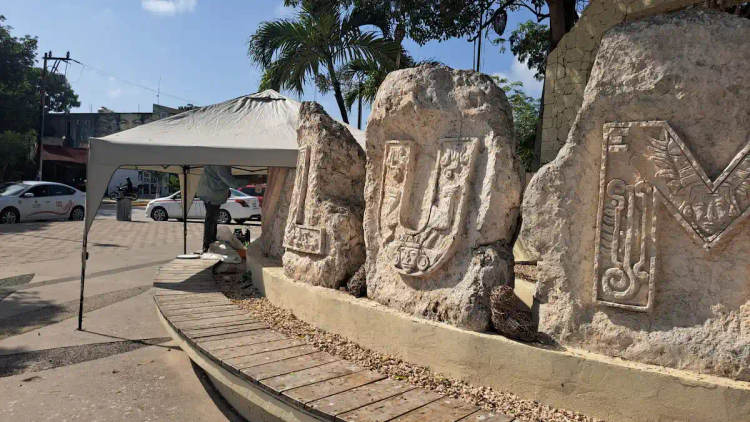
The Tulum tourist letters, the oversized sign in the town's main park, are being coated in fine stucco and handmade Maya pigments, replacing standard paint with techniques drawn from the region's ancient muralists.
The work is led by Luis Manuel May Kú, a sculptor, ceramist, and self-taught researcher of Maya culture. He applies a thin layer of stucco over the stone letters, then adds natural pigments he produces himself: Maya blue, red, yellow, and green, all derived from minerals and earths gathered around the region.
What sets the project apart is not the palette but where it comes from. Monumental letters in tourist destinations across Mexico are usually finished with industrial or acrylic paint. The Tulum tourist letters are instead receiving materials made through artisanal processes, the same family of substances that once gave Maya murals their depth and staying power.
A pre-Hispanic method returns to the Tulum tourist letters
May Kú describes the work as a deliberate return to how Maya painters treated stone.

"I am carrying out an intervention on these stone letters with pre-Hispanic style work, the way the ancient Maya did it," he said. "It is a very fine stucco over the stone that serves as a base to receive the natural pigments I make, such as Maya blue, red, yellow, and green."
His aim is for the letters to read like the murals and decorative elements that distinguished the old Maya cities. The stucco base is not cosmetic. It is the surface that lets the mineral colors bind and hold the way they would on a plastered wall inside an ancient structure.
Why the pigments are made by hand
Behind the technique sits close to a decade of research. May Kú has spent years collecting soils and minerals from the region and working out how to stabilize pigments with plants and other natural elements, a problem the ancient Maya solved with their own recipes.
Maya blue is the best-known result of that lineage. Historically, it was a blend of indigo and a regional clay, fused into a color that resisted humidity and sun for centuries on temple walls. Reproducing it has become the work that defines May Kú's reputation as a ceramist, and on the Tulum letters it now sits alongside the reds, yellows, and greens pulled from the same local ground.
A municipal push for Maya heritage
The project did not start with the artist alone. May Kú said the initiative grew out of interest from Tulum's municipal president, Diego Castañón Trejo, in promoting the preservation and spread of Maya cultural heritage.

That framing places a piece of street furniture inside a larger civic argument. Tulum's identity leans heavily on its Maya past, from the walled archaeological site above the coast to the branding that saturates the town. Finishing a public landmark with genuine pre-Hispanic materials, rather than a stylized imitation, gives that identity something concrete to point to.
Workshops aim to spread the knowledge
The intervention is meant to reach past the park. According to May Kú, the project also includes pre-Hispanic ceramics workshops aimed at Maya communities, intended to strengthen local knowledge and the value placed on Quintana Roo's cultural traditions.
That piece matters because a painted sign, on its own, stays decoration. Passing on the methods- how to gather the minerals, prepare the stucco, and fix the color- is what carries the practice beyond a single commission.
For now, the work continues on the letters themselves. No completion date for the full sign has been announced, and the municipality has not said how many workshops will run or where. What is visible in the park is the first stage, stone surfaces slowly taking on colors that Tulum's original builders would have recognized.
Should more of Tulum's public landmarks be finished with traditional Maya materials instead of industrial paint? Join the conversation and share your perspective with us on Instagram and Facebook at @thetulumtimes .
This image was generated or enhanced using artificial intelligence to improve its quality.

The Tulum Times · Newsletter
The story continues in your inbox.
Essential Tulum news and local insight, a few times a week. Free.
No spam. Unsubscribe anytime.

“The best journalists reporting from paradise, highlighting the heroes that keep Tulum the most beautiful place in the world! THANK YOU!”