
ZOFEMAT staff, volunteers, collectives, and company representatives sifted the sand at Playa del Pueblo early Friday, and the Tulum beach cleanup ended with 32 kilos of marine litter weighed and classified.
Two hundred grams of that weight was microplastic, the fraction that stays invisible until someone pushes the sand through a mesh.
The sorting is what separates Friday from an ordinary morning on this coast. ZOFEMAT moves sargassum off Tulum's public beaches by the ton, and volume is usually the figure announced. This exercise asked something narrower. It asked what kind of waste reaches a beach the municipality already cleans every day, and it answered with an inventory rather than a total.
Inside the 32 kilos
The department broke the haul down by material. PET, glass, HDPE, rubber, polystyrene foam, aluminum, synthetic fiber, caps and other plastics all came off the same stretch of sand.

Of the total, 300 grams were logged as macroplastics and 200 grams as microplastics. Both are small figures next to 32 kilos, and both are the hardest part of the count to obtain because they come from sieving rather than walking.
ZOFEMAT also flagged a group of items it classified as risky and hazardous.
- 3 syringes
- 5 lighters
- 2 aerosol cans
- Bottle caps and fragments of glass
Shoes came out of the sand as well, along with household objects, brushes, and toothpaste tubes.

What a Tulum beach cleanup learns by sifting instead of raking
David Buchanan, general director of ZOFEMAT Tulum, described the method in plain terms.
We are sieving the beach to identify the waste we do not always see and, at the same time, we walk the area to locate the macro waste. This lets us know what kind of marine litter is reaching our beaches.
He was speaking in Spanish, and the wording above is a translation.

The morning was logged through Ocean Conservancy's platform, the organization behind the International Coastal Cleanup. That cleanup has run since 1986 and lands on the third Saturday of September, which this year falls on September 19. Tulum went out a day ahead of it.
Counting is the whole point of the platform. Volunteers on other coasts record each item they pick up against the same categories, which turns a morning of filling bags into a figure that can be compared with last year and with the next beach up the coast. A cleanup that only removes weight leaves the sand lighter by lunchtime. One that classifies leaves a record.
Toothbrushes, toothpaste tubes and shoes in the haul
Household waste on a public beach is the detail worth sitting with. ZOFEMAT described the 32 kilos as marine litter, and its account does not distinguish between what the current brought in and what was left behind on the sand.
The distinction decides what can be done about it. Debris carried in by the sea is a regional problem no municipal crew can stop at the shoreline. Waste dropped by whoever was on the beach the night before is local, and it is the one Buchanan went after.
He asked people who use the beaches to carry their waste out with them and to use the bins, noting that public beaches already have waste stations for this purpose. It is the cheapest line in any coastal cleanup budget, and the only one a crew cannot carry out on anyone else's behalf.

The same crews hauled 6,500 tons of sargassum this year
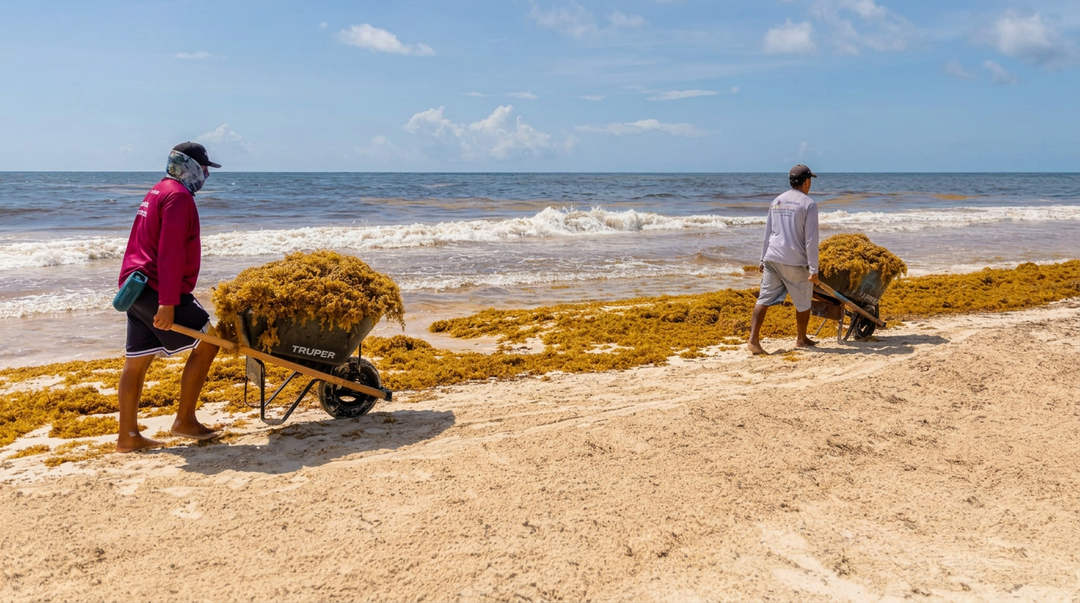
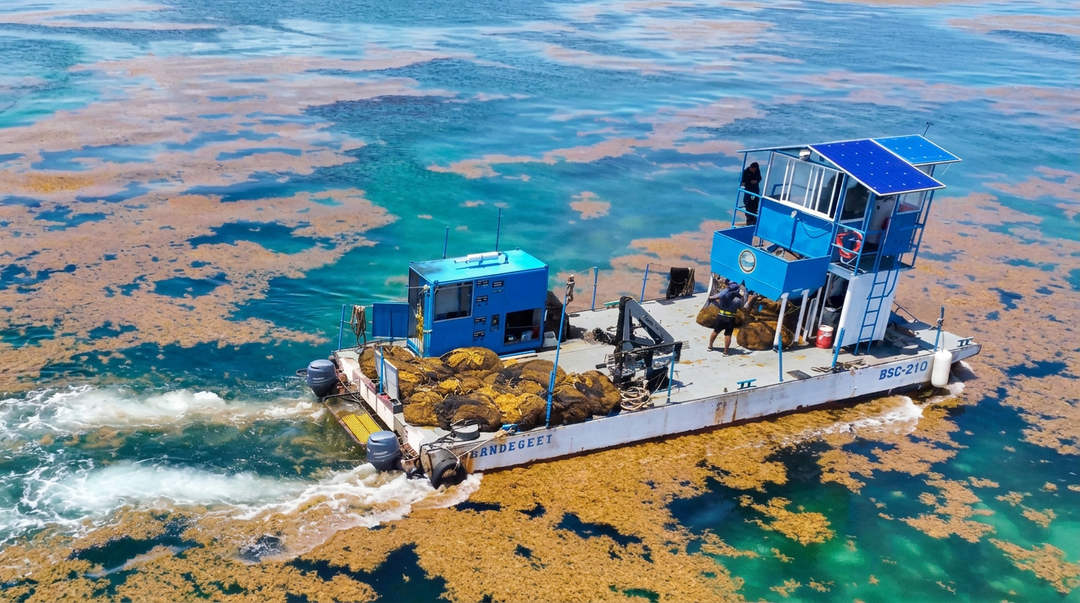
Friday's 32 kilos sit inside a much heavier operation. ZOFEMAT's own account of its work, published the day before and reviewed by The Tulum Times, put the sargassum taken off the Tulum coast at more than 6,500 tons so far in 2026 and reported moving it in more than 1,800 container trips to the disposal site. Four public beaches get priority, Playa del Pueblo among them, with Parque del Jaguar, Punta Piedra and Conchitas.
Those containers also carry seaweed gathered by the Navy, CONANP, and hotels, which ZOFEMAT then transports.
The two hauls are cleaned in completely different ways. Sargassum arrives in quantities measured in tons and is cleared with machinery, most of it before the first swimmers appear. The plastic in the same sand is measured in grams and has to be looked for on purpose. Our guide to the beaches of Tulum sets out which of these stretches are public and which sit behind a hotel.
One beach sieved, and the bulletin stops there
The characterization covered only Playa del Pueblo. Parque del Jaguar, Punta Piedra and Conchitas receive the same daily cleaning, and the announcement says nothing about whether the sieves go there next, how often the exercise would be repeated, or whether the item-by-item results will be published beyond the weights released on Friday.
ZOFEMAT has not said whether the sieve goes back out. What the public has from this Friday is one figure, 32 kilos, and one detail inside it that nobody has accounted for: how three syringes ended up in the sand of the town's own beach.
Have you picked up something on a Tulum public beach that had no business being in the sand? Join the conversation and share your perspective with us on Instagram and Facebook at @thetulumtimes.

The Tulum Times · Newsletter
The story continues in your inbox.
Essential Tulum news and local insight, a few times a week. Free.
No spam. Unsubscribe anytime.
Beach Access, Public Shoreline, and Coastal Rules in Tulum
Coverage of public beach access, coastal restrictions, closures, and the balance between tourism and public space.

“The best journalists reporting from paradise, highlighting the heroes that keep Tulum the most beautiful place in the world! THANK YOU!”