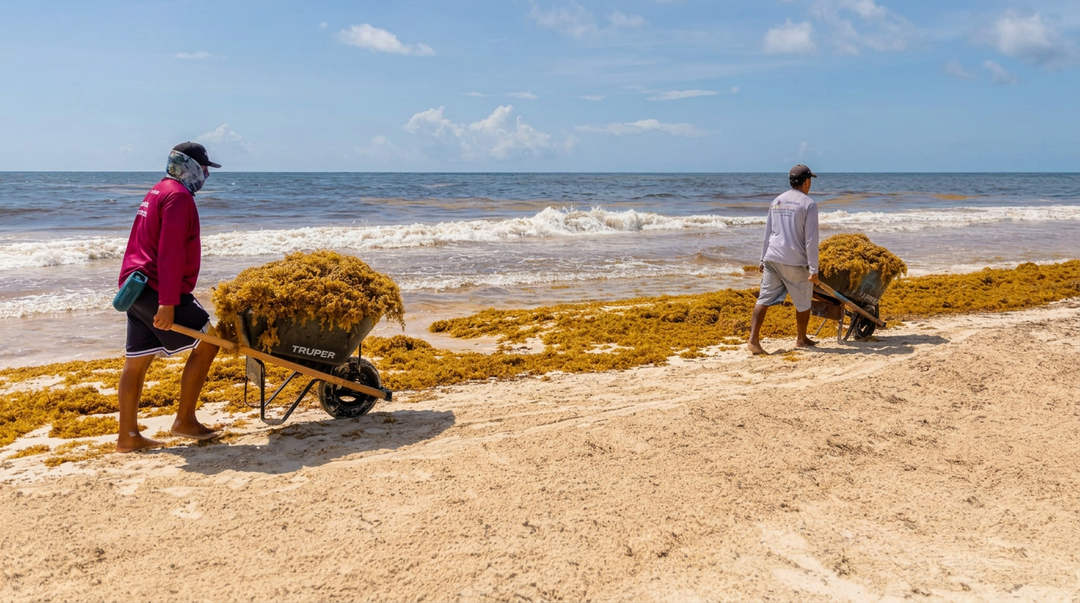

Tulum municipal authorities have extracted over 1,300 tons of sargassum from local coastlines this year. The operation relies on a logistical network designed to mitigate the environmental and economic impact on the destination.
The arrival of pelagic sargassum has evolved into a recurring structural challenge for the Mexican Caribbean. In Tulum, where coastal aesthetics drive the international tourism sector, unchecked macroalgae accumulation presents immediate risks to hotel occupancy and local commerce. Decomposing biomass left on the shore also accelerates coastal erosion, damages sea turtle nesting grounds, and degrades nearshore water quality.

To address the continuous arrivals, the administration of Mayor Diego Castañón Trejo has formalized a targeted collection system. Current operations center on 17 strategic containers, prioritizing the high-density hotel zone where economic vulnerability is highest.
The infrastructure, operated in coordination with the Federal Maritime Terrestrial Zone (Zofemat), allocates 10 of its 17 containers directly to the Hotel Zone. This segment services more than 25 major lodging centers. Municipal data indicates this setup has facilitated 380 direct extraction trips. The immediate removal strategy is engineered to intercept the algae before decomposition begins.

To ensure the physical integrity of the beaches, the strategy intentionally minimizes the use of heavy machinery directly on the sand. Instead, manual labor by dedicated environmental brigades and cooperative hotel staff forces the accumulation points toward the dedicated containers. This logistical mechanism safeguards the delicate coastal profile while maintaining efficiency in biomass extraction.
Beyond sargassum extraction, the municipal sweeps have yielded more than 15,000 kilograms of general marine waste and debris. This secondary clearance function remains critical for preventing plastic pollution, discarded fishing gear, and microplastics from drifting into the adjacent Mesoamerican Barrier Reef system. These overlapping conservation efforts aim to preserve the delicate balance of the marine corridors located just offshore.

David Buchanan, Director General of Zofemat, and official Fili Tah Balam accompanied the mayor during recent supervisory rounds to evaluate the operational efficiency of the container network. Their oversight confirms that rapid response times are crucial during peak influx periods heavily influenced by the prevailing wind currents in the Mexican Caribbean.
The local government approaches the cleanup as an essential utility for both the visitor economy and the resident population. Long-term management of the environmental phenomenon dictates continuous institutional investment and structural collaboration with hotel operators, establishing permanent logistics over temporary seasonal reactions.

How has the continuous presence of sargassum impacted your experience or business on the coast of Tulum this season? Join the conversation and share your perspective with us on Instagram and Facebook at @thetulumtimes.
*Photos from the Tulum City Hall.

The Tulum Times · Newsletter
The story continues in your inbox.
Essential Tulum news and local insight, a few times a week. Free.
No spam. Unsubscribe anytime.
Tulum Sargassum Updates and Beach Conditions
Live seaweed conditions, cleanup updates, forecasts, and practical beach planning across Tulum and the Riviera Maya.

“The best journalists reporting from paradise, highlighting the heroes that keep Tulum the most beautiful place in the world! THANK YOU!”