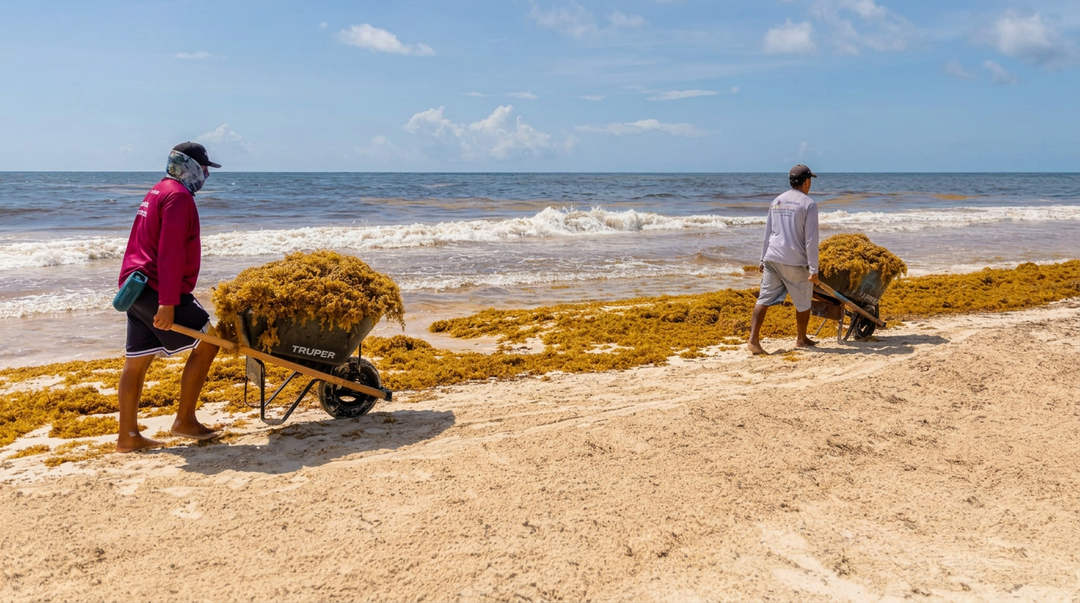
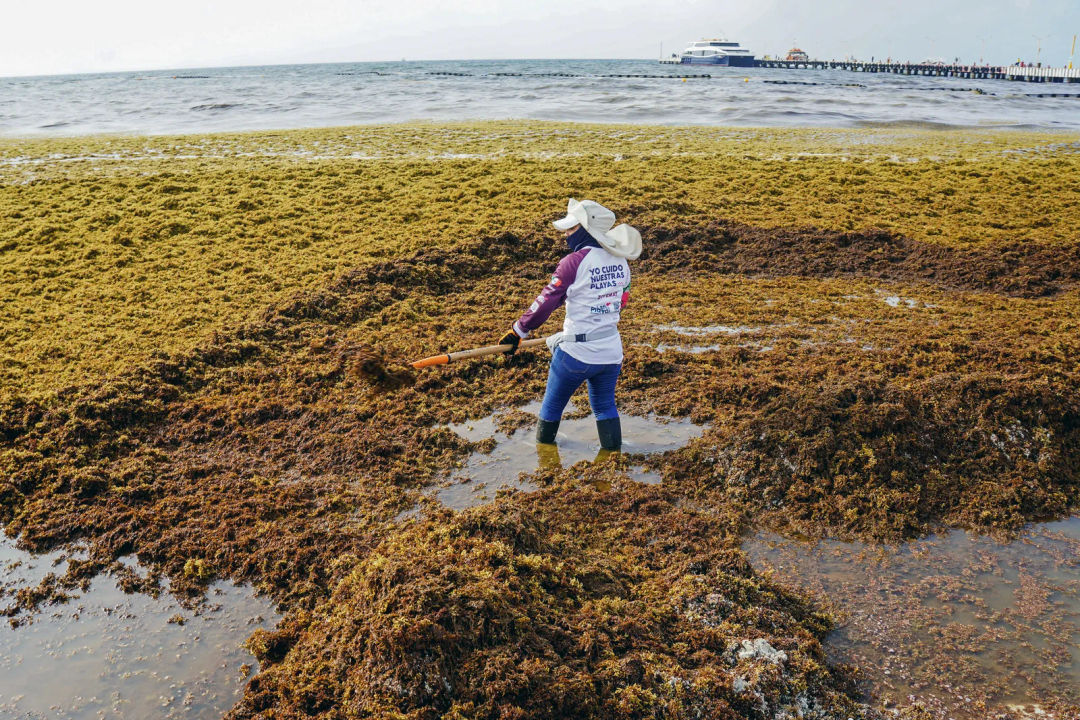
A peer-reviewed study of sargassum cleanup workers in the Mexican Caribbean has documented hydrogen sulfide exposure above Mexico's legal limits, alongside skin, respiratory, and neurological symptoms reported across three beach towns.
The findings, published in the April issue of the journal Harmful Algae, mark the first time researchers have directly measured the toxic gas in real time among the people who clear the seaweed from Quintana Roo's coast. The data points to a labor health problem that has remained largely invisible inside the region's broader sargassum response.
How the study measured worker exposure
Researchers monitored 35 sargassum collectors working in Puerto Morelos, Playa del Carmen, and Mahahual between June and August 2024, during one of the most intense sargassum blooms on record. Portable sensors fixed to the workers' chests captured hydrogen sulfide concentrations in real time, while 32 of the participants completed health questionnaires.
The project was supported by the National Autonomous University of Mexico, the University of São Paulo, and Canada's New Frontiers in Research Fund. Lead researcher Rosa Rodríguez and her team state that no previous published work has directly quantified real-time exposure for this specific group of workers.

The authors describe cleanup crews as a group that "likely faces greater risk than the general population due to prolonged, repeated contact with decomposing biomass, often without adequate protective equipment." Shifts in the region typically run eight hours a day, six days a week, across cleanup seasons that can stretch to nine months a year.
Hydrogen sulfide levels above the Mexican permissible limit
Hydrogen sulfide, or H2S, is a toxic gas released when sargassum rots in anaerobic conditions. It is identifiable by its rotten egg smell, and at high concentrations it can be fatal.
The recorded measurements ranged from 1 to 50.8 parts per million. Of all readings, 46.3% exceeded Mexico's permissible limit of 1 ppm for an eight-hour workday, 11.3% exceeded the 5 ppm short-term exposure limit, and 1.7% exceeded 10 ppm. Some readings climbed past 50 ppm, a level the study describes as potentially life-threatening.
Workers handling sargassum directly in the water, or in zones with dense, decomposing accumulations, reported more severe symptoms than those working drier piles. The risk, the study notes, rises sharply once the seaweed begins to break down.

Symptoms reported by sargassum cleanup workers
The health questionnaires returned a wide range of complaints. Among the workers surveyed, 46.9% reported itching and burning skin, 43.8% reported headaches, and 37.5% reported both dermatitis and fatigue. Eye irritation and nausea affected 28.1% of those interviewed, while 25% reported dizziness.
Hives and nasal congestion appeared in 21.9% of responses, and 18.8% reported throat irritation and difficulty breathing. Smaller groups described vomiting, anxiety, sleep disturbances, skin infections, localized hair loss on the legs, and, in a few cases, loss of toenails.
The clustering of dermatological and respiratory complaints points to cumulative effects rather than isolated incidents, particularly for workers who return to the same decomposition zones year after year.
What researchers recommend for cleanup operations
Rodríguez said the results indicate an urgent need for protective measures along the Quintana Roo coast. Her recommendations include continuous hydrogen sulfide monitoring, personal alarm sensors for each worker, mandatory protective equipment, properly fitted respirators, and staff rotation to cap individual exposure time.
She also recommended excluding workers with asthma or other respiratory conditions from areas where sargassum is actively decomposing, and called for long-term medical surveillance and epidemiological studies to track delayed or chronic effects.
A second line of action sits upstream of the cleanup itself. Faster collection, before the seaweed begins to rot, would limit the volume of gas released at the shoreline and reduce the conditions that produced the highest readings in the study.
The El Recodo problem and what it signals
Rodríguez singled out El Recodo, a beach in Playa del Carmen where sargassum has accumulated to the point of turning into a dark sludge that can only be removed with machinery. She noted that other sites along the coast carry even higher hydrogen sulfide concentrations than those documented in the study.
These hotspots are the operational reality crews face when arrivals outpace removal capacity. They are also where the gap between current cleanup protocols and the protective measures the research describes is widest.
The study does not propose a single regulatory remedy, and Mexican authorities have not yet announced a formal response. What the data establishes is a baseline. Real-time exposure can now be measured, the symptoms can be catalogued, and the conditions that drive the worst readings, decomposition and direct water contact, can be identified.
The question now turns to whether federal, state, and municipal actors involved in sargassum collection will incorporate the findings into worker safety protocols before the next major bloom season.
Should sargassum cleanup workers in Quintana Roo receive mandatory protective equipment and continuous H2S monitoring? Join the conversation and share your perspective with us on Instagram and Facebook at @thetulumtimes.

The Tulum Times · Newsletter
The story continues in your inbox.
Essential Tulum news and local insight, a few times a week. Free.
No spam. Unsubscribe anytime.
Tulum Sargassum Updates and Beach Conditions
Live seaweed conditions, cleanup updates, forecasts, and practical beach planning across Tulum and the Riviera Maya.

“The best journalists reporting from paradise, highlighting the heroes that keep Tulum the most beautiful place in the world! THANK YOU!”