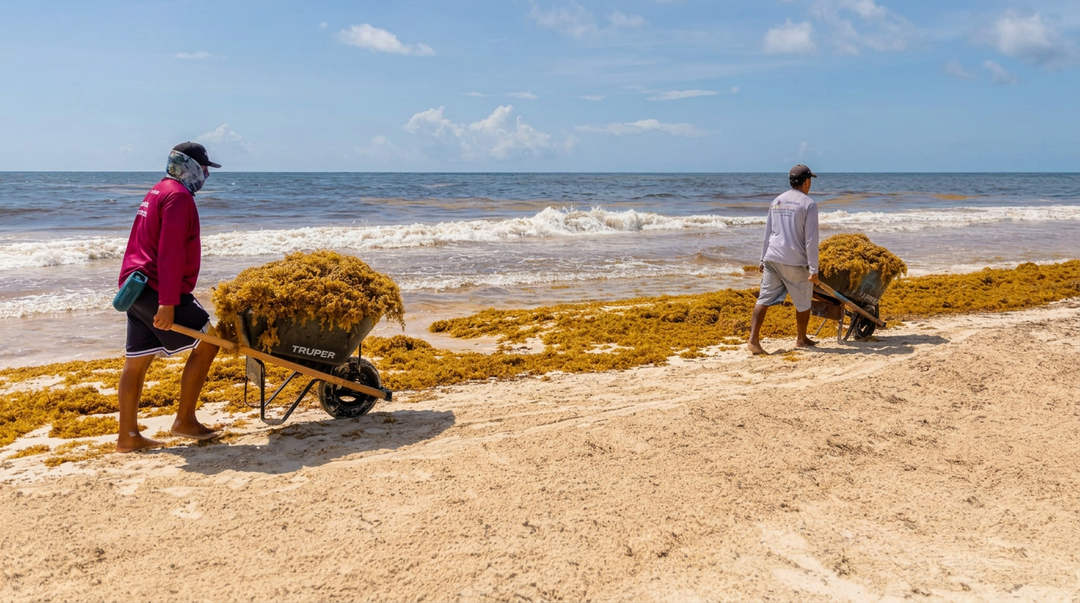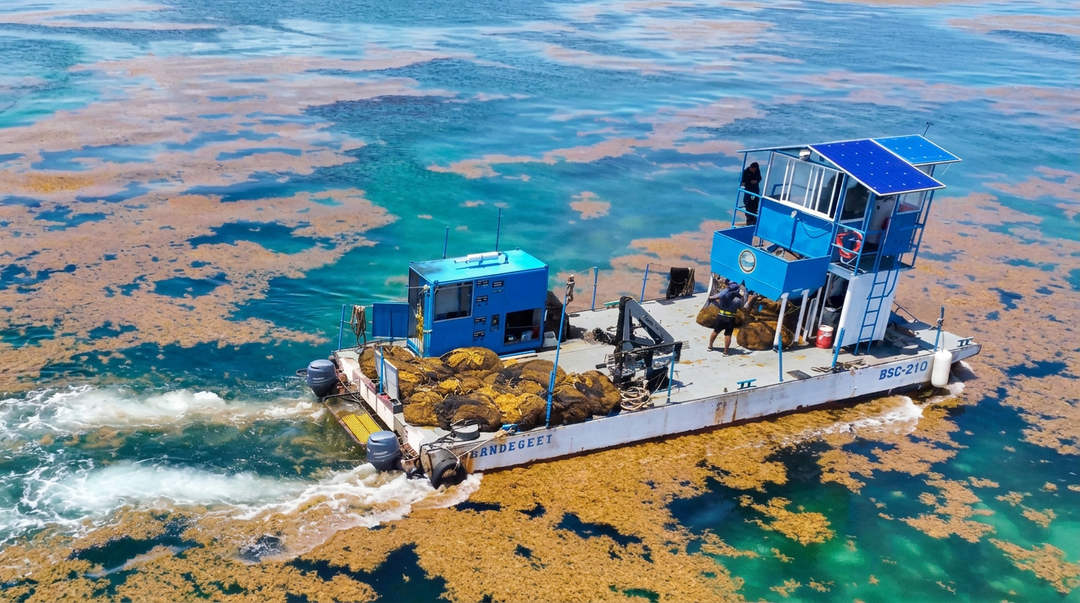

Cleanup workers stationed along Tulum's coastline say the municipality is experiencing one of its most intense sargassum seasons in recent memory, and that the burden of keeping beaches clear has fallen almost entirely on government brigades while the hotel sector contributes a fraction of the manpower required.
The complaint arrives as the University of South Florida's Oceanography Lab has classified 2026 as a potentially record-breaking sargassum year, with Atlantic biomass exceeding 75 percent of all historical values recorded since 2011. Tulum, whose coastline faces directly east into the open Caribbean without reef or geographic barrier to deflect incoming mats, has historically been the first and hardest-hit destination in Quintana Roo each season.
A government operation carrying private-sector weight
Shamir Cruz, a beach cleanup worker currently assigned to Tulum's coastal strip, said that the bulk of day-to-day removal work falls on personnel from the Zona Federal Marítimo Terrestre (Zofemat) and the Secretaría de Marina. Hotel participation, he said, remains well below what the scale of the problem demands.
The numbers he described are stark. Across more than eight kilometers of coastline in the hotel zone, Cruz said approximately ten people assigned by beachfront hotels are actively helping collect sargassum. That ratio, he and fellow workers noted, is nowhere near sufficient for the volume of macroalgae arriving daily.

Cruz also pointed to a contrast with other tourist municipalities in northern Quintana Roo, where dedicated hotel-employed beach crews operate throughout the season. In Tulum, he said, that structure largely does not exist at the same scale.
What the official data shows
The workers' account is consistent with what municipal figures reveal about the pressure on public resources. By mid-April, Tulum's Zofemat teams had collected more than 1,224 tons of sargassum from the coast, a figure that counted only government-operated brigades. Hotel removal and Parque del Jaguar brigades were not included in that total.
That same volume in 2025 stood at 462 tons for the same period, a difference that Zofemat director David Buchanan acknowledged when presenting the numbers. The season also arrived earlier than usual, with significant landings recorded before the end of January and cleanup operations running daily from before 5 a.m.
To manage the workload, the municipality deployed 17 containers across the coastline, ten of them positioned in the hotel zone to serve more than 25 beachfront properties. Navy personnel have been operating in specific areas including Playa Pescadores and Playa Santa Fe, reinforcing Zofemat crews that concentrate on high-volume public beaches such as Playa del Pueblo, Punta Piedra, and Pez.

A structural gap between capacity and demand
The situation workers describe is less a logistical failure than a coordination gap. Zofemat's container system was designed partly to make hotel participation easier, giving properties a disposal point without requiring them to manage transport. But participation in that system remains uneven, and the number of hotel staff actively collecting on the sand is, by the workers' account, far below what eight-plus kilometers of affected coastline requires during a heavy season.
Workers warned that prolonged accumulation has consequences beyond aesthetics. Decomposing sargassum releases hydrogen sulfide, a gas associated with respiratory irritation and the distinctive odor that drives visitors away from beach areas. Extended accumulation also degrades the visual quality of the coast, the single most important draw for the international tourism Tulum depends on.
Sargassum season shows no sign of easing
The broader regional picture offers little relief in the short term. The USF forecast, issued in February 2026 based on satellite data and Atlantic biomass measurements, warned that conditions could exceed any previous season on record by mid-summer. A weekly conditions report published at the start of June confirmed heavy accumulations persisting along Tulum, Akumal, and Playa del Carmen, with forecasters noting the pressure is expected to continue through August.
Tulum's geographic position compounds the problem. Its coastline runs nearly due north-south, perpendicular to the prevailing sargassum currents. There is no offshore reef to intercept floating mats and no sheltered bay to reduce exposure. What arrives in the open Atlantic reaches Tulum's shore at full volume.
Beach workers called for stronger coordination between government and the private sector before conditions worsen further. The coming months represent the peak of sargassum season, and with daily collection already straining existing brigades, the gap between what is being removed and what continues to arrive will be difficult to close without broader participation from the hotel industry.
Whether that coordination materializes, and on what timeline, remains an open question heading into what forecasters expect to be the most demanding stretch of the 2026 season.
Are hotels in Tulum doing enough to help clean up sargassum this season? Join the conversation and share your perspective with us on Instagram and Facebook at @thetulumtimes.

The Tulum Times · Newsletter
The story continues in your inbox.
Essential Tulum news and local insight, a few times a week. Free.
No spam. Unsubscribe anytime.
Tulum Sargassum Updates and Beach Conditions
Live seaweed conditions, cleanup updates, forecasts, and practical beach planning across Tulum and the Riviera Maya.

“The best journalists reporting from paradise, highlighting the heroes that keep Tulum the most beautiful place in the world! THANK YOU!”