

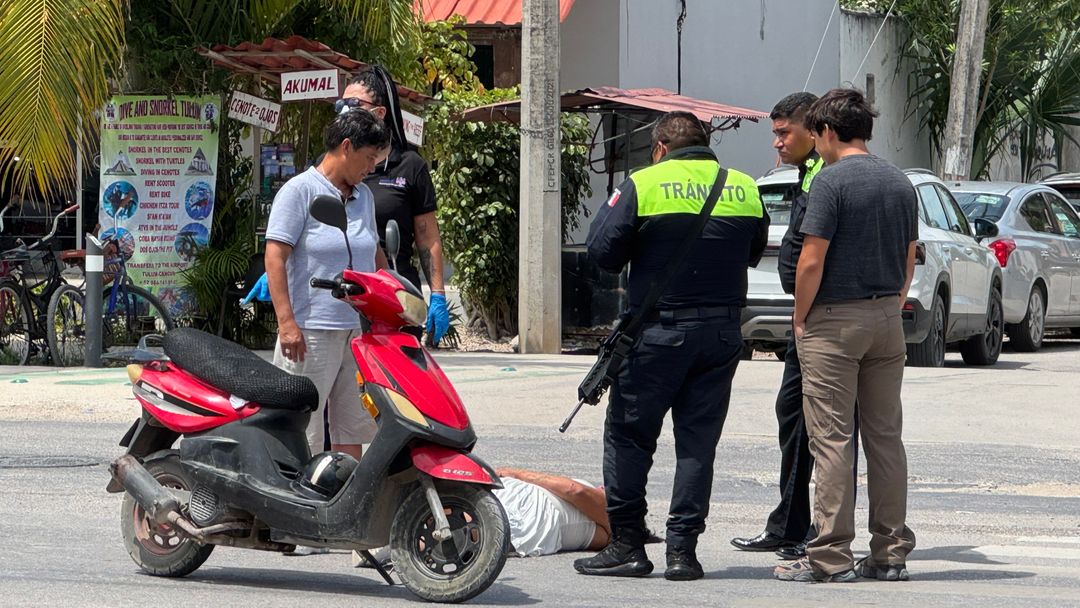
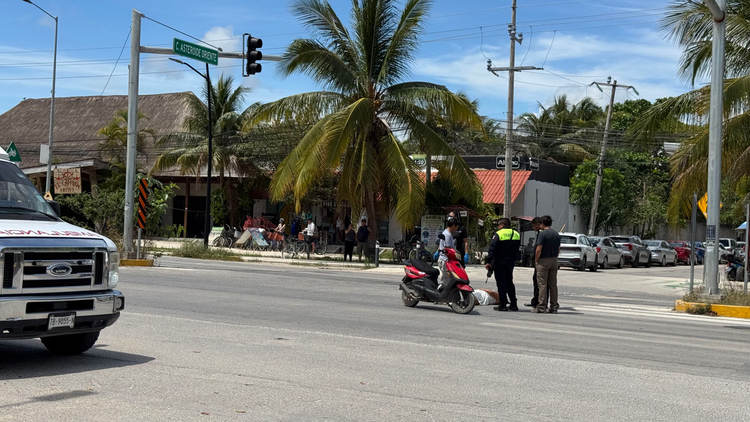
Earlier this morning, another traffic accident took place on Avenida Cobá, directly in front of Chedraui, one of the busiest intersections in Tulum. A woman riding a motorcycle was struck by a vehicle beneath a traffic light that, according to what residents and regular drivers have observed, had been installed not long ago, worked only briefly, and then stopped functioning.
What happened there was serious, but it was not unusual. That is precisely what makes the situation more troubling.
In Tulum, traffic incidents are no longer being seen as isolated events or as the inevitable side effects of a town in transition. They have become part of a wider pattern tied to rapid growth, weak road planning, poor maintenance, inconsistent traffic control, and the lack of safe conditions for drivers, cyclists, motorcyclists, and pedestrians alike.
This is no longer only a problem of congestion. It is a broader urban mobility crisis, one that is becoming harder to ignore because its consequences are already visible in daily life.

Avenida Cobá as a Symptom of a Larger Failure
The intersection near Chedraui has become one of the clearest examples of how fragile traffic conditions in Tulum have become. It carries a constant mix of private vehicles, trucks, taxis, motorcycles, bicycles, delivery units, and people trying to cross on foot. For a brief moment, the installation of a traffic light suggested that the scale of the problem had been recognized. But once that signal stopped working, the disorder returned almost immediately.
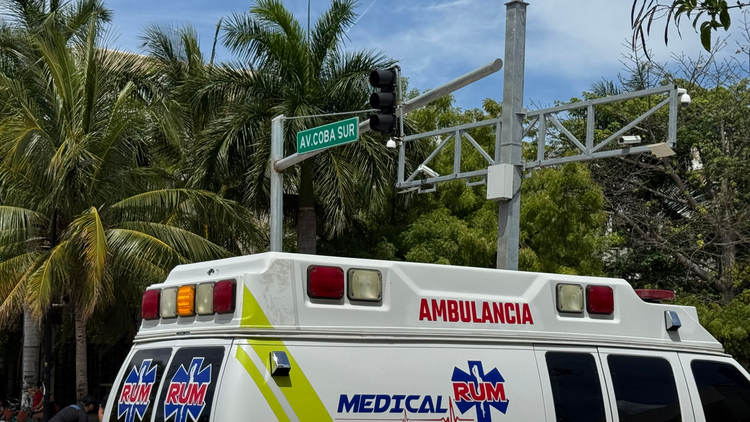
The issue is not only that one traffic light failed. It is what that failure reveals. At one of the town’s most active and conflictive intersections, even a basic effort to impose order has not remained in place long enough to make a meaningful difference.
For many who move through Tulum every day, the accident on Avenida Cobá did not feel like an exception. It felt like another example of a problem that has become part of the city’s normal rhythm.
Dangerous Corners and Improvised Responses
The same concerns can be seen in other parts of town. The intersection of Kukulkán and Juanek is another highly exposed point, especially because of the speed at which vehicles often approach from the hotel zone. It is one of several areas where drivers, motorcyclists, cyclists, and pedestrians are left to negotiate space with limited guidance and little visible protection.

In places like this, the most common response has often been the installation of aggressive speed bumps. These topes may reduce speed, but they frequently do so in a crude way. Cars are jolted, motorcycles lose stability, bicycles are forced into awkward maneuvers, and the street becomes harsher instead of more orderly.
That is part of the larger concern. In too many cases, the solutions appear reactive rather than planned. Measures are introduced, but they often feel disconnected from a broader strategy for how traffic in Tulum should actually function.
A Growing City Without Clear Road Order
Tulum has expanded rapidly, but its road infrastructure has not evolved with the same consistency. Traffic volumes have increased, neighborhoods have grown, and the number of residents, workers, tourists, suppliers, and service vehicles moving through town every day continues to rise. Yet many of the most basic elements of road organization remain missing or incomplete.
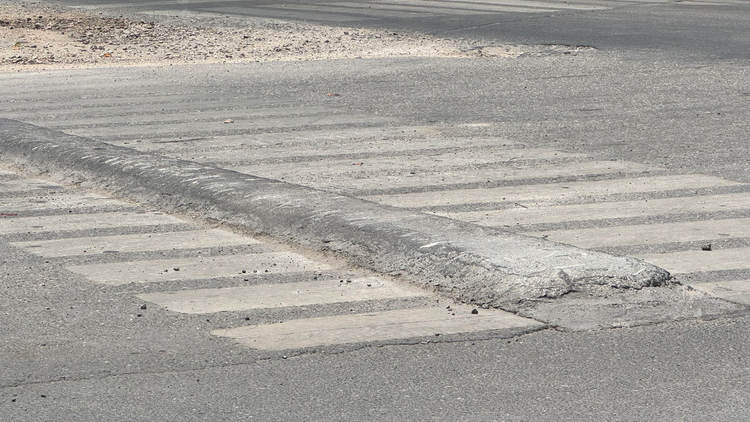
In many streets, pavement markings are faded or absent. Directional signs are limited. Street names are often difficult to find. For anyone unfamiliar with the town, that creates immediate confusion. Drivers enter one-way streets in the wrong direction. Vehicles stop suddenly to orient themselves. Riders make last-minute turns. Under already strained conditions, these are not small inconveniences. They are direct risk factors.

The problem becomes even more serious when pedestrians are considered. In many parts of Tulum, sidewalks are incomplete, blocked, too narrow, or simply nonexistent. Residents, workers, and visitors often end up walking along the edge of busy roads or directly on the street itself, sharing space with cars, motorcycles, bicycles, and trucks. That has become so common that it risks being treated as normal, even though it clearly should not be.
Calle 7 in La Veleta and the Consequences of Poor Execution
If one street reflects the consequences of poor planning and weak execution, it is Calle 7 in La Veleta. Once a broad and active road where vehicles, bicycles, motorcycles, and pedestrians could circulate with relative ease, it has become increasingly difficult to navigate safely.
Planters were added along the sides, reducing the usable width of the road to the point that in some sections it is barely wide enough for a single car. That decision altered the street’s basic function. Cars and motorcycles can no longer pass each other comfortably, movement slows, bottlenecks form, and routine circulation becomes more tense and more dangerous.
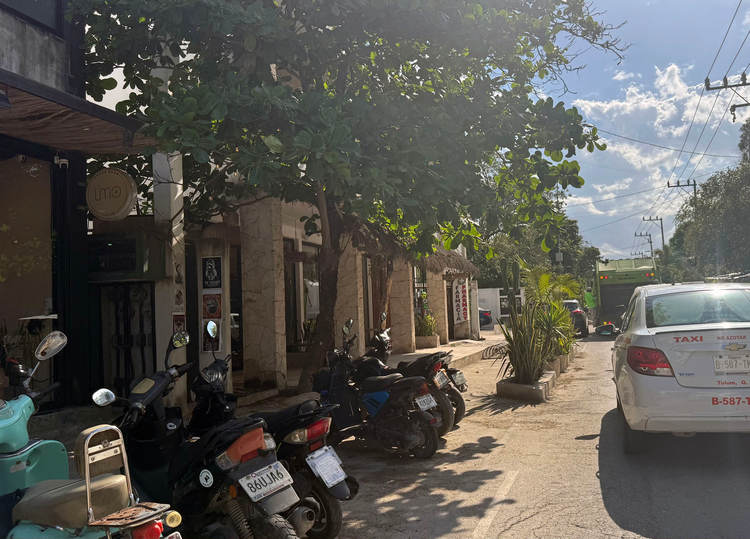
The condition of the pavement has made matters worse. After underground pipe work carried out last year, the road surface was broken up and later repaired in a way that left the central section uneven, rough, and difficult to cross, especially for motorcycles and bicycles. Combined with parked vehicles, the lack of sidewalks, and the reduced space created by the planters, Calle 7 has become a daily example of how an active street can be turned into a corridor of friction and risk.
It is not simply a street in poor condition. It is a case study in what happens when interventions are made without enough attention to how a road is actually used.
The Hotel Zone and the Image of the Destination
The same problems extend to the hotel zone and the avenues leading into it. Avenida Kukulkán and sections of the coastal road continue to show serious wear, including potholes, broken pavement, abrupt depressions, and irregular surfaces that become especially dangerous on curves and in lower-visibility areas.
For residents and workers, these roads are part of daily life. For visitors, they are also part of their first-hand experience of the destination. The condition of these routes affects more than comfort. It affects safety, ease of movement, and the basic ability to access one of Tulum’s most important areas without facing avoidable hazards.
At night, the problem becomes more severe. In some stretches, limited public lighting makes road damage much harder to detect. For cyclists and motorcyclists, especially those unfamiliar with the area, the combination of darkness, uneven pavement, and a lack of protected space creates conditions where one unexpected obstacle can quickly lead to a serious accident.

Weak Enforcement and Normalized Risk
Infrastructure, however, is only part of the problem. The lack of visible and consistent traffic enforcement also plays a major role in the disorder seen on Tulum’s streets.
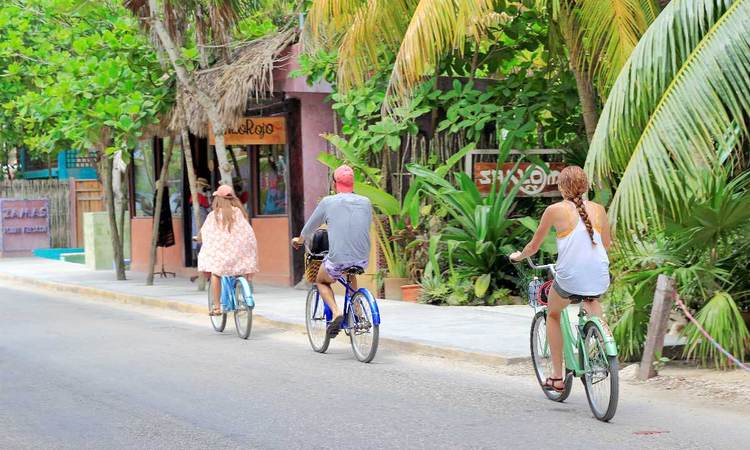
It remains common to see cyclists riding against traffic, both locals and visitors, often on roads that already lack clear signage or lane guidance. In an environment with narrow streets, uneven surfaces, and increasing vehicle volume, that kind of behavior reduces reaction time and raises the likelihood of collisions.
Motorcycle use presents another urgent concern. It is not unusual to see motorcycles carrying three, four, or even five people at once, including children and babies, often without helmets. These are not rare scenes. They have become part of daily life in Tulum, despite the clear danger they represent not only for those riding the motorcycle, but also for everyone else sharing the road.
There are also older forms of local mobility and commerce that continue to move through a town that has changed dramatically around them. Vendors transporting food and drinks on bicycle-pulled carts still circulate through some streets and avenues, even as traffic has grown faster, heavier, and more complex. The issue is not the existence of that work. The issue is that Tulum has not adapted its streets to allow very different forms of movement to coexist safely.
That lack of regulation and adaptation adds another layer of unpredictability to roads that are already under pressure.
Shared Responsibility on Unpredictable Roads
In a town where road conditions remain inconsistent and traffic patterns are still adapting to rapid growth, avoiding certain behaviors is not only a matter of courtesy, but of safety. Much of the risk seen on Tulum’s streets comes not only from infrastructure gaps, but from habits that increase unpredictability in already fragile conditions.
Riding or driving against traffic, even for short distances, reduces reaction time and creates situations that other road users are not prepared to handle. In narrow or poorly marked streets, this becomes especially dangerous.
Overloading motorcycles, particularly when carrying multiple passengers without helmets, significantly increases the likelihood of serious injury in the event of an accident. This is one of the most visible and high-risk practices currently seen across the town.
Driving at speed through intersections without clear right-of-way, especially in areas where traffic lights are absent or not functioning, contributes to collisions that are often avoidable with more cautious behavior.
Using roads without proper awareness of signage, or the lack of it, can also lead to sudden stops, wrong turns, and erratic maneuvers that affect everyone sharing the street. When in doubt, slowing down is often the safest response.
For cyclists and motorcyclists, navigating damaged pavement, potholes, and uneven surfaces requires constant attention. At night, limited lighting in some areas makes these conditions more difficult to anticipate, increasing the need for reduced speed and greater caution.
Pedestrians, in the absence of consistent sidewalks, are often forced into the roadway. Failing to account for this reality, whether by driving too fast or not anticipating people walking along the street, adds another layer of risk.
Tulum’s roads are shared by a wide range of users, from heavy vehicles to bicycles, scooters, and pedestrian traffic. Until infrastructure and regulation catch up with the pace of growth, individual awareness remains one of the most immediate ways to reduce risk and prevent accidents.
A Public Safety Issue That Requires Priority
What is happening in Tulum should not be reduced to a simple complaint about traffic. It is a public safety issue. It affects the person commuting to work by motorcycle, the pedestrian forced to walk in the street, the family moving through town with children, the visitor trying to navigate unfamiliar roads, and the cyclist crossing potholes after dark.
Each of these situations may appear ordinary when viewed separately. Together, they tell a clearer story. They show a town where road risk has become normalized while the underlying causes remain insufficiently addressed.
Tulum still has time to respond in a more serious and coherent way. But doing so will require more than isolated fixes or improvised measures. It will require functioning traffic signals, clearer signage, safer pedestrian infrastructure, better road maintenance, stronger circulation rules, and a more consistent application of basic safety standards.
For now, the image remains difficult to ignore: a woman injured on Avenida Cobá, her motorcycle on the pavement, beneath a traffic light that no longer works. It is not only the image of one accident. It is the image of a larger problem that has been building for too long.

The Tulum Times · Newsletter
The story continues in your inbox.
Essential Tulum news and local insight, a few times a week. Free.
No spam. Unsubscribe anytime.
Transportation in Tulum: Taxi, Bus, Transfers, and Mobility
Taxi fares, buses, transfers, road changes, mobility updates, and practical transport guidance for Tulum.

“The best journalists reporting from paradise, highlighting the heroes that keep Tulum the most beautiful place in the world! THANK YOU!”


