
On May 12, 2026, a Morelet's crocodile named Panchito bit an elderly tourist at Casa Cenote in Tulum. Witnesses reported that visitors had been throwing stones at the animal before the attack. It was the first recorded incident involving Panchito, who had spent years sharing the water with snorkelers, divers, and swimmers who arrived, in many cases, without knowing he was there.
That last detail is the one that deserves attention. Not the attack itself, not the provocation, but the fact that thousands of visitors had entered that cenote over the years without any clear, enforced information about what they were swimming alongside. Panchito's story raises a question that applies to far more sites than Casa Cenote: how much do tourists in Tulum actually know about the wildlife sharing the water with them?
The Animal in the Water: What Morelet's Crocodile Actually Is
The Morelet's crocodile (Crocodylus moreletii), also known as the Mexican crocodile or swamp crocodile, is the species native to the freshwater and brackish ecosystems of the Yucatan Peninsula. It is the crocodile visitors are most likely to encounter in and around Tulum's cenotes, rivers, and lagoons. Understanding what it is, how it behaves, and where it lives is not optional knowledge for anyone spending time in these environments. It is basic orientation.
The species was first formally described by French naturalist Pierre Marie Arthur Morelet in 1851 after an expedition through Mexico and Central America. Its range covers the Gulf coast of Mexico from Tamaulipas south through the Yucatan Peninsula, extending into Belize and northern Guatemala. In Quintana Roo specifically, documented populations exist throughout the Sian Ka'an Biosphere Reserve, in the lagoon systems connecting to the coast, and in freshwater and brackish cenotes integrated into mangrove ecosystems.

What It Looks Like
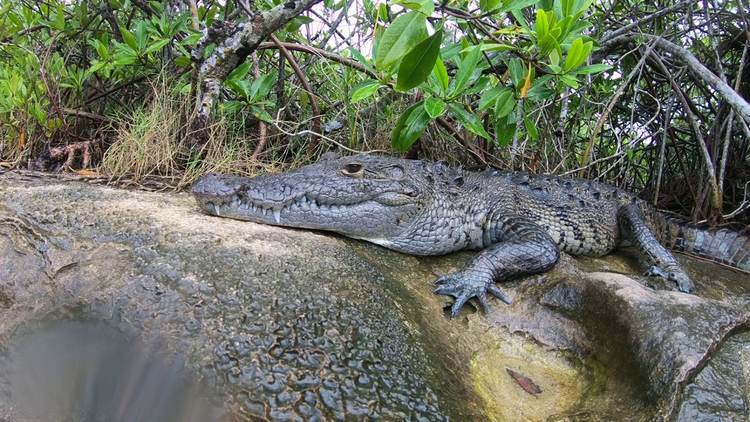
The Morelet's crocodile is a medium-sized crocodilian with a broad, rounded snout, a feature that distinguishes it from the narrower-snouted American crocodile (Crocodylus acutus). Adults are grayish-brown with darker spots and bands along the body and tail. The eyes carry a distinctive silvery-brown iris. Juveniles look almost entirely different: bright yellow with dark bands, small enough to go unnoticed in shallow water or dense vegetation.
Most adults reach between 1.5 and 3 meters in length and weigh roughly 50 kilograms. The largest recorded individuals approach 3.5 meters. In the water, with limited visibility, it is not always easy to see one coming.
Two Species, Two Different Habitats
Tulum and the broader Quintana Roo coast are home to two crocodile species, and knowing the difference matters for understanding where encounters are actually likely.
The American crocodile (Crocodylus acutus) prefers saltwater and brackish coastal environments: mangrove channels, estuaries, coastal lagoons, and tidal flats. It is larger, lighter in color, and has a narrower snout. In the Tulum area, American crocodiles are documented in the coastal lagoons of Sian Ka'an and in mangrove zones near the sea.

The Morelet's crocodile is the freshwater species. It inhabits rivers, swamps, marshes, forested wetlands, and cenotes. The Yucatan Peninsula's underground water network is freshwater and brackish karst terrain, exactly the habitat this species has occupied for thousands of years. When a cenote connects to a surface wetland, a river, or a mangrove system, it is, by definition, potential Morelet's crocodile territory. The same applies to every lake, lagoon, and body of freshwater that tourists in this region regularly visit.
Where Crocodiles Live in the Tulum Region: A Site-by-Site Picture
The risk does not begin and end at Casa Cenote. Across the destinations that form the standard Tulum tourism circuit, crocodile presence is documented, confirmed by environmental authorities, and in several cases a known and ongoing reality that visitor infrastructure has not clearly communicated.
Casa Cenote (Cenote Manatí)
The most prominent case. Casa Cenote is a brackish open-air cenote that flows through mangrove forest and connects directly to the Caribbean Sea, roughly 15 minutes north of Tulum's town center. Panchito, a resident Morelet's crocodile, had lived there for years and became something of a local celebrity before the May 2026 attack. He is not, and was never, the only crocodile in the surrounding system. The site has no barrier between the swimming area and the water the animal inhabits. No enforced visitor distance rules exist.
Laguna de Cobá
Cobá is primarily known for its archaeological zone and the climb up the main pyramid, but the town sits alongside a freshwater lake that has a well-documented crocodile population. Morelet's crocodiles have been observed leaving the water and crossing the main road that divides the lagoon from a second body of water nearby. According to Rocío Peralta Galicia, head of the Natural Resources Department of the local environmental authority, sighting reports are practically constant. The animals cross the road regularly enough that residents and officials have called for trilingual signage in Spanish, English, and Mayan to inform the tourists who visit the archaeological zone and walk that road daily.
Most visitors to Cobá arrive focused entirely on the ruins. Few are told anything about what lives in the lake beside them.
Laguna de Bacalar
Bacalar's famous Seven Colors Lagoon is one of the most-photographed destinations in southern Quintana Roo. Kayaking, paddleboarding, and swimming from docks and boats are standard activities. Morelet's crocodiles are present in the lagoon, a fact confirmed publicly by Javier Carballar Osorio, director of IBANQROO, the state biodiversity institute. Following the unusually heavy rainfall of 2024, which flooded crocodile habitats across the region, populations displaced from saturated wetlands moved into new territories, including the lagoon. Authorities noted that while the animals do not represent a constant danger, the risk of misidentifying a swimmer for prey increases at night, when crocodiles are most active and splashing in the water can be confused for the movement of fish or birds.
Swimming from Bacalar's public docks and pirate channel after dark carries a risk that most visitors are not informed about when they book.
Open-Air Cenotes Along the Coastal Corridor
The cenotes most likely to carry crocodile presence share common characteristics: they are open to the sky, they sit within or adjacent to mangrove or wetland systems, and they connect to surface water networks. The Carwash Cenote, officially known as Aktun-Ha, has documented crocodile sightings. Corazón Cenote, in the same coastal corridor as Casa Cenote, has produced encounter reports from visitors. Any cenote that forms part of a river or mangrove ecosystem should be treated as potential habitat until a wildlife assessment says otherwise.
Enclosed underground cenotes, deep cave systems, and cavern cenotes with no surface connection to wetlands or rivers have no known permanent crocodile populations. The distinction that matters is not the cenote's fame or its popularity. It is its ecological connection to surface water.

How Dangerous Are They? Reading the Risk Honestly
The honest answer is: less dangerous than most visitors fear, and more dangerous than most operators communicate.
Morelet's crocodiles are generally described by wildlife specialists as shy and cautious animals that prefer to retreat from human contact. That behavioral profile is accurate for undisturbed animals in their natural range. It is not a guarantee of safety, and it changes under specific conditions.
When the Risk Increases
A crocodile is more likely to respond defensively when it is cornered, directly threatened, or unable to retreat. In the confined water environment of a cenote or a narrow lagoon channel, escape routes are limited. That is precisely the scenario that produced the May 2026 attack: an animal in a bounded space, targeted with thrown stones, with nowhere to go.
Nesting season introduces a separate risk category. Morelet's crocodiles breed once a year, with egg-laying concentrated between April and June. Females build mound nests up to three meters wide and guard them actively until the eggs hatch, a process that takes two to three months. A female protecting a nest near a swimming area is a materially different animal than the same individual in a calm period. The attack on Panchito's site occurred in May, at the peak of nesting season.
Low light is the third major variable. Morelet's crocodiles are primarily nocturnal hunters. Dawn and dusk are periods of heightened activity. A location that felt safe at midday carries a different risk profile at 6 p.m. Swimming in Bacalar or any open lagoon after dark combines two of the most significant risk factors simultaneously: low visibility and peak hunting activity.
What the Data Shows
Academic research tracking human-crocodile interactions in Mexico recorded 51 documented cases between 2018 and mid-2021. Of those, 44 were non-fatal and seven were fatal. Quintana Roo accounted for roughly 20 percent of all cases nationally, placing it among the highest-risk states alongside Tamaulipas. That is a low absolute number across a multi-year national dataset. It is not zero, and those figures predate the significant growth in cenote and lagoon tourism that has characterized the region in recent years.
The statistical reality is that the probability of a crocodile attack at any given site in Tulum on any given day is low. The conditions required to drive that probability toward zero, documented wildlife protocols, enforced safety distances, informed visitors, have not been consistently present at the sites where encounters are most plausible.
What to Do If You See a Crocodile in the Water
This is practical information, not a warning to avoid these places. The vast majority of visitors who encounter a Morelet's crocodile in Tulum or Quintana Roo experience a distant sighting and nothing more. The animal sees them, decides they are not a threat, and moves away. Knowing how to respond correctly is what keeps that outcome the most likely one.
Stay calm and do not make sudden movements. Rapid splashing mimics the movement of prey. A slow, deliberate exit draws less attention than a panicked retreat.
Do not approach the animal, regardless of how still it appears. The distance at which a crocodile feels threatened varies by individual and circumstance. There is no reliable way for a swimmer to know where that threshold is. Always increase distance, never reduce it.
Do not provoke, feed, or throw objects. Feeding conditions an animal to associate humans with food. Throwing objects signals a direct threat. Both behaviors elevate risk for everyone in the water, not just the person responsible.
Exit slowly, keeping the animal in your line of sight. Move toward the nearest bank without turning your back on the crocodile. Calm movement is safer than speed.
Alert staff and other swimmers immediately. Other people in the water may not have seen the animal. Guides and site workers need to know about any sighting so they can manage the area.
Do not re-enter the water until staff confirms it is safe. A crocodile that appeared calm and distant can reposition underwater faster than most people expect.
Avoid open water at dawn, dusk, and after dark. This applies to cenotes, lagoons, and any natural body of water in the region. These are the periods of highest crocodile activity. The risk profile of a swimming spot at 7 p.m. is not the same as at 11 a.m.
Questions Every Visitor Should Ask Before Getting In
Before entering any open-air cenote, lagoon, or natural body of water in the Tulum and Quintana Roo region, a few direct questions are worth asking out loud.
Has wildlife, including crocodiles, been documented at or near this site? What is the protocol if an animal is sighted in the swimming area? Are there enforceable restrictions on how close visitors can approach wildlife? Is a trained guide present throughout the visit?
A site with a genuine wildlife management plan answers those questions directly. One that treats the question as unusual has not thought through the risk seriously. That reaction is, in itself, useful information before you get in the water.
These Places Are Still Worth Visiting
Tulum's cenotes, Bacalar's lagoon, the lakes around Cobá, the mangrove channels of Sian Ka'an. These are among the most ecologically extraordinary environments in the Americas, and the presence of wildlife in them, including apex predators, is part of what makes them significant.
The Morelet's crocodile has inhabited the Yucatan Peninsula for millions of years. The cenotes and lagoons are its territory as much as they are a tourism destination. That coexistence is not a problem to be solved. It is a condition that requires honest communication, adequate signage, trained guides, and the basic respect that any wild environment demands.
Visitors who arrive informed, who ask the right questions, and who understand what they are entering face a risk so low it should not deter anyone. The problem has never been the crocodile. It has been the absence of clear, honest information about what shares the water, and what that actually means for the people in it.
Panchito spent years in that cenote without harming anyone. What changed on May 12 was not the animal. It was what the people around him did, and what no one had made clear enough, for long enough, that they must never do.
Have you encountered a crocodile while swimming in a cenote or lagoon in Tulum, Cobá, or Bacalar? What did the site tell you about wildlife before you got in the water? Join the conversation and share your perspective with us on Instagram and Facebook at @thetulumtimes.

The Tulum Times · Newsletter
The story continues in your inbox.
Essential Tulum news and local insight, a few times a week. Free.
No spam. Unsubscribe anytime.
Tulum Cenotes, Ruins, and Practical Visitor Guides
Guides, access updates, regulations, and practical planning around cenotes and the Tulum archaeological zone.

“The best journalists reporting from paradise, highlighting the heroes that keep Tulum the most beautiful place in the world! THANK YOU!”