
Senator Mayuli Martínez says National Guard members blocked her from filming Tren Maya construction in Quintana Roo, marking the second documented incident at the same site in recent weeks.
The standoff revives concerns about transparency, press access, and civilian oversight at one of the federal government's most expensive infrastructure projects, even as President Claudia Sheinbaum has publicly insisted that filming the works is permitted and that censorship does not exist in Mexico.
Senator says she was turned away at the construction site
Martínez, a senator with the National Action Party (PAN), traveled to a stretch of the Tren Maya in Quintana Roo to record the works underway. According to her account, uniformed personnel intercepted her, questioned her presence, and demanded credentials before allowing any filming.
"Do you have a permit? Did you request authorization from the company so you can gather information about the construction?" one of the National Guard members asked her, according to the recording she later released.

The senator, who said she arrived without identification, pushed back. She questioned why a lawmaker would need authorization to film a federally funded public works site when her purpose was simply to inform.
The agent appeared to struggle to answer. "Well, the company has... to make a documentary or something, you have to request a permit. Why? Why? Obviously so they grant you authorization," he said.
A second incident at the same Tren Maya stretch
Martínez visited the same area where, weeks earlier, security personnel reportedly asked a citizen to delete a video documenting reinforcement work on the elevated viaduct.
That earlier video was published by engineer and activist Wilberth Esquivel. Filming from inside his vehicle, Esquivel said the southern segment of Stretch 5, near Xpu-Ha, had shown signs of subsidence. "They're shoring up the support beam because the piles are sinking," he said in the footage.
Days before the senator's visit, Esquivel released a second video showing that the temporary metal supports near Xpu-Ha had been removed. According to his account, the supports came down after crews finished demolishing and rebuilding columns at points where the original piles had failed, while the metal scaffolding served as provisional reinforcement.
Workers at the site had pressed Esquivel to stop filming, arguing that recording was not permitted in a federal zone. The video was released anyway.

Sheinbaum's position and the contradiction on the ground
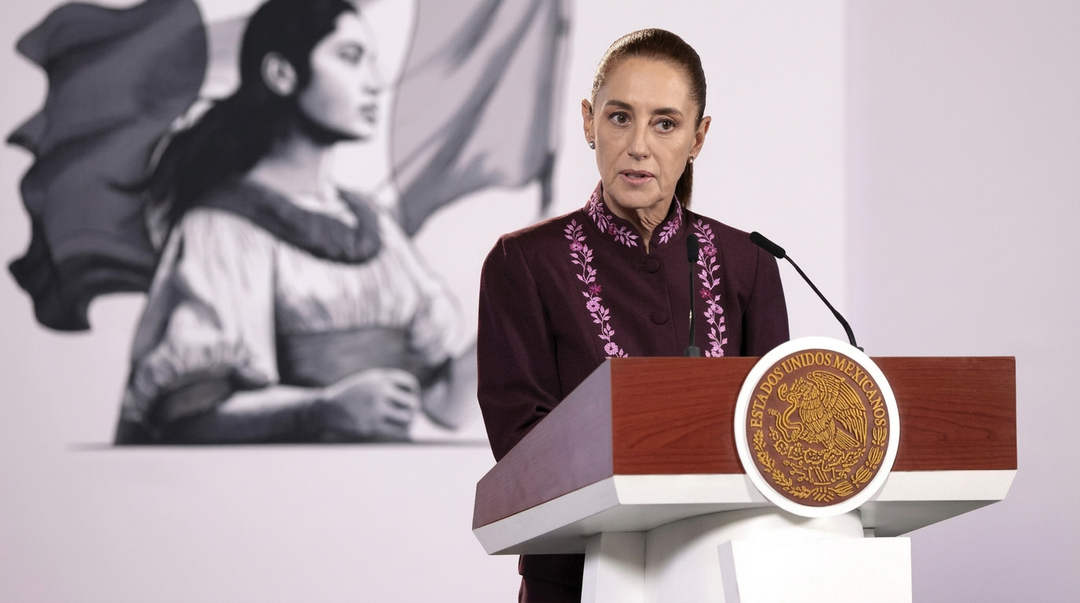
At her April 8 morning press conference, President Claudia Sheinbaum addressed the Esquivel incident and stated there was no obstacle to documenting the area.
"They should not have asked him to delete the video. Any video can be published. There is freedom of expression in Mexico," the president said when questioned about the recording, which had been distributed through a YouTube channel.
The senator's experience, captured after that public assurance, sits directly at odds with the official line. Martínez framed her visit as routine legislative oversight rather than provocation. The exchange she recorded shows the agent insisting on a permit issued by the construction company contracted to build the line, not by a public authority.
The Tren Maya National Guard role and the oversight question
The federal government has assigned the National Guard a significant role in protecting and operating segments of the Tren Maya. The corps was created as a civilian security force but is largely staffed by personnel of military origin, and its deployment around the project has placed armed federal agents at the perimeter of works funded with public money.
That arrangement has now produced two filmed encounters in quick succession at the same point of the line. In both, the person filming was either asked to stop, asked to delete the recording, or required to show a permit issued by the construction firm. Neither person was obstructing the work itself.
Neither the National Guard nor the federal agency responsible for the Tren Maya has publicly clarified what rules govern filming on the right-of-way, who is authorized to grant access, or how those rules align with the president's stated position that recording is allowed.
For now, the senator's footage adds new pressure on a project already facing scrutiny over its environmental impact, cost overruns, and a sequence of technical concerns about portions of the elevated viaduct in Quintana Roo. The next test will be whether the federal government publishes a written protocol on access, or whether the gap between official statements and on-site practice continues.
Should lawmakers and citizens be required to ask the construction company for permission to film a federally funded public works site? Join the conversation and share your perspective with us on Instagram and Facebook at @thetulumtimes.

The Tulum Times · Newsletter
The story continues in your inbox.
Essential Tulum news and local insight, a few times a week. Free.
No spam. Unsubscribe anytime.
Tulum Development, Permits, and Construction Watch
Reporting on permits, construction, regulation, and major development decisions shaping Tulum’s urban growth and investment climate.

“The best journalists reporting from paradise, highlighting the heroes that keep Tulum the most beautiful place in the world! THANK YOU!”