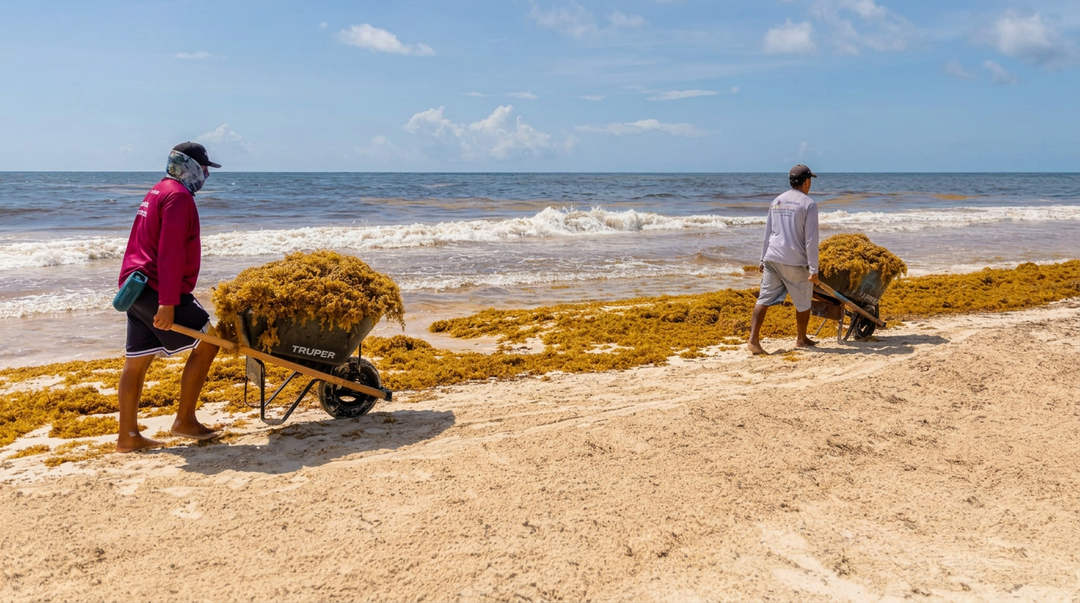

The sargassum Quintana Roo 2026 season arrived three months ahead of schedule, and the Mexican Caribbean has not recovered since. At least 70 beaches across the state are now operating under a red alert designation, state authorities acknowledge, as the volume of seaweed accumulation overwhelms barriers, cleanup fleets, and local improvisation in equal measure.
The numbers define the scale of the problem. Around 16,000 tons of sargassum have already been removed from coastlines across the state. Official projections, however, estimate that the full season could generate between 120,000 and 130,000 tons, a figure that would make 2026 one of the most severe on record. Monitoring data indicates a 25 to 30 percent increase over 2025 levels, a year that was itself considered above average.
The early arrival, detected as far back as January when accumulations at this scale are historically uncommon, disrupted the seasonal management calendar that authorities and hotel operators had planned. Cleanup crews, barrier systems, and vessel deployments were designed around a spring onset. The algae did not follow that schedule.
A Coastline Under Pressure
The concentration of impact falls on the destinations that drive the region's economy. Cancún, Playa del Carmen, Tulum, Isla Mujeres, and Puerto Morelos are all reporting significant beach coverage. The problem extends further south, with critical conditions flagged in Othón P. Blanco and Mahahual, communities with fewer resources and less institutional backup than the northern tourist corridor.
In Mahahual, the situation has gone beyond the capacity of official barriers. Local fishermen and business operators have responded with improvised defenses: plastic bottles strung together into makeshift barriers in an attempt to slow the algae's advance toward the shoreline. The image illustrates something the official deployment figures do not fully capture. Formal capacity has been reached, and communities are now filling the gap with ingenuity rather than infrastructure.
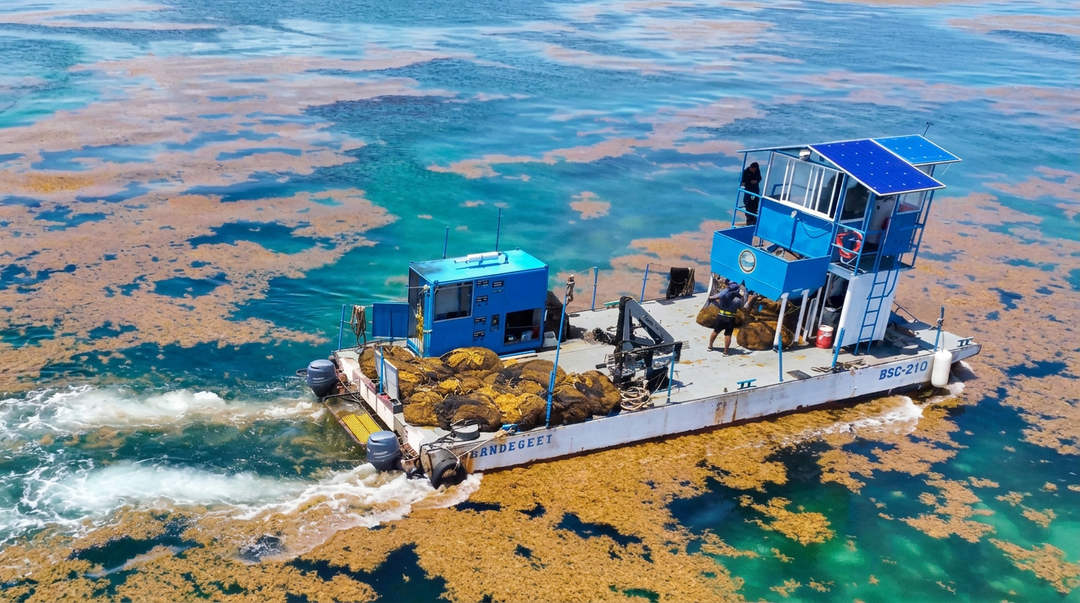
The operational response from the federal government includes 11 coastal vessels, one oceanic unit, 18 smaller craft, and four amphibious sargassum collectors deployed by the Secretaría de Marina. Additional vessels have been integrated to expand interception operations in open water, where stopping the algae before it reaches shore is the most effective strategy. Whether that expanded fleet will be sufficient against a season projected to be 25 to 30 percent larger than last year remains to be seen.
The FIFA 2026 Factor
The timing compounds the pressure. The FIFA World Cup 2026, co-hosted by Mexico, the United States, and Canada, will bring an extraordinary volume of international visitors to the country beginning this summer. Cancún and the Riviera Maya are positioned as primary beneficiary destinations, where beachfront hotels, tourism infrastructure, and regional promotion have all factored in World Cup traffic as a commercial opportunity.
That opportunity now runs directly into the sargassum season's most intense phase. Beaches saturated with decomposing algae, which emit hydrogen sulfide gas as they break down and produce a characteristic odor, are not the promotional image the region needs to capitalize on international tourism. The contrast between what gets advertised and what visitors are likely to encounter creates a credibility risk that goes beyond this single season.

Quintana Roo's tourism-dependent economy has no structural alternative during these months. Hotel occupancy rates, transportation demand, and the service sector across the coast are all calibrated around peak beach season. A severe sargassum year does not simply reduce visitor satisfaction. It carries genuine economic consequences for communities whose livelihoods depend directly on the beach product.
The Limits of Current Strategy
The principal tool in the state's arsenal remains reactive: deploy vessels, install barriers, collect what arrives, and repeat. That approach has a ceiling, and this year's volumes appear to be testing it.
Barriers are designed for manageable accumulations. When the volume exceeds a certain threshold, as it clearly has in Mahahual and several sections of the northern corridor, the barriers become overwhelmed and the algae simply flows around or over them. The 16,000 tons already removed represent a significant logistical effort, but they account for a fraction of what projections suggest is still incoming.
Officials have acknowledged the limits of containment and have introduced longer-term proposals into the public conversation. One recurring framework involves converting sargassum into productive input: construction materials, biofertilizers, and other industrial applications that would transform the algae from a liability into a commodity. Pilot programs and private partnerships have explored these pathways, and the logic is economically sound in principle.
The execution, however, remains nascent. Processing infrastructure does not exist at the scale the seasonal volumes would require. Supply chains for collection, transport, and transformation have not been built. The proposal is being developed against a backdrop where thousands of tons are already accumulating on beaches and the removal capacity remains below what projections demand.
An Annual Reckoning, Accelerated
Sargassum has been a recurring challenge for the Mexican Caribbean since the Atlantic bloom began intensifying around 2011. The annual arrival disrupts tourism, strains government resources, and generates repeated cycles of emergency response that have yet to produce a durable structural solution.
What is different about 2026 is the convergence of factors. The season is arriving earlier, in larger volume, and against a moment of heightened international tourism exposure. The red alert designations across 70 beaches are not a temporary measure; they reflect conditions that are likely to intensify through the peak summer months before any meaningful reduction.
Quintana Roo's coastline is the economic foundation of one of Mexico's most visited states. Protecting it requires a response architecture that matches the scale of what is now arriving. Improvised plastic-bottle barriers in Mahahual are not that architecture. Neither, at this point, is the existing deployment of vessels and collection teams, not when projections indicate that what has already been removed represents roughly 12 percent of the total expected this year.
The region has time to recalibrate before the FIFA 2026 visitor wave arrives. How that time is used will determine whether the World Cup becomes a net gain for the Caribbean coast or a moment when the gap between what Quintana Roo promises and what it delivers becomes visible to a global audience.
Join the conversation: How should Quintana Roo evolve its sargassum containment strategy before the FIFA 2026 arrival? Share your thoughts with the community on Instagram and Facebook at @thetulumtimes.
Contact the Editor: editorial@tulumtimes.com

The Tulum Times · Newsletter
The story continues in your inbox.
Essential Tulum news and local insight, a few times a week. Free.
No spam. Unsubscribe anytime.
Tulum Sargassum Updates and Beach Conditions
Live seaweed conditions, cleanup updates, forecasts, and practical beach planning across Tulum and the Riviera Maya.

“The best journalists reporting from paradise, highlighting the heroes that keep Tulum the most beautiful place in the world! THANK YOU!”