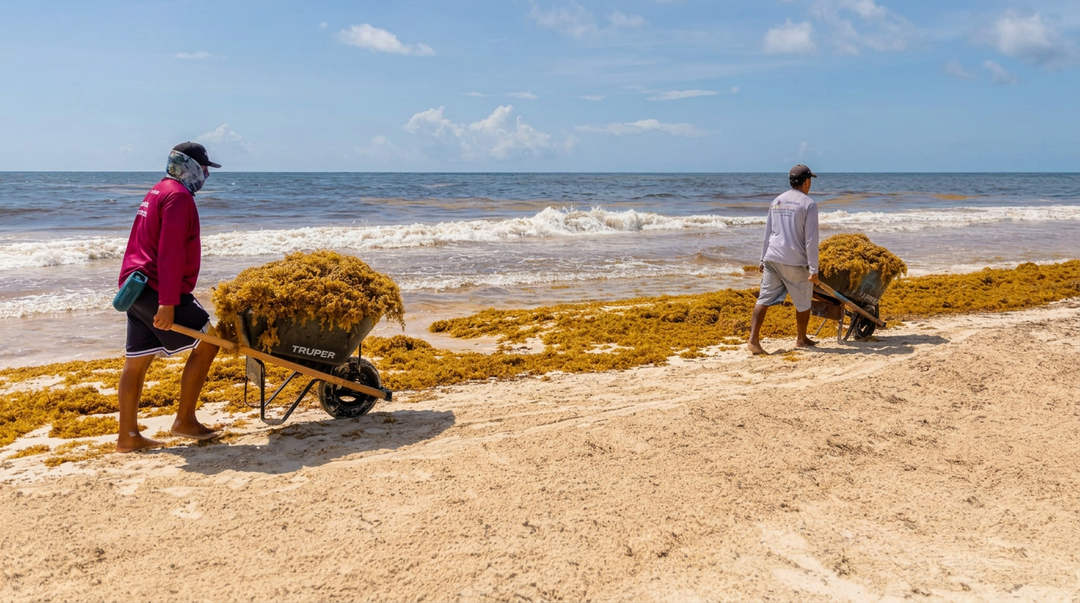

Mexico's Navy has positioned 13 ships in open water along the Mexican Caribbean to intercept sargassum before the seaweed reaches the shore, deploying the country's most visible federal response yet to a phenomenon that officials now project will surpass last year's already damaging season by 30 percent.
The operation, led by the Secretariat of the Navy (Semar), currently includes 191 naval personnel distributed across five Quintana Roo municipalities: Playa del Carmen, Tulum, Othon P. Blanco, Puerto Morelos, and Cozumel. Since the season began, the Navy has collected more than 29,000 tons of sargassum. The goal, according to Semar, is to reduce the environmental, tourism, and economic damage along the coastline of Quintana Roo, which remains the most affected state in the country.
The scale of the intervention reflects how much pressure the Mexican Caribbean is now under. Forecasts from the Centro de Monitoreo de Sargazo de Quintana Roo project that up to 130,000 tons of sargassum could wash ashore this year. In 2025, the figure was approximately 96,000 tons. The center's director, Esteban Amaro, has identified the central and southern zones of the state as the areas most likely to bear the worst of the incoming volume.
A Strategy That Starts at Sea
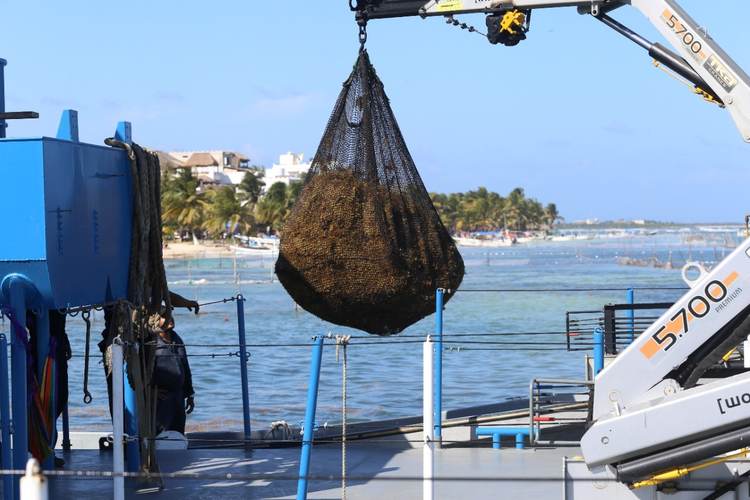
Semar's containment approach is designed to reduce the load before the seaweed ever makes landfall. The centerpiece is the Buque Sargacero Oceanico, an oceanic sargassum vessel that operates in deep water using conveyor belts to channel the collected algae into a holding hopper with a capacity of up to 250 tons per load. Eleven additional coastal sargassum vessels work in shallower zones along key interception points.

On the beaches themselves, Emergency Beach Collection Groups (GREP) handle the sargassum that does get through. Some 7,500 meters of containment barriers have been installed across the Mexican Caribbean, covering priority zones in Puerto Morelos, Playa del Carmen, Tulum, and Mahahual.
This combined operation is part of the National Sargassum Strategy, which Semar is implementing alongside the Quintana Roo state government and the Secretariat of Environment and Natural Resources (Semarnat).
Playa del Carmen Already on Red Alert
The urgency of the response is visible in Playa del Carmen, where authorities have already placed the destination on sargassum red alert following a surge in recent days. Of the 191 naval personnel deployed across the state, 110 are concentrated in Playa del Carmen alone. Tulum has 18 elements assigned. Mahahual, despite its smaller size, has 63.
Red alert classification signals that sargassum arrivals are heavy enough to create significant operational challenges on the beach and to affect the visitor experience. For a destination of Playa del Carmen's scale, the designation carries economic weight.

What Is Driving the Increase
Satellite imagery has confirmed the presence of the Great Atlantic Sargassum Belt in the Atlantic Ocean. This mass extends from the waters off the African coast toward the Lesser Antilles and is tracking directly toward the Mexican Caribbean. Its trajectory is consistent with the projections being made by the Quintana Roo monitoring center.
The belt's scale explains why 2026 is expected to be notably worse than 2025. The conditions that caused last year's elevated levels are not receding. They are compounding.
Cozumel Under Study
Cozumel has emerged as a point of concern, with discussions underway about the installation of additional barriers around the island. Technical experts have cautioned that further studies are needed first to determine whether the proposed barriers could hold up against the volume of sargassum expected this season. No barriers have been confirmed for Cozumel yet.
That caution reflects a broader challenge: the infrastructure required to manage sargassum at the scale being projected is still being tested and expanded in real time, even as the season accelerates.
The 29,000 tons already collected as of early May represent a significant operational achievement. Whether that pace can hold as the full weight of the 2026 belt arrives is the central question for every municipality along the Quintana Roo coastline.
Are your travel or business plans for the Quintana Roo coast being shaped by the sargassum outlook this season? Join the conversation and share your perspective with us on Instagram and Facebook at @thetulumtimes.

The Tulum Times · Newsletter
The story continues in your inbox.
Essential Tulum news and local insight, a few times a week. Free.
No spam. Unsubscribe anytime.
Tulum Sargassum Updates and Beach Conditions
Live seaweed conditions, cleanup updates, forecasts, and practical beach planning across Tulum and the Riviera Maya.

“The best journalists reporting from paradise, highlighting the heroes that keep Tulum the most beautiful place in the world! THANK YOU!”