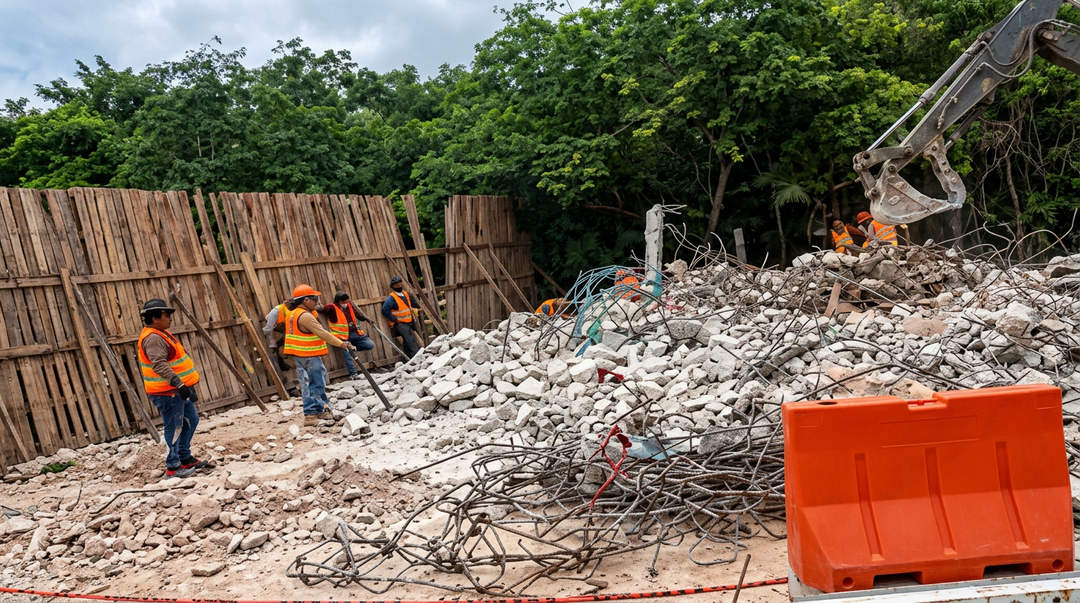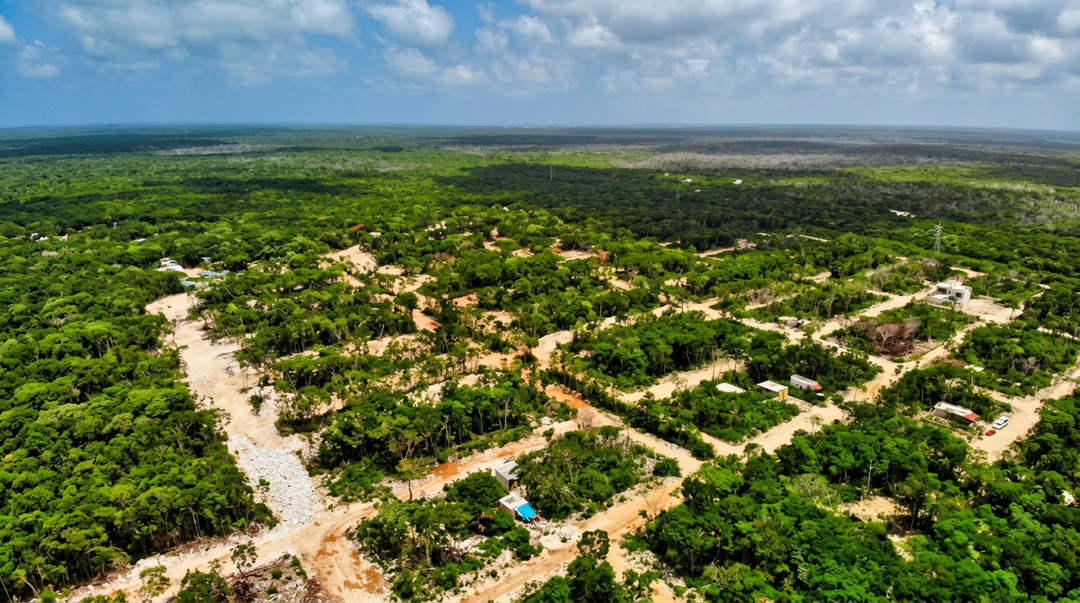

The wall that residents spent two years demanding be torn down was never improvised. Federal records place its construction in the first stage of the Jaguar park, tendered by Sedatu in June 2022, a month before the park legally existed.
Tulum beach access has a paper trail. Decrees, tenders, canceled titles, closure seals and committee votes, most of it published in the Diario Oficial de la Federación or in the bulletins of the agencies that issued it.
Read in order, those documents answer a question the argument on the ground never settles. The sand was always public. The crossing to it was always somebody's to grant.
The park was decreed on July 27, 2022, and the perimeter came first
The decree published that day declared an área de protección de flora y fauna over the zone known as Jaguar, in the municipality of Tulum, covering 2,249 hectares, 71 areas, and 4.30 centiares, split into a core zone of 1,967 hectares and a buffer zone of 282 hectares. Conanp announced it as the country's 185th federal protected area.

Two obligations sit inside that text. Owners and holders of rights in land within the polygon remain bound by the LGEEPA and the decree itself. And Semarnat, through Conanp, was required to register the area in the corresponding public property registries, the National Agrarian Registry, and the national registry of protected areas within 180 days.
The construction sequence ran ahead of the paperwork. Reporting from the week of the decree noted that the first works expected to begin in August were the perimeter wall enclosing the more than 2,000 hectares, for which Sedatu had issued a call for bids in June.
A wall is both a conservation and a control instrument. Which one it turns out to be depends entirely on how many openings are cut into it, and by whom.
A national park written for a municipality that did not exist
The older layer is stranger. Parque Nacional Tulum was created by decree in 1981, covering 664 hectares, 32 areas, and 13 centiares, and the decree designates that surface in the municipality of Felipe Carrillo Puerto. Tulum would not become a municipality until 2008.

Conanp reproduced that original wording again in January 2024, when the Diario Oficial published the summary of the park's management program, more than four decades after the land was set aside.
The gap matters because the park was never fully federal ground to begin with. Only part of the 664 hectares belonged to the nation when it was decreed, the outlet Pie de Página reported, which left it exposed to speculation from the first day. A constitutional controversy in 2008 and a ruling in 2011 confirmed Conanp as legitimate owner and possessor. Land inside the polygon kept selling regardless, some parcels carrying two, three and four titles at once.
The twenty meters that no concession converts into property
Everything above happened on land. The beach itself follows a separate rule that has not changed.
The Ley General de Bienes Nacionales classifies maritime beaches and the zona federal marítimo terrestre, the twenty-meter strip of firm ground above the high tide line, as common-use property of the nation, inalienable and impossible to acquire through long possession. Semarnat may grant a concession for that strip. A concession is temporary permission to use federal property and does not transfer ownership, a distinction that the legal site Paréntesis Legal argued was systematically ignored for decades.
Two documents show how loosely the strip was governed. Semarnat published NOM-146-SEMARNAT-2017 in December 2017 to establish the official method for delimiting and mapping the federal zone, meaning there had been no single official method for the boundary before then. And Profepa issued a formal recommendation to coastal states, reminding them that granting concessions in the federal zone is the exclusive responsibility of Semarnat and that municipal governments must stop issuing such documents.
Profepa also announced a review and regularization program for the federal zone in Tulum and Bahía de Akumal, promising a diagnosis of concessions and authorizations within a month. The diagnosis was never published in a consolidated public form. Semarnat's focalized transparency portal posts concession titles, extensions, and modifications by state, which leaves any count of who currently holds federal zone concessions along the Tulum to Boca Paila road to be assembled title by title.
Forty-nine years to answer whether the ejido reached the sea
The land conflict behind the hotels has a documented origin and end, with half a century in between.
In 1973, the federal government created the Nuevo Centro de Población Ejidal José María Pino Suárez, settling families from Tenosique, Tabasco. According to Proceso, which reviewed the case file in February 2024, the grant affected 105 hectares then held by Antonio González Avilés, adjacent to the Caribbean federal maritime zone, plus ten hectares held by Felipe Hernández Colli. From 1974 onward, the magazine reported that alterations to the land registry by authorities affected a large portion of ejido land along the coast, and that land that legally could not be sold to private parties was acquired fraudulently.
In March 2022, the Procuraduría Agraria stated publicly that the Pino Suárez ejido does not extend to the sea, that titles and certificates issued for that zone therefore lack validity, and that the National Agrarian Registry's representative in Quintana Roo had been removed for issuing them.
The cancellation is the most concrete number in this entire history. One survey plan. One assembly record from 2006. One thousand ninety-two parcel certificates. Seven hundred six property titles.
Attorney Víctor Salaya, for the private parties, told La Jornada Maya that the ruling clarifies where the ejido ends and recognizes the coastal lots as private property, and described the previous uncertainty it had produced. Buyers who arrived during the boom purchased in good faith from ejidatarios whose titles were worth nothing.
Seals, moving trucks and the decade the coast changed hands
Enforcement is documented in bursts, and each burst reads like a snapshot of what the rules were worth that year.
Profepa closed 14 hotel installations within Parque Nacional Tulum in July 2008 after inspections found they had been built without environmental impact authorization, without land-use change permits on forest land, and without any federal maritime zone concession. In December 2022, the agency sealed a hotel under construction at Playa Santa Fe, inside the park and under 800 meters from the ruins, the day after Sedatu announced a reordering plan for the beach zone.
Between those two dates came June 2016. Around 300 tourists were removed from beachside lodgings under an order from a civil court in Playa del Carmen, amid a dispute that is already more than two decades old. Hotel owner Alonso Ventre told La Jornada that men arrived at four in the morning with twenty-five moving trucks, carrying machetes, pipes, sticks and stones, that guests and furniture were taken out, and that those who resisted were met with tear gas. He said no eviction order was shown and no notice was given.
Press coverage has long framed that conflict as coastal ejidatarios against two Monterrey business groups identified as Schiavon Magaña and Garza Ponce, including allegations of fraudulent titles that those parties have disputed in court, where they maintain they bought the coastal lots legitimately. No criminal convictions against them have been reported, and the 2022 agrarian decision favored the private ownership side of the boundary dispute.
Tulum beach access priced between 105 and 500 pesos
The federal gate arrived last and moved fastest.
The administration of the Jaguar park was transferred in December 2024 to Grupo Mundo Maya, the state company operating under Sedena, as part of a project whose federal cost has been reported to exceed 2.7 billion pesos. On December 5, 2024, workers and shopkeepers from the plazas at the entrance to the ruins blocked Federal Highway 307, demanding restoration of normal access after Sedena, INAH and Conanp rerouted visitors through the entrance of the former naval base.
Proceso reported charges of 105 to more than 500 pesos to reach coastal stretches that had been free, and the closure of artisan shops around the ruins within nine months. Occupancy followed. Against a 2024 annual average near 74 percent, Animal Político reported 66.7 percent in September 2025 and 49.2 percent for the week of September 27 to October 3, down 17.5 percent year on year for the month.
Mayor Diego Castañón Trejo denied that beach entry fees existed and called the accusations a smear campaign, while separately accusing the military administration of blocking one access and failing to deliver an agreed residents' credential scheme. Protesters argued that the charges contradicted Article 27 of the Constitution and federal law on the maritime zone.
Ten openings cut into the wall, and a registry still unpublished
The reversal is documented too, and it is recent.
On November 12, 2025, federal tourism secretary Josefina Rodríguez Zamora and Governor Mara Lezama opened two free-access points inside the park, including the traditional entrance residents had been demanding, and highlighted the public beaches of El Pueblo and Conchitas. Nine days later, Profeco closed four hotels and five supermarkets in Tulum for overpricing after finding a plain hamburger priced at 400 pesos inside the park.
On July 17, 2026, President Claudia Sheinbaum presented Plan Tulum Renace in Tulum. Entry to the park became free; admission to the archaeological zone and protected area dropped to 80 pesos for Mexican visitors and 265 pesos for foreign visitors; and the only charge left inside is 20 pesos for the optional electric shuttle. Ten public beach accesses have been opened, and the perimeter wall at the traditional entrance is to be replaced with an arch.
The legislative track has not closed. On October 1, 2025, the Chamber of Deputies approved by unanimity, 465 votes in favor, reforms to the Ley General de Bienes Nacionales and the LGEEPA making beach access free, gratuitous and permanent, banning fees outside narrow exceptions, and ordering Semarnat and coastal municipalities to build a Registro Nacional de Accesos a Playas inscribed in cadastres and property registries so that no later sale can erase an entrance. The Senate tourism committee, chaired by Quintana Roo senator Eugenio Segura, approved the minuta on December 9, 2025.
What the public record still does not show
Three gaps remain, each a document that has not been published.
- The decree from the 2025 reform has not been confirmed as published in the Diario Oficial. Until it is, the 180-day clock for Semarnat to adjust its regulations has not begun.
- The national registry of beach accesses does not exist yet. Every access opened in Tulum since November 2025 is an administrative decision, reversible by the administration that made it.
- There is no consolidated public list of who currently holds federal maritime zone concessions along the Tulum coast, and the regularization diagnosis Profepa promised for Tulum and Akumal was never released as one.
Until those three exist on paper, the openings in the wall are exactly as durable as the goodwill of whoever administers them, which is the same arrangement this coast has been living under since 1973.
Which document would you most want to see published, the beach access registry or the concession list for the Tulum coast? Join the conversation and share your perspective with us on Instagram and Facebook at @thetulumtimes.

The Tulum Times · Newsletter
The story continues in your inbox.
Essential Tulum news and local insight, a few times a week. Free.
No spam. Unsubscribe anytime.
Tulum Development, Permits, and Construction Watch
Reporting on permits, construction, regulation, and major development decisions shaping Tulum’s urban growth and investment climate.

“The best journalists reporting from paradise, highlighting the heroes that keep Tulum the most beautiful place in the world! THANK YOU!”