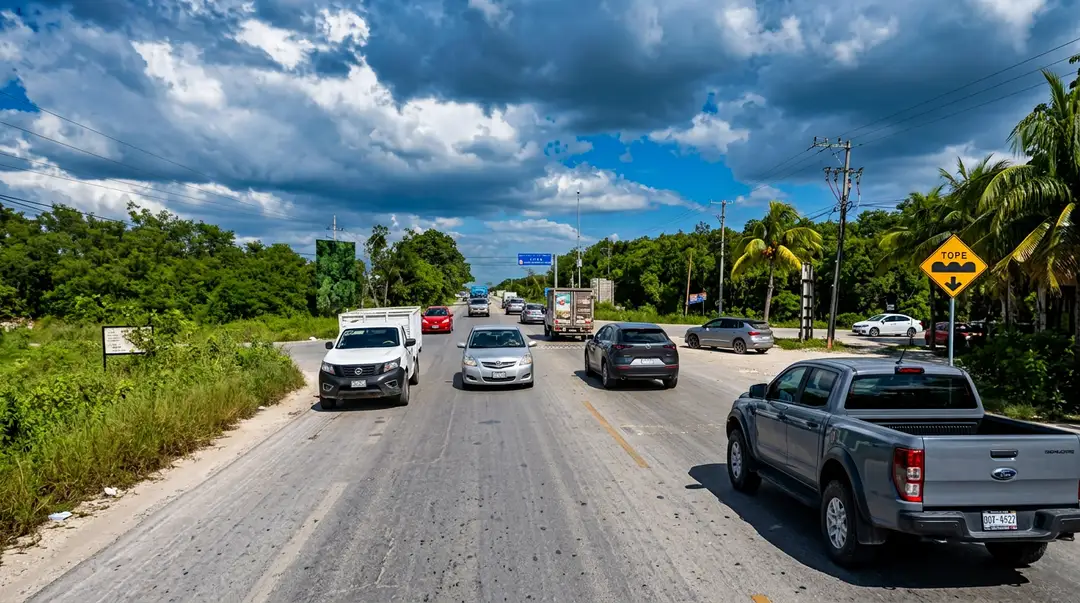
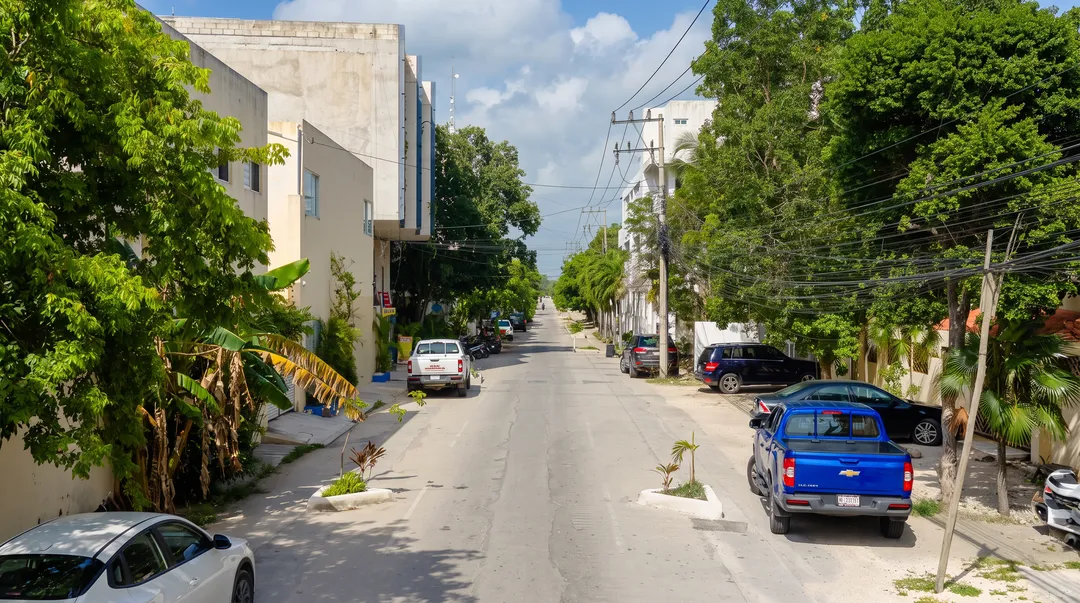
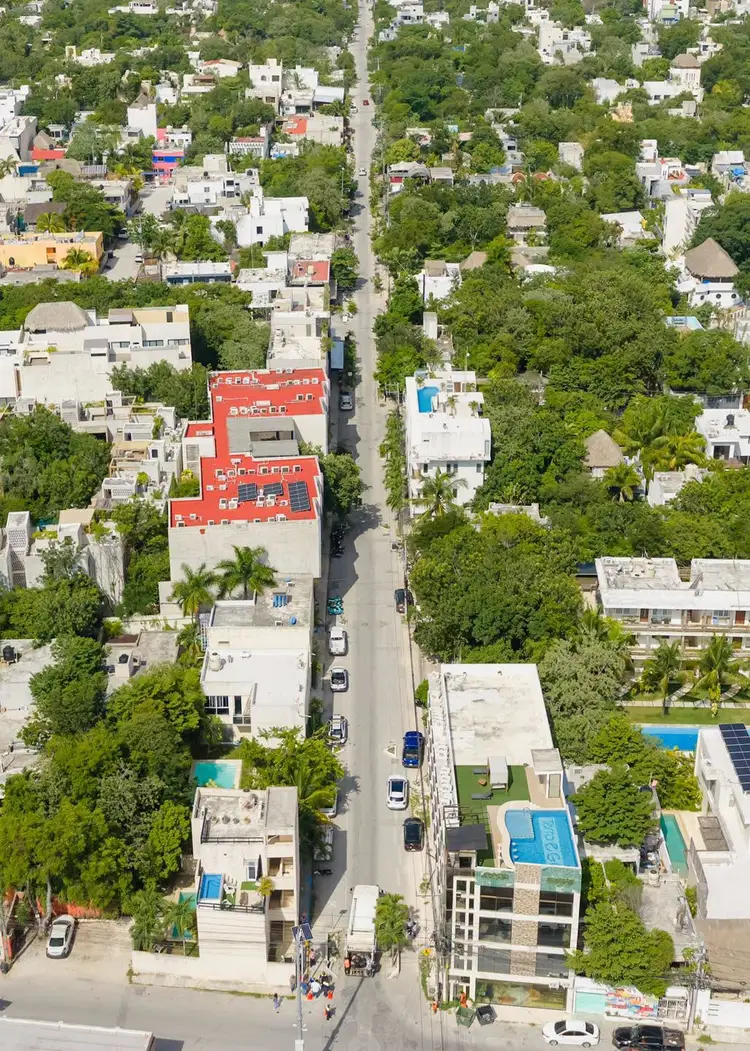
600 meters of Calle 7 have been under construction since early 2025. This month, the municipal government said crews are laying curbs and sidewalks along it, work it described as making the street safer to walk.
The announcement arrives at the end of a sequence, not the start of one. Everyone who runs a business on that stretch has already lived through the planters, the single lane, the excavation, and the silence that followed each of them.
What is being poured now is the first piece of infrastructure on Calle 7 that residents were told about in advance.
The planters came first, and the street lost a lane
The municipal urban development office installed large planters along both sides of Calle 7, framed at the time as beautification and a step toward a more walkable street. The result ran the other way. With the planters in place, one lane of traffic remained, and pedestrians, bicycles, and cars were pushed into the same narrow channel.
Deliveries slowed. Access tightened. Some businesses closed. The Tulum Times reported at the time that merchants absorbed the disruption on the assumption it was temporary, the cost of an upgrade that would eventually arrive.
Calle 7 was not a minor address to disrupt. The stretch held more than 100 businesses, a concentration of restaurants, bars, and shops that had turned a residential grid street into the commercial spine of La Veleta and one of the few parts of Tulum where residents and visitors used the same sidewalk at the same hour.
A trench three meters deep ran the length of Calle 7 Tulum
Then the machinery came back. An excavation roughly three meters deep and more than a meter wide was opened along the full length of the street for drainage and utility work.
Customers parked several hundred meters away and walked dirt paths past mounds of earth, exposed cable, and open pits to reach whatever was still trading. Some businesses shut temporarily without knowing whether they would reopen. Others stayed open at a fraction of their previous traffic.
The work itself was not optional. Fernando Aznar Pavón, president of the Tulum College of Engineers, told this publication in September 2025 that close to 60 percent of Tulum's urban zone lacked functional sewage service, and that only two streets in the entire municipality were being equipped with lines at the time. Calle 7 was one of the streets finally getting them.
The patch that closed the trench is still there
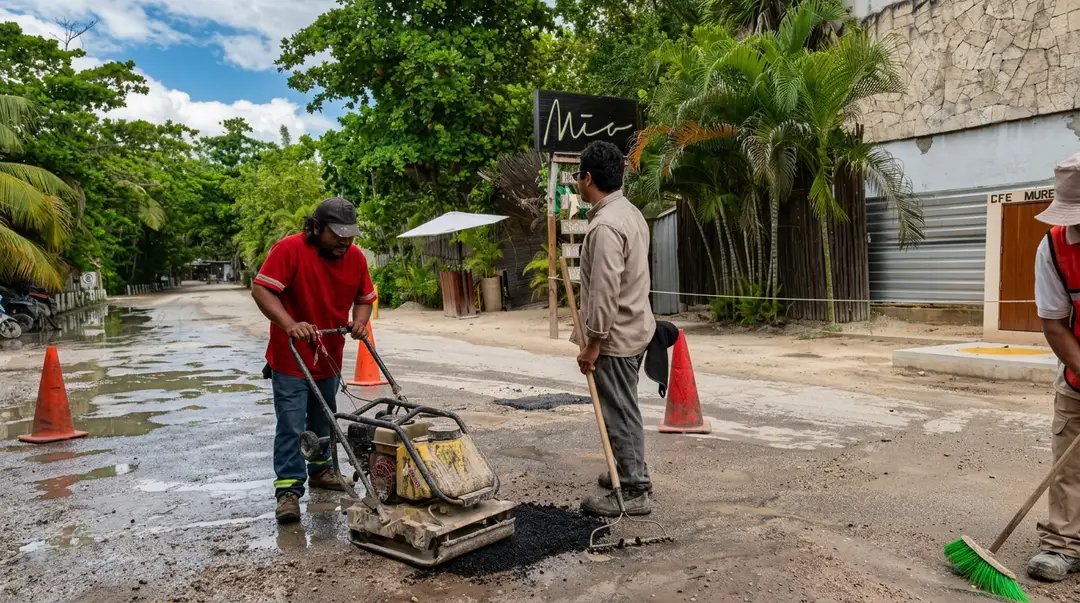
What went back on top of the excavation is the part of this story nobody has answered for. The asphalt used to close the trench was laid unevenly along the roadway centerline, leaving a raised, broken seam that runs the length of Calle 7.
Riders adapted rather than waited. Motorcycles and bicycles now travel hugging the edges of the street, sometimes within centimeters of parked cars and pedestrians, because taking the center means absorbing the seam through the frame and the spine. On a street where the sidewalk was already close to nonexistent, that pushes two-wheeled traffic into exactly the space the new walkways are meant to protect.
The Tulum Times described the resurfacing as poorly executed shortly after it was finished, and residents at the time called the street an obstacle course for cars, motorcycles, and bicycles alike. More than a year later, the seam has not been repaired. No municipal office has publicly explained who did the work, who signed off on it, or whether the contractor was required to return.
Merchants were never given a schedule
The complaint that outlasted the dust was not about the digging. It was about the absence of a date. Business owners along the corridor said they received no timeline, no phased plan, and no consistent point of contact at the municipality while their storefronts sat behind a trench.
A year earlier, residents had run into the same wall from a different direction. When neighbors raised concerns about the spread of bar seating, sound systems, and terraces encroaching into the roadway at night, attempts to get comment from Tulum's Dirección de Comercio went unanswered. Residents at that point described the sidewalks on Calle 7 as nearly nonexistent, which is part of why the current curb work feels like more than routine maintenance.
May's consultation put numbers on paper
On May 22, 2026, the Ayuntamiento opened opinion tables in La Veleta to present a redesign of the corridor. Víctor Hernández, director general of Municipal Planning, said the project stemmed from requests by merchants and residents themselves.
The design shown at those sessions specified walkways with a minimum width of 1.80 meters, ramps and adapted infrastructure for people with reduced mobility, marked zones for loading, unloading, and passenger pickup, and planters, seating, and street furniture along the route.
Mayor Diego Castañón Trejo led the groundbreaking for the curb and sidewalk phase on July 10, saying the administration wanted the street to look good, attract visitors, and provide conditions for people to walk and use the businesses along it. He said his government would be watching the project closely.
Ten kilometers per hour is the line that matters
One specification in the May design does more work than the rest: a single vehicle lane with a maximum speed of 10 kilometers per hour.
That is slower than a bicycle. Enforced, it turns Calle 7 into a shared surface where cars move at the pace of the people around them. Unenforced, it is a sign. Nothing published so far explains how the limit would be applied or whether raised crossings, narrowed entries, or other physical design elements will bear the weight that signage alone rarely can.
The design also says nothing about the surface that lane will run on. A 10-kilometer-per-hour corridor built over an uneven patch is a corridor where riders keep using the edges.
The pattern Calle 8 set two blocks away
La Veleta already has a case study in what happens when a street is improved without those questions being answered. After Calle 8 was resurfaced, residents told The Tulum Times that drivers began reaching speeds of around 70 kilometers per hour on the new smooth surface between the main avenue and Calle 7. The potholes that had been slowing traffic were gone, and nothing replaced them. Requests for speed bumps went unanswered.
The broader pattern is documented across the colonia. In October 2025, residents described a neighborhood where construction cranes never stop while drainage, lighting, and continuous sidewalks lag years behind the buildings. Calle 7 is the most visible street in that neighborhood, which makes the current work a test with an audience.
What the municipality still has not published
Neither the current announcement nor the July groundbreaking included a budget figure, the name of the company executing the work, the number of blocks covered, or a target completion date.
The comparison is available in the same administration's own communications. When the first stage of the Tulum sports complex rehabilitation opened on August 4, the mayor gave a number: 90 days, and asked for patience. Calle 7 has been given no equivalent.
Nor has the municipality published what came out of the May opinion tables, or which of the proposals residents brought to them survived into the design now being built.
What can be measured once the concrete cures?
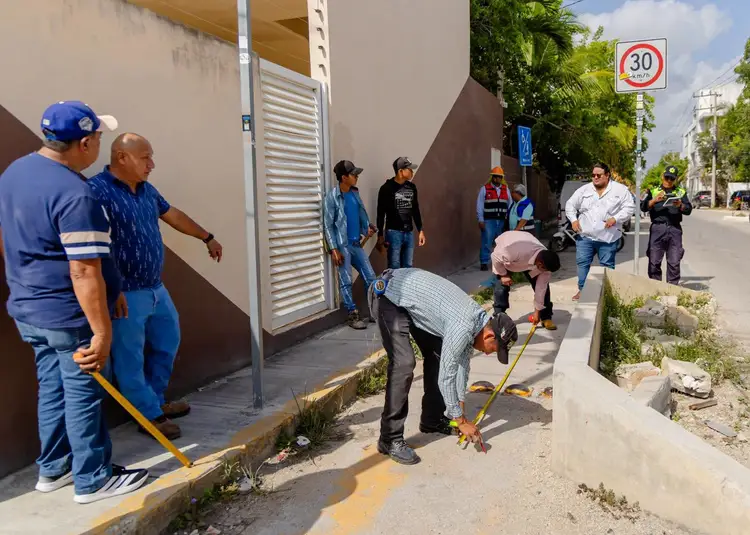
The first testable claim is the simplest one. The May design specified sidewalks of at least 1.80 meters. Whether the finished walkways on Calle 7 reach that width can be settled with a tape measure by the same merchants and residents who sat through the consultation.
The second question is the one the current work does not touch. The seam left behind by the trench is still in the middle of the street, and no phase announced so far includes repaving over it. Calle 7 can end this year with new curbs, new sidewalks, and a center lane that motorcycles and bicycles still refuse to use.
If you ride a motorcycle or bicycle on Calle 7, are you still going around the center of the street after the trench was patched? Join the conversation and share your perspective with us on Instagram and Facebook at @thetulumtimes .
This image was generated or enhanced using artificial intelligence to improve its quality.

The Tulum Times · Newsletter
The story continues in your inbox.
Essential Tulum news and local insight, a few times a week. Free.
No spam. Unsubscribe anytime.
Transportation in Tulum: Taxi, Bus, Transfers, and Mobility
Taxi fares, buses, transfers, road changes, mobility updates, and practical transport guidance for Tulum.

“The best journalists reporting from paradise, highlighting the heroes that keep Tulum the most beautiful place in the world! THANK YOU!”