

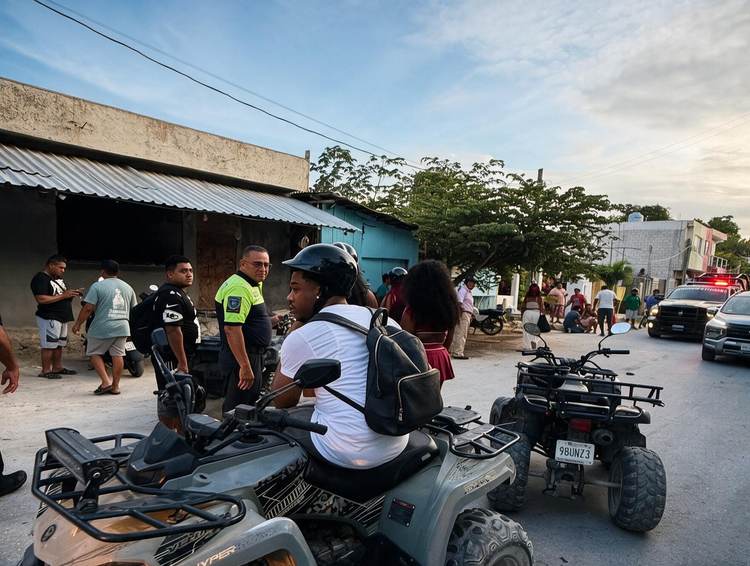
A woman five months pregnant was struck by a rented ATV on Mercurio Oriente Avenue on Sunday afternoon. ATVs in Tulum are not named once in the municipal traffic regulations.
She was hit before the approach to Cobá Avenue and stayed on the pavement with a probable right knee injury and severe abdominal pain, waiting with family members and witnesses who had stopped to help. Her husband was struck as well and came away with scrapes and superficial injuries.
Municipal Traffic Police arrived first and secured the scene. Mexican Red Cross paramedics immobilized her on a stretcher, Civil Protection joined the response, and at her family's request she was taken to Costamed Hospital so doctors could rule out complications for her and the baby. The pregnancy was not lost, though it came close, according to information gathered by The Tulum Times.
Two ATVs were involved. The driver identified as responsible, an American tourist riding alone, stayed at the scene and was placed at the disposal of the authorities. A second ATV carried another foreign visitor and a woman. Traffic authorities have not issued a determination of responsibility, and the driver's own account of the collision has not been made public.

Whatever that determination concludes, it will be written under a rulebook that does not know what an ATV is.
ATVs in Tulum have no legal definition
Article 4 of the Reglamento de Tránsito para el Municipio de Tulum lists the vehicles the municipality recognizes. A bicycle is two wheels moved by the rider. A tricycle is three wheels moved by the rider. A motorcycle is a motorized vehicle of two wheels, carrying one or two people. A motorized four-wheeled ATV matches none of the three.
That omission is not cosmetic. Chapter 10 of the regulation, articles 63 through 66, is where the helmet requirement lives. It is also where the municipality orders riders to travel in the direction of the lane, stay off sidewalks, keep out of the space between lanes, and ride with the lights on. Every one of those obligations is addressed to "conductores de bicicletas, triciclos y motocicletas." By the regulation's own definitions, the machine that hit a pregnant woman on Sunday is not one of the three.
The state framework is no more specific. The Reglamento de la Ley de Movilidad del Estado de Quintana Roo defines a motorcycle as a handlebar vehicle of two or more wheels, from 49 cubic centimeters up, that the rider leans into a curve to counter centrifugal force. An ATV does not lean. It is built precisely so it does not have to.

Article 70 hands visiting drivers two free passes
The regulation does contain one provision written specifically with visitors in mind. Article 70 creates a "boleta de infracción de cortesía," a courtesy citation applied exclusively to tourists who break the rules. It carries no cost. Its stated purpose is to point out the violation and encourage compliance. It can be issued up to two times to the same vehicle or the same driver before an actual fine applies, and it does not cover serious acts or omissions.
A visitor who rents an ATV in Tulum, then, can be stopped twice for speeding or riding against traffic and pay nothing either time.
What the rental contract covers and the city does not
The stricter rules governing ATVs in Tulum are currently private ones. Rental operators publish their own conditions, and they are more specific than anything in the municipal text: a valid driver's license for a car or a motorcycle, the rental contract carried at all times, helmets required, no riding on the beaches because of turtle nests, no entry into Sian Ka'an, and use restricted to the urban area rather than the federal highway toward Playa del Carmen, Cobá, or Cancún.
Those are commercial terms. A company can waive them, and the city cannot enforce them.
Municipal law does reach the rental business at one point. Article 29 states that no person or company that owns a vehicle may allow it to be driven by someone without a license authorizing it, and makes the owner responsible for the damages and infractions that follow. The regulation does not establish which license class authorizes an ATV, because it never classifies the vehicle.
Since April 2025, the Quintana Roo Mobility Institute has issued a provisional license for foreign tourists, valid 30 to 120 days for 328 pesos, requiring proof of legal stay and a driving certificate from an institution the institute recognizes. It was designed around rental cars.

Excessive engine noise already carries a fine
Here the common complaint runs into a rule that already exists. Article 38 prohibits producing excessive or annoying noise with a vehicle's stereo, horn, or engine. It separately prohibits modified horns and mufflers, exhaust valves, and similar devices. It prohibits unnecessary noise from a vehicle that lacks a functioning muffler. Each carries a fine of five days of minimum wage.
Speed is covered too. Article 37 sets 50 kilometers per hour on primary roads where no sign says otherwise, 40 on local streets, and 20 in school, pedestrian, and hospital zones, and requires every driver to travel in the direction the road indicates. Those duties are addressed to "los conductores" generally, which is the strongest argument that ATVs are not lawless in Tulum. Speeding and riding the wrong way are already violations, whatever the machine is called.
What the municipality has not published is how often any of it is enforced against ATVs, or how many are circulating. There is no public municipal registry of ATV incidents.
La Veleta, February 17
On that morning, two tourists were injured when the ATV they were riding, an Italika of 190 cubic centimeters, lost control on Avenida 5 shortly before Calle 7 Sur Poniente and rolled onto a pile of stones. Traffic officers attributed the crash to immoderate speed.
In September 2025, two foreign tourists were hurt on the Tulum to Boca Paila road near the Azulik hotel after losing control of an ATV. Both were taken to Costamed. Investigators listed excess speed or loss of control as the lines of inquiry.
Three incidents in eleven months is not a trend, and this publication will not present it as one. It is, however, the same vehicle, the same visitor profile, and the same absence of a definition every time.
A definition would cost less than a ban
Prohibiting ATVs outright is one available answer, and it is the one residents raise most often. It is also the heaviest. It would close a rental sector that employs local operators, and it would do so before the municipality has ever established what the vehicle legally is or produced a single number on how much harm it causes.
The cheaper move sits in Article 4. Adding a definition for a motorized four-wheeled vehicle would drag the ATV into Chapter 10, where the helmet requirement and the direction-of-travel rule already sit, and would let the municipality say which license class covers it. Article 72 could be extended so that rented vehicles carry liability insurance, which today only public transport must hold. Article 70 could be narrowed so that courtesy citations stop applying to violations that put other people in a hospital.
None of that requires a new law. It requires the municipality to name a vehicle it has been renting to visitors for years.
For now, Municipal Traffic Police hold the file on Sunday's collision, and no determination of responsibility has been issued. The rental company that supplied the ATV has not been identified publicly and has made no statement. Neither has the Ayuntamiento. When the determination arrives, it will be applied under a regulation in which the vehicle involved does not appear.
Should Tulum define and regulate ATVs, or keep renting them under rules written for two wheels? Join the conversation and share your perspective with us on Instagram and Facebook at @thetulumtimes.
This image was generated or enhanced using artificial intelligence to improve its quality.

The Tulum Times · Newsletter
The story continues in your inbox.
Essential Tulum news and local insight, a few times a week. Free.
No spam. Unsubscribe anytime.
Transportation in Tulum: Taxi, Bus, Transfers, and Mobility
Taxi fares, buses, transfers, road changes, mobility updates, and practical transport guidance for Tulum.

“The best journalists reporting from paradise, highlighting the heroes that keep Tulum the most beautiful place in the world! THANK YOU!”