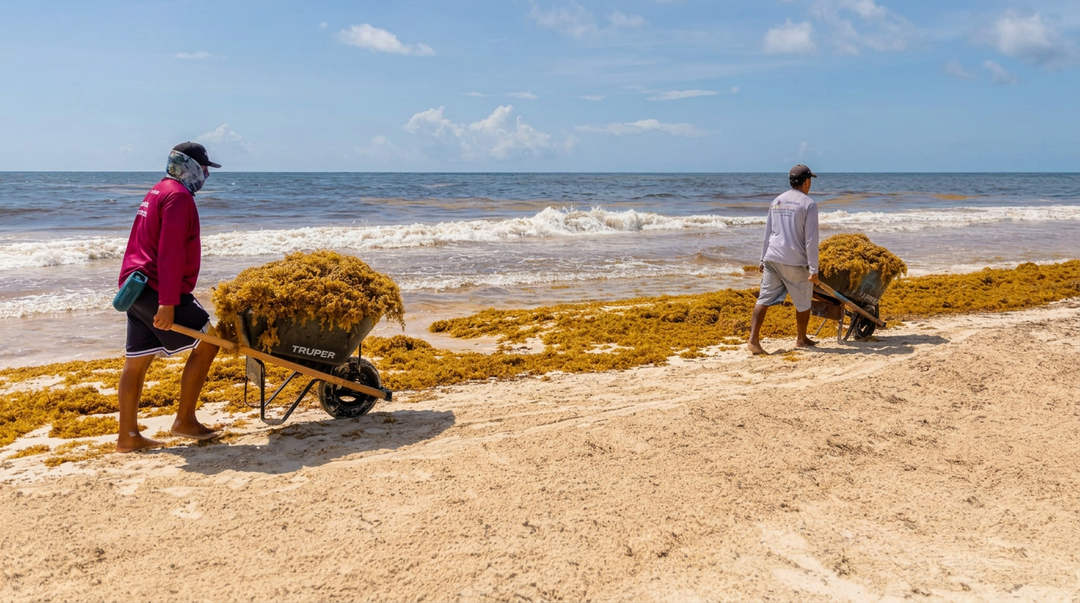

Tulum's municipal government has added nine pieces of specialized machinery to its sargassum response operation after collecting 2,458 tons of seaweed from the municipality's beaches in 2026, a figure that nearly doubles the 1,378 tons removed during the same period last year.
The equipment delivery signals a notable escalation in the city's cleanup effort at a moment when sargassum arrivals across the Mexican Caribbean are running well above seasonal norms. For a destination where beach quality directly shapes tourism revenue, the scale of this year's accumulation is difficult to absorb with existing resources alone.
What the new equipment adds to beach operations
According to David Buchanan, director general of the Federal Maritime Land Zone (Zofemat), the delivered machinery includes four motorcycles with trailers, two tractors fitted with sweepers, and three dump trucks. Together, the nine vehicles are designed to speed up every stage of the process: collection on the sand, transport away from the shoreline, and final disposal.
Buchanan noted that the trucks are particularly valuable in stretches of beach where temporary storage containers cannot be installed for logistical reasons. In those areas, crews previously had fewer options for moving large volumes quickly. The new dump trucks close that gap.

Municipal brigades are operating continuously throughout the peak arrival season. The permanent schedule reflects both the volume of incoming seaweed and the pressure to keep coastal zones functional for residents and visitors.

A season running well outside normal patterns
Municipal president Diego Castañón Trejo, who presided over the equipment handover, described 2026 as an atypical year with unusually high sargassum arrivals. He credited state government support for making the acquisition possible and acknowledged that the phenomenon extends well beyond Tulum's coastline.
"We are working very closely with the state government, and I am grateful for this support, which will allow us to work better on the sargassum issue. As everyone knows, we are experiencing an atypical year with very high seaweed arrivals," Castañón Trejo said.
The 2,458-ton figure registered through the current period in 2026 against 1,378 tons in the equivalent stretch of 2025 represents an increase of roughly 78 percent. Authorities attribute the difference to atypical accumulation patterns across multiple zones of the Mexican Caribbean, not to any single localized surge.

Sargassum pressure on Tulum's tourism economy
Sargassum has been a recurring challenge for Tulum and the broader Riviera Maya for over a decade, but volumes fluctuate significantly from year to year depending on Atlantic ocean conditions. When arrivals are heavy, the brown algae piles up on beaches faster than crews can clear it, affecting the visual appeal and, in extreme cases, the air quality of coastal areas through decomposition.

For Tulum specifically, the stakes are high. Beach tourism is the foundation of the local economy, and the destination competes directly with other Caribbean markets for travelers who can easily redirect bookings if conditions disappoint. A visible, well-organized cleanup operation is as much a communications asset as it is a logistical one.
The state government's decision to provide equipment rather than simply funding reflects a hands-on coordination model that Castañón Trejo has framed as a working partnership rather than a one-directional subsidy.

Operations will run through the peak of the season
Zofemat brigades will continue permanent cleanup operations through the months of highest sargassum arrival. Authorities have not announced a specific end date for the reinforced effort, as accumulation patterns depend on open-ocean conditions that cannot be predicted with precision weeks in advance.
What is clear is that the new machinery is already in service. With the 2026 total already well ahead of last year's pace and the peak of the Caribbean sargassum season still to run its course, the nine vehicles delivered this week are unlikely to sit idle.
Have you noticed the sargassum situation on Tulum's beaches this season, and do you think municipal resources are keeping up? Join the conversation and share your perspective with us on Instagram and Facebook at @thetulumtimes.

The Tulum Times · Newsletter
The story continues in your inbox.
Essential Tulum news and local insight, a few times a week. Free.
No spam. Unsubscribe anytime.
Tulum Sargassum Updates and Beach Conditions
Live seaweed conditions, cleanup updates, forecasts, and practical beach planning across Tulum and the Riviera Maya.

“The best journalists reporting from paradise, highlighting the heroes that keep Tulum the most beautiful place in the world! THANK YOU!”