
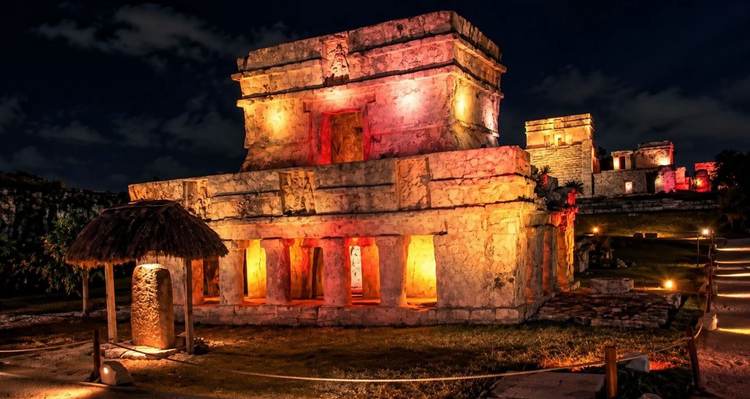
The lamps were disguised as rocks, so the site would not notice them. Then the sun went down over the wall, and the Tulum ruins at night turned into another city.
Forty people went in together. The walk took about 45 minutes; the starting hour moved through the year because it followed sunset rather than a clock, and the audio guide spoke to each visitor in the language they chose.
Nobody in Tulum talks about that circuit in the past tense on purpose. It simply stopped being sold, and the town has spent two years discovering how much of what it offered for free or almost free was actually the product. The numbers now say it out loud. Visits to the archaeological zone fell 33.1% in the first quarter of this year, and hotel occupancy went from 73.2% in January to 42.3% in September.
Forty people at a time
The design was the quiet part, and the best part. The Consejo Nacional de Arqueología prohibited excavation, so INAH ran the cables along the surface, set the fixtures on the ground, and shaped those beside the paths to resemble stones. A visitor walking the circuit stepped past the lighting without seeing it. What they saw was limestone holding color against a black sky.
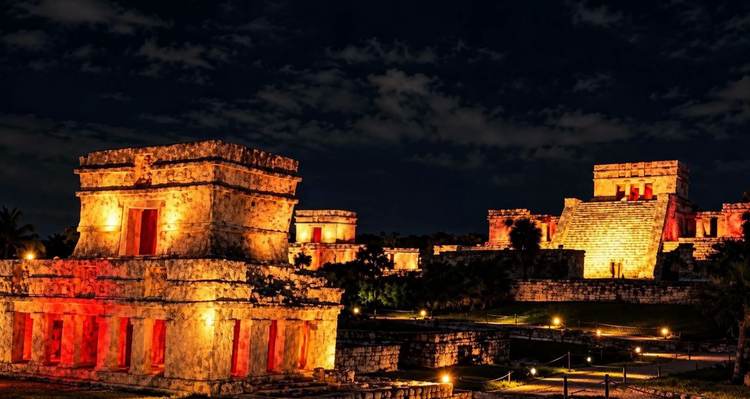
The route took in the whole heart of the walled city. El Castillo. The buildings of the inner precinct. The northern stretch with the Casa del Cenote, the Templo de los Frescos, the Casa del Halach Uinic, the Casa de las Columnas and the structures around the Casa del Chultún.
Agencies up the coast built evenings around it. A light dinner in Playa del Carmen first, then headsets in six languages and a bus down the 307. One operator ran the excursion on Tuesdays, from 5 p.m. until 11:30 at night.
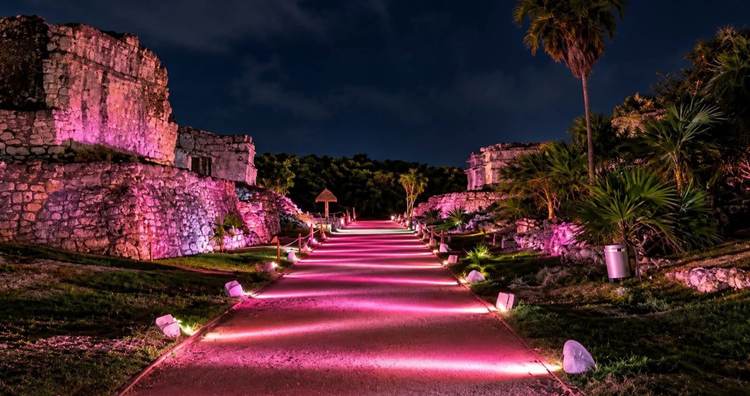
Travelers who went in 2006 and in 2008 wrote about it on travel forums in almost identical words. Gates open from roughly 7 to 9. A ticket around 250 pesos. The buildings lit in different colors. A long walk out to the highway afterward, because no taxi waited at that hour, and more than one of them said the walk was worth it. The phrase that repeats in those posts is that the place felt completely unlike the site they had toured that same morning.
That is the thing worth holding on to. For a few years, the most photographed ruin in Mexico belonged, after dark, to whoever showed up with a ticket and a pair of headphones.

The night circuit at the Tulum ruins ended without a goodbye
There was never an announcement. The tour pages that sold the night excursion from Cancún and Playa del Carmen are still online with the full itinerary, but under one line it says it is no longer available.
A private project announced a successor. Tulum Iluminado, a 75-minute light-and-sound walk with projections on the temples, advertised continuous departures every 15 minutes from 7 to 10:30 p.m. Its website, which carries INAH and state tourism promotion logos, still announces an opening for July 2024, and several answers in its FAQ remain placeholder text. The Tulum Times found no listings, reviews, or coverage of the experience running.
So the site keeps daytime hours. It opens at 8 a.m. and closes at 5 p.m., with the last access listed by INAH at 3:30 p.m., inside a Parque del Jaguar that closes its own gates at 7.
Three ticket windows and a park in between
The Parque del Jaguar opened on September 6, 2024, inaugurated by Andrés Manuel López Obrador with Claudia Sheinbaum beside him, and the arithmetic of visiting changed that same week.
INAH laid out the stack plainly. The tickets issued by Gafsacomm and Conanp came to 415 pesos per person for foreigners, 255 for Mexican nationals, and 105 for residents of Quintana Roo, all of it separate from the INAH fee for the ruins themselves. Free Sundays applied to the INAH ticket. The other two kept charging.
Residents felt the new geometry before visitors did. In November 2025, the federal government opened two public beach accesses inside the park. By March, people were reporting that the internal electric transport had been suspended on Sundays without warning, the one day locals enter free, which left families walking long distances to the sand with private cars barred. On May 30, municipal inspectors sealed a booth at the north access after complaints that its operators were charging without supporting documents.
Antonio Laviada, owner of the Pocná hotel, said in April that the management program is too restrictive, that businesses have closed, and that some operators moved to other parts of Quintana Roo rather than wait.
A third fewer people through the gate this year
INAH counted 257,978 visitors to the Tulum archaeological zone from January to March 2026, compared with 385,879 in the same period in 2025.
The curve is longer than a quarter. A Riviera Maya hotel association report, citing INAH, put 2024 at roughly 1.24 million visitors and 2025 at 1,031,443, down 20.7%, then 444,035 in the first half of this year against 627,634 a year earlier.
Everything around the site moves with it. Hotel occupancy averaged 63.7% from January to July, down from 72.7% a year earlier, according to the state tourism ministry, and state figures cited this week put September at 42.3%. The airport handled 471,500 passengers in the first half of the year against 705,400, a 33.2% drop in AFAC figures cited by El Economista. Aeroméxico suspended its Tulum flights on September 30; Volaris expects to launch service in early 2027, and François Duflot of Bloomberg Intelligence put United States carrier capacity into Tulum down 72% for the quarter.
Read coldly, those are bad numbers. Read as a cycle, they are the price of a decade in which Tulum charged more every season and asked less of itself every year, and they are already pushing the town toward the opposite correction.
What tourists reported at a Tulum checkpoint
Some of the damage never appears in an occupancy table.
Four visitors from the United States said early this year that municipal police stopped them over a supposed traffic violation, held them and pressed them for cash, and that the officers tried to move them onto a dirt road away from witnesses once they noticed they were being filmed. In February, the municipal security office dismissed a traffic officer after a video showed him taking money from a driver on the Tulum to Boca Paila road. In July, local outlets reported that a British couple said they paid around 21,000 pesos following a checkpoint breath test. In December, a 26-year-old Colombian visitor reported that drivers in Aldea Zamá blocked her from a ride booked through an app, and that the trip she took instead cost her 1,200 pesos.
David Ortiz Mena, who presides over the Mexican Caribbean hotel council and the Tulum hotel association, said those videos hurt the destination's reputation and called for investigations, sanctions, better-trained officers, and tourist police within operations. Profeco ran its own price inspection in November 2025 after complaints from visitors and residents.
Each of those cases drew a public response. That is the part worth noting in a town that spent years treating complaints as noise.
Plan Tulum Renace reached the ticket booth on July 17
Tourism secretary Josefina Rodríguez Zamora presented ten measures for Tulum that morning, at the military air base next to the town's airport.
The Parque del Jaguar stopped charging Mexican visitors. The archaeological zone dropped to 80 pesos for Mexicans and 265 pesos for foreigners, with free entry on Sundays for nationals. The beaches were declared open at no cost to anyone who wants them. Internal electric transport was set at 20 pesos. Sectur has since announced seasonal connections with the United States and Canada for the winter.
Prices came down. The hours stayed exactly where they were.
Built to come down, and to go back up
Here is the detail that makes this story hopeful rather than elegiac. INAH described the night lighting as surface-laid and easy to remove or replace, precisely so it could be taken down before a hurricane and reinstalled afterward.
Which means nothing needs to be dug, drilled, or debated about the stone. Lighting the Castillo again is a decision, a schedule, and somebody willing to open the gate at seven in the evening.
Tulum still has the sea behind the wall, the Templo de los Frescos, a cheaper ticket than it had in June, and a winter of arriving flights to fill. The rest of what people remember about this place fits inside 45 minutes and a pair of headphones.
Did you ever walk the Tulum ruins after dark, back when the lamps were on? Would you go again tomorrow? Join the conversation and share your perspective with us on Instagram and Facebook at @thetulumtimes.

The Tulum Times · Newsletter
The story continues in your inbox.
Essential Tulum news and local insight, a few times a week. Free.
No spam. Unsubscribe anytime.
Tulum Cenotes, Ruins, and Practical Visitor Guides
Guides, access updates, regulations, and practical planning around cenotes and the Tulum archaeological zone.

“The best journalists reporting from paradise, highlighting the heroes that keep Tulum the most beautiful place in the world! THANK YOU!”