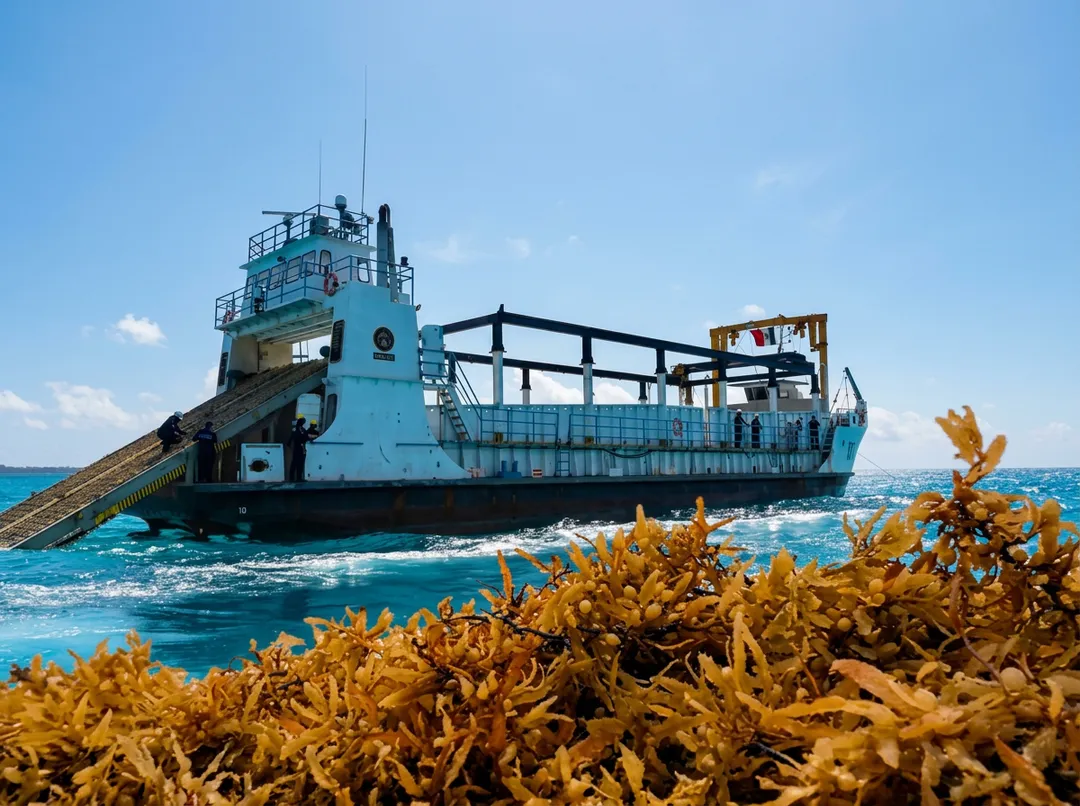
President Claudia Sheinbaum said the federal government is weighing a stronger response to sargassum along Quintana Roo, adding collection vessels and marine barriers to intercept the algae before it reaches the state's beaches.
Speaking at her morning press conference held in Tulum, Sheinbaum framed the plan around a single priority. Stop the macroalgae offshore, where it is easier to gather, and keep it from washing onto the sand that draws millions of visitors to the Mexican Caribbean each year.
The timing matters. The region is in the middle of another heavy sargassum season, the window when hotel occupancy peaks and the daily cost of clearing beaches climbs across the state.
A strategy built on catching sargassum at sea
Sheinbaum said her administration is studying the purchase of additional sargassum-collecting vessels and the installation of more containment barriers offshore. The reasoning is practical. Algae stopped in open water can be removed before it decomposes on the shoreline, where it releases odor, discolors the water, and forces crews and heavy machinery onto the sand to haul it away.
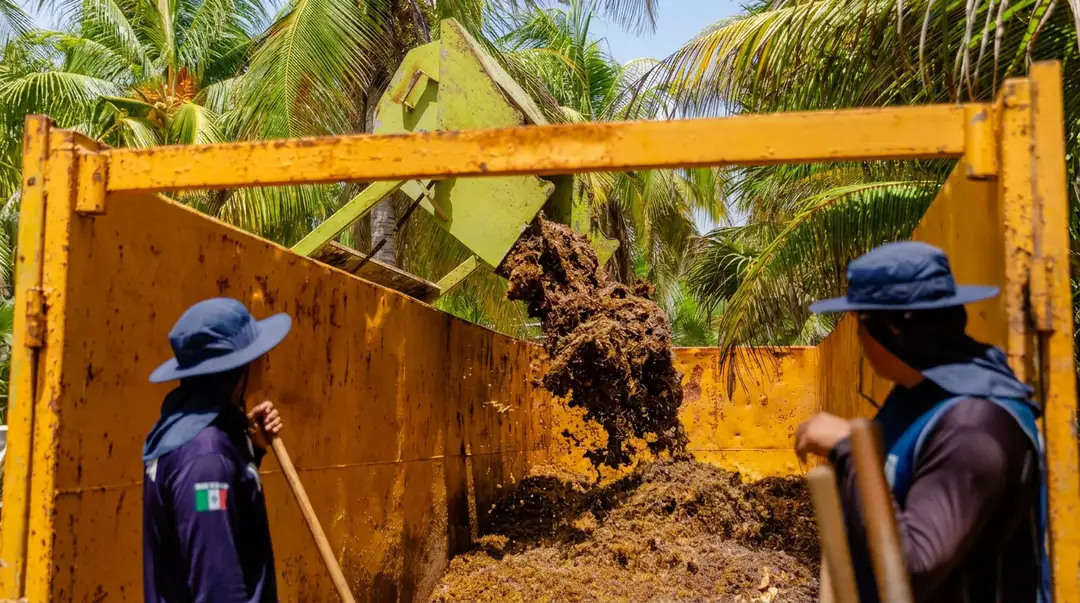
She said the offshore approach has already reduced the volume reaching the coast, and that the objective is to make that interception more efficient rather than depending on cleanup once the sargassum lands. Prevention, in her framing, is cheaper than the alternative.
Coordination with the Navy and Quintana Roo
The president said the effort is being coordinated with the Mexican Navy, known as Semar, the government of Quintana Roo, and other federal agencies. Environment Secretary Alicia Bárcena, who leads Semarnat, has been part of the broader response, which pairs collection at sea with plans to reuse the material instead of sending it to landfills.
Sheinbaum also pointed to recycling as part of the longer arc. She said collected sargassum could be redirected toward energy production or construction materials, giving a recurring nuisance a possible economic use rather than treating it purely as waste.
The scale of this year's influx
Figures cited at the press conference help explain why the plan is being revisited. Officials described roughly 90,000 tons of sargassum drifting in nearby waters, with close to 9,000 tons reaching the coast on the heaviest days. By one comparison offered at the event, that daily load is the equivalent of about 640 dump trucks of algae arriving on the beaches.
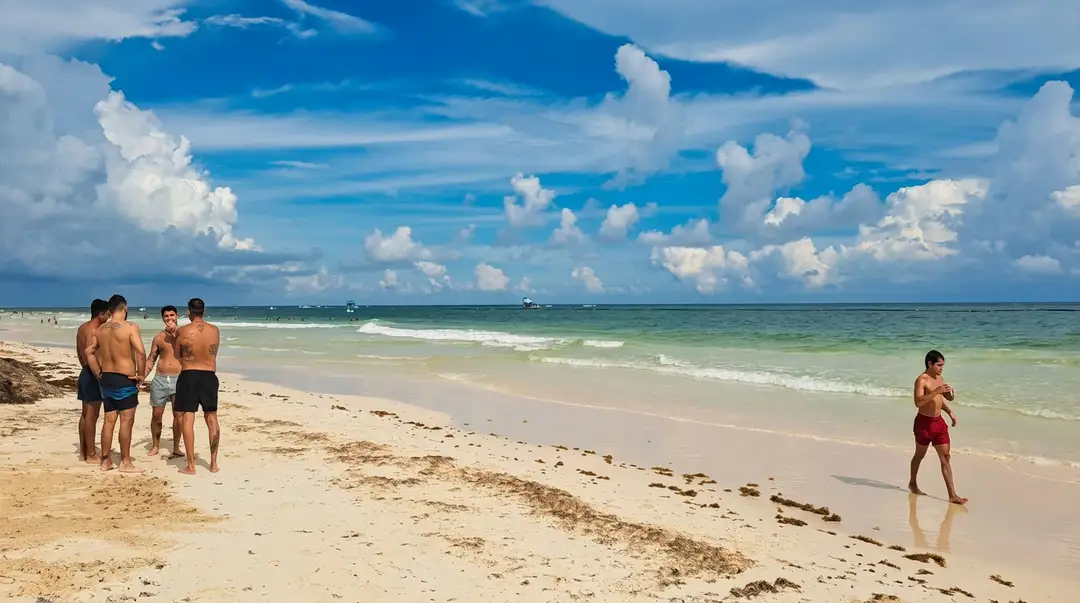
Current collection capacity falls short of those peaks. That gap between what arrives and what can be gathered is precisely what the additional vessels and barriers are meant to narrow.
What the sargassum strategy means for Quintana Roo beaches
The stakes are spread across the state's best-known destinations. Cancún, Puerto Morelos, Playa del Carmen, Tulum, and Mahahual all face recurring landings that pull crews and equipment onto the sand for much of the year. Local economies built on beach tourism absorb the visible effects, from guest complaints to the labor bill for keeping shorelines clear.
For hotel operators, the barriers are the piece to watch. Sheinbaum indicated the expanded containment lines would be coordinated with the private sector, a nod to the resorts that have installed their own barriers and hired their own crews during past seasons.
Costs, timelines, and open questions
The president did not attach a budget figure or a firm number of new vessels to the announcement, describing the measures as still under evaluation. That leaves the timeline uncertain for the remainder of the season, even as the direction of the strategy is clear.
What remains to be seen is how quickly the additional equipment can be acquired and deployed, and whether offshore interception can keep pace with a bloom that researchers have tracked at near-record levels across the Atlantic this year. For residents and businesses along the coast, the near-term test is simple. Fewer tons on the sand, and lower cleanup bills, before the peak weeks pass.
Do you think catching sargassum offshore should be the priority for Quintana Roo, or should more resources go toward cleaning the beaches directly? Join the conversation and share your perspective with us on Instagram and Facebook at @thetulumtimes.
This image was generated or enhanced using artificial intelligence to improve its quality.

The Tulum Times · Newsletter
The story continues in your inbox.
Essential Tulum news and local insight, a few times a week. Free.
No spam. Unsubscribe anytime.
Tulum Sargassum Updates and Beach Conditions
Live seaweed conditions, cleanup updates, forecasts, and practical beach planning across Tulum and the Riviera Maya.

“The best journalists reporting from paradise, highlighting the heroes that keep Tulum the most beautiful place in the world! THANK YOU!”