


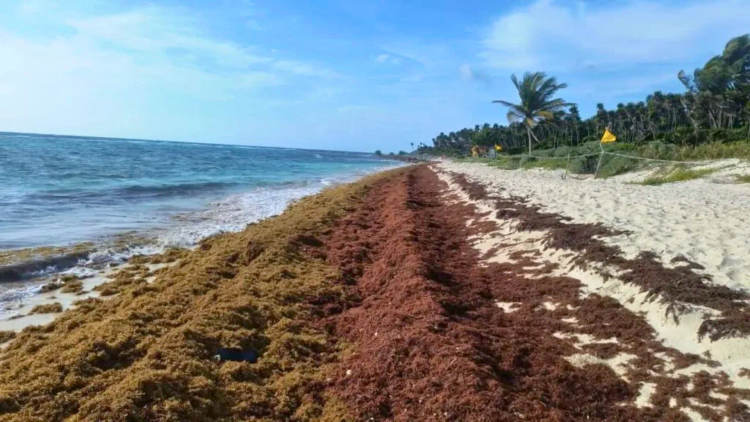
Tulum is facing an early and unusually heavy arrival of sargassum in 2026, adding new pressure to a tourism sector already dealing with reputational strain after a 2025 marked by criticism over high prices, limited public beach access, and a growing perception of excessive exclusivity. The latest figures point to a sharp escalation. In February alone, authorities collected 244 tons of sargassum in Tulum, far above the 59 tons recorded in the same month last year, raising concerns that the coming season could be even more severe.
The timing is central to the risk. Sargassum season typically begins in April, but significant accumulations were reported as early as January. That earlier arrival matters for Tulum because the destination depends heavily on beach conditions, visual appeal, and visitor confidence. It also changes the calendar for hotels and tourism operators, who now face cleanup demands and image management months before the usual seasonal peak.
“This is not normal at all. Everything indicates that this year will be even worse than 2025,” David Buchanan, director of the Federal Maritime Land Zone in the municipality, said.
That warning comes as the wider picture in Quintana Roo grows more difficult. In 2025, the state set a record with more than 80,000 tons of sargassum collected, reinforcing a rising trend that now appears to be accelerating. Satellite data has added to those concerns, showing there is currently eight times more sargassum biomass in the western Caribbean than in the same period a year earlier.

Tulum sees an unusually early shift
For Tulum, the change is not only about volume. It is about how early the problem is becoming visible. January reports of significant accumulation and the steep February total suggest that the destination is entering a difficult period long before the traditional sargassum window.
That has immediate local relevance. Tulum’s tourism economy is closely tied to its coastline, and beach conditions shape everything from hotel demand to the day-to-day work of businesses that depend on visitor spending. An early surge leaves less time to prepare and extends the period during which tourism operators must dedicate staff, equipment, and funding to response efforts.
The jump from 59 tons in February 2025 to 244 tons in February 2026 also confirms an atypical start to the year. And while sargassum has become a recurring challenge in the Mexican Caribbean, the current pace points to a season that may arrive earlier, last longer, and cost more.
Researchers have also warned that the current event is stronger not only in appearance but in biological intensity. With biomass levels now reported at up to eight times those of the same period last year, concern is shifting from isolated beach impacts to the possibility of broader regional disruption over the summer months.

Hotels absorb the cost of daily cleanup
The financial pressure on hotels is already rising. According to the Tulum Hotel Association, the cost of daily beach cleaning in many cases now matches electricity bills, significantly increasing operating expenses.
That comparison captures how much the burden has grown. Electricity is a core and unavoidable cost in hospitality. When sargassum cleanup reaches that same level, it stops being a secondary environmental issue and becomes a central operating concern.
Business owners estimate the sector spends as much as $150 million a year to contain sargassum, a figure that reflects the scale of the ongoing response. Traditionally, those efforts are concentrated between April and September. But in 2026, the season began much earlier, forcing hotels and tourism businesses to absorb those costs sooner and for a longer period.
Some tourism complexes have responded by installing containment systems and strengthening cleanup brigades ahead of the high season. Others are watching conditions day by day, knowing that even strong preparation may not fully shield them from the next heavy arrival.
The unpredictability of sargassum makes the problem harder to manage. Hoteliers say conditions can change from one day to the next, complicating planning and directly influencing how travelers see the destination.
Occupancy and reputation are both at risk
The effect is already visible beyond cleanup costs. During 2025, several destinations in Quintana Roo reported occupancy levels below expectations at the same time massive sargassum arrivals were recorded, a pattern that could repeat if current conditions continue.
“In 2025 we had worse occupancy than expected, coinciding with the massive arrival of sargassum,” hotel representative David Ortiz Mena said.
For Tulum, that link is especially sensitive because the destination’s image is part of its market strength. The problem is no longer only the physical presence of macroalgae on beaches. It is also how that presence circulates online and shapes travel decisions before visitors even arrive.
Videos on social media already show long stretches of coastline covered in sargassum, adding a reputational layer to the environmental challenge. For a destination whose appeal depends heavily on beach imagery, those visuals can influence traveler expectations quickly and at scale.
The issue also lands at a difficult moment. After a 2025 marked by criticism over high prices, lack of public beach access, and the perception that Tulum had become too exclusive, the destination now faces another test to its competitiveness. The cumulative effect matters because it combines environmental stress with an image problem that was already present.
This does not mean every stretch of coast will be affected in the same way every day. Specialists have warned that sargassum behavior remains unpredictable and that not all of the biomass currently detected will necessarily reach the beaches. But uncertainty itself has become part of the challenge. Tourism businesses must make decisions, communicate with guests, and manage expectations without knowing exactly how conditions will evolve.
Regional containment efforts are expanding
Elsewhere in Quintana Roo, response measures are intensifying. In Playa del Carmen, authorities and private sector groups have expanded preventive actions, including marine barriers that could extend up to five kilometers to help contain incoming sargassum before it reaches the shoreline.
That strategy reflects a broader shift in the region. Instead of relying only on cleanup after the macroalgae lands, destinations are trying to intercept and reduce its impact earlier. Hotels are also investing in their own containment systems and reinforcing beach crews as the high season approaches.
Still, the current outlook for the Mexican Caribbean points to a difficult summer. With record levels present from the first months of the year, sargassum is becoming one of the clearest threats to the region’s tourism competitiveness.
For Tulum, the stakes are especially high. What matters now is not only how much sargassum arrives, but how long the destination can manage the combined pressure of cleanup costs, weaker visitor perception, and softer occupancy. What changes from now on is the timeline and the scale of the response. The problem is starting earlier, demanding more resources, and hitting a destination that is already trying to recover its image. For residents, workers, hotels, and travelers, Tulum sargassum is no longer a seasonal inconvenience. It is a defining challenge for the months ahead.
We’d love to hear your thoughts. Join the conversation on The Tulum Times’ social media. How should Tulum respond as environmental pressure and tourism image risks grow at the same time?

The Tulum Times · Newsletter
The story continues in your inbox.
Essential Tulum news and local insight, a few times a week. Free.
No spam. Unsubscribe anytime.
Beach Access, Public Shoreline, and Coastal Rules in Tulum
Coverage of public beach access, coastal restrictions, closures, and the balance between tourism and public space.

“The best journalists reporting from paradise, highlighting the heroes that keep Tulum the most beautiful place in the world! THANK YOU!”


