

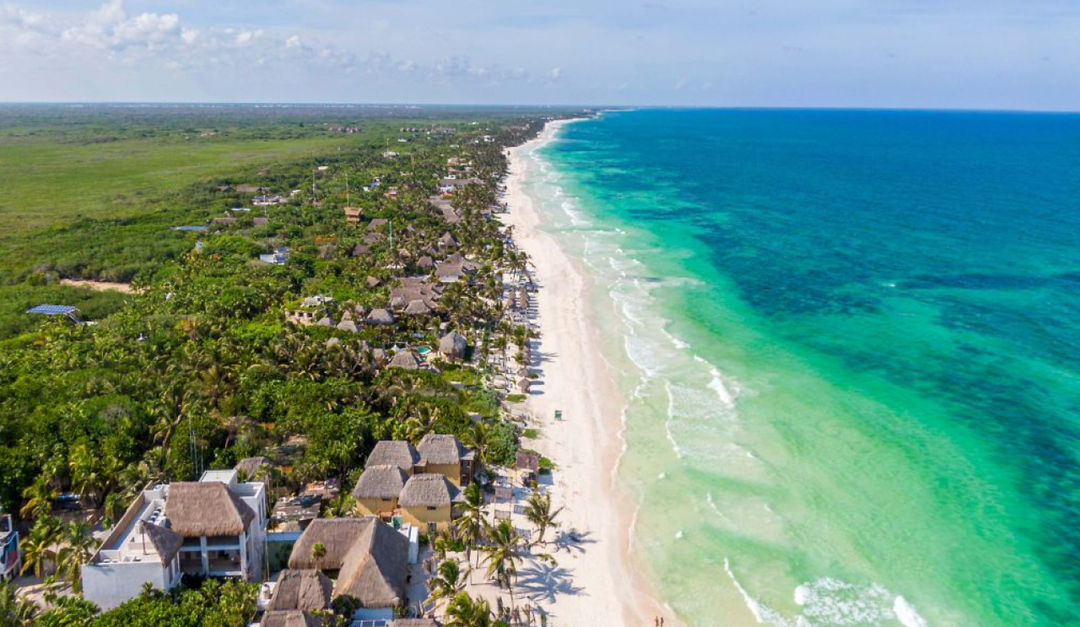
Under Mexican law, every beach in the country is public. The strip of sand where the waves reach, together with the adjacent federal maritime zone, belongs to no one and to everyone. That has been true for decades. In Tulum, for most of the past few years, it meant relatively little in practice.
The arrival of Parque del Jaguar in 2024, and the closure of traditional beach corridors that followed, crystallized something that residents and regular visitors had long experienced: legal rights to beach access and the physical ability to exercise them are not the same thing. The backlash was loud enough to reach the federal level. By 2025, SECTUR had intervened, voluntary agreements had been signed with 15 hotels and beach clubs, and two dedicated public entry points had been opened in the Hotel Zone. The situation is now meaningfully better than it was 18 months ago. It is still not simple.
What Mexican Law Actually Guarantees
The federal maritime land zone, known by its Spanish acronym ZOFEMAT, is the stretch of beach from the waterline to 20 meters inland. This zone belongs to the federal government and must remain accessible to all. No hotel, beach club, or private entity can legally block access to it, regardless of what their property sits behind. What private businesses can do is control the experience on their portion of land beyond that zone, including whether they offer chairs, bathrooms, shade structures, food, or service of any kind.
The practical consequence: a property can legally prevent you from using its loungers, drinking at its bar, and walking through its lobby. It cannot legally prevent you from reaching the beach itself. When hotels and beach clubs in Tulum's Hotel Zone were charged with blocking access, the violations were not legal ambiguities. They were straightforward contraventions of established federal law, which is why the government's response in 2025 came with fines of up to one million pesos and warnings of potential property closure. The beach access coverage at The Tulum Times has tracked these enforcement actions in detail.

The Two Dedicated Public Access Points
The clearest way to reach Tulum's beach without walking through any hotel or beach club is through either of the two dedicated public access corridors established in the Hotel Zone.
Playa Conchitas sits at approximately kilometer 4.5 on the coastal road (Carretera Tulum-Boca Paila). It is a direct, open-access point with no entry fee, no consumption requirement, and no affiliation with any private property. Visitors arrive at the public parking area, enter through a marked corridor, and reach the beach without passing through hotel grounds.
Playa del Pueblo sits at approximately kilometer 5.5 on the same coastal road. The setup is equivalent: a public entry corridor with no gate, no fee, and no hotel intermediary. Both points were formalized through coordination between the federal tourism ministry and municipal authorities in 2025. Neither requires a reservation, a wristband, or a guest status of any kind.
These two points are the most practical option for visitors who want to reach the sand independently, without relying on hotel agreements or navigating private property rules. For groups traveling with coolers, umbrellas, or outside food, they are also the only viable route, since the hotel access corridors prohibit all of those items.

The Fifteen Hotels With Free Access Agreements
A separate resolution to the access crisis came through voluntary agreements signed in 2025 by 15 hotels and beach clubs along the Hotel Zone. Each property committed to allowing free passage through their grounds to the beach, with no cover charge and no minimum consumption. The participating establishments, as confirmed at the time of signing, are:
- Ana y José
- Casa Gitano
- Casa Violeta
- Ahau
- Delek
- Alaya
- Coco Unlimited
- Hotel Nest
- Hotel Sana
- Dos Ceibas
- Villa Alquimia
- Papaya Playa Project
- Hotel Maxanab
- La Eufemia
- Fara Fara
The agreements were signed voluntarily, not imposed by court order. Participation can change. Before making a trip specifically to one of these properties, a quick call to confirm their current access policy is worth the effort, particularly for properties that have changed management or ownership since the agreements were announced.
What the Hotel Corridors Allow and What They Do Not
Free access through a participating hotel does not mean unrestricted use of the property. The access corridors allow passage to the beach and use of the public ZOFEMAT sand. They do not include chairs, umbrellas, shade structures, bathrooms, or showers, all of which remain reserved for paying guests or customers.
The hotel access corridors also prohibit outside food, drinks, and related items including coolers. This restriction is enforced at most properties and is not negotiable. Visitors who want to bring a picnic or a cooler to the beach should use Playa Conchitas or Playa del Pueblo instead, where no such restriction applies. Bringing a bottle of water is generally not challenged, but full-scale beach setups with outside provisions are not compatible with the hotel corridor route.
How the Access Crisis Developed and Why It Matters
The current access arrangements did not emerge from goodwill alone. Tulum's Hotel Zone went through a period of significant restriction beginning in late 2024, when Parque del Jaguar was placed under new management and several traditional access corridors were effectively closed. The occupancy rate for vacation rentals in the area dropped to 20.5 percent, well below previous seasons, and protests from residents and local advocates added public pressure on top of the economic signal. For a deeper account of how the conflict developed, the fight over Tulum's beach access and the federal intervention that reversed the closures are both covered in detail on the site.
The resolution was partly practical: tourism numbers fell, and beach access had become one of the clearest pain points visitors cited. The agreements and public access points that followed were a response to that pressure, not a structural reform of how hotel concessions in the coastal zone operate.
Getting There and What to Bring
Tulum's Hotel Zone runs south from the town center along the Carretera Tulum-Boca Paila coastal road. The transportation options into the Hotel Zone include taxis from the town center, which take 10 to 15 minutes and cost roughly 150 to 200 pesos. Bicycles are a practical option from most hotels and hostels in the town center, with the ride taking about 20 minutes. There is no regular bus service along the Hotel Zone road itself. For Playa Conchitas and Playa del Pueblo specifically, both have vehicle parking areas, which makes them practical for visitors arriving by rental car or in groups.
For the direct public access points: shade, food, drinks, and a cooler are all permitted, and the beach is yours to use as you would any public space. Bring what you need, as neither access point has commercial vendors on-site. For the hotel corridors: a small bag, sunscreen, a towel, and a personal water bottle. Nothing that signals an independent beach setup. The corridor experience is access, not hospitality.
Tulum's beach in January or February, on a clear morning before the wind picks up, is worth every bit of the logistical consideration it now requires. The access system is imperfect and its durability depends on continued enforcement of agreements that were made under pressure. But the beach is there, and the law is clear about who it belongs to.
Has getting to Tulum's beach become easier or harder in your experience over the past year, and do you think the current access agreements are actually being honored? Join the conversation and share your perspective with us on Instagram and Facebook at @thetulumtimes.

The Tulum Times · Newsletter
The story continues in your inbox.
Essential Tulum news and local insight, a few times a week. Free.
No spam. Unsubscribe anytime.
Beach Access, Public Shoreline, and Coastal Rules in Tulum
Coverage of public beach access, coastal restrictions, closures, and the balance between tourism and public space.

“The best journalists reporting from paradise, highlighting the heroes that keep Tulum the most beautiful place in the world! THANK YOU!”


