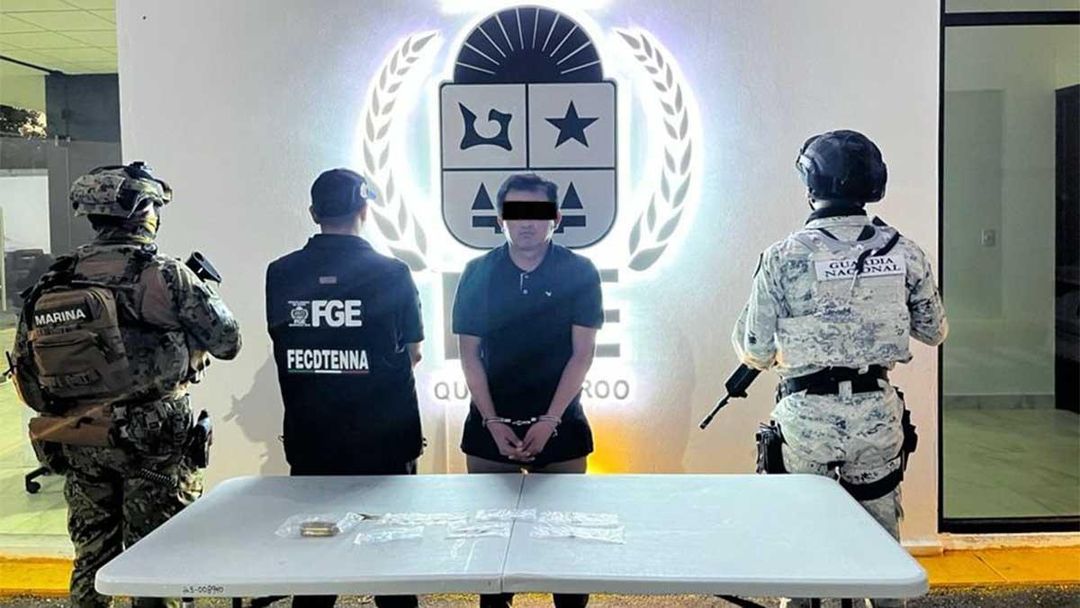
Forces representing the Fiscalía General del Estado, with support from federal maritime and military units, successfully executed four surgical raids across Tulum, liberating three victims from a sophisticated criminal trafficking network this week. The operation, which involved the Secretaría de Marina and the Guardia Nacional, targeted a cell specialized in the intersection of human exploitation and retail narcotics distribution within the city's most prominent tourist sectors.
The apprehension of David “N,” an operative identified by the alias “Rambo,” marks a significant disruption in the logistical architecture of narcotics distribution within Tulum’s high-value coastal corridor. This operation underscores the evolving nature of organized crime in the Riviera Maya, where human exploitation is increasingly weaponized as a primary mechanism for retail-level drug trafficking in luxury tourism hubs.
The Intersection of Exploitation and Distribution
The three liberated women, two of whom are minors, represent a demographic often targeted by organized crime: domestic migrants from socio-economically vulnerable states including Michoacán, Guerrero, and Jalisco. These victims were not merely brought to the coast for labor; they were integrated into a predatory system designed to maximize the footprint of illicit substances in high-traffic environments.
According to investigative findings released by the Fiscalía General del Estado (FGE) of Quintana Roo, the victims were kept under constant surveillance and coerced into selling assorted narcotics, including marijuana, cocaine, crystal meth, and the synthetic cocktail known as “tusi,” within the bars and restaurants of Tulum’s Hotel Zone. The use of threats and physical oversight ensured that the criminal group could operate with a degree of separation from the direct transaction, shifting the primary legal risk onto the victims.

Tactical Precision in the "La Selva" Operation
The security sweep was characterized by its geographic diversity, targeting both the urban core and the periphery of Tulum. The most sensitive phase of the operation occurred in the district known as “La Selva,” a region historically noted for its complex terrain and utility as a logistical hideout. Search warrants were also executed on Calle Júpiter and Avenida Kukulkán, areas that serve as strategic conduits between the downtown area and the coastal strip.
The arrest of David “N” occurred at a residence on Calle Kiss, located in Region 03. During this search, authorities recovered not only diverse narcotics but also official documentation and communication devices that point toward a broader organizational hierarchy. In a separate lot in Region 2, on Calle Acuario Sur, tactical teams located two of the teenage victims. The environment described by authorities, consisting of restricted mobility and the presence of ammunition, highlights the violent framework used to maintain control over the trafficking ring’s human capital.
The "Black Uniform" Identification Strategy
One of the more chilling aspects of the investigation involves the group’s methodology for visual control. Intelligence suggests that “Rambo” and his associates provided the victims with specific black uniforms. This choice of attire served a dual purpose: first, it functioned as a branding mechanism, allowing the criminal cell to identify their operatives at a distance within crowded social spaces; second, it acted as a psychological tool of subjugation, stripping the victims of their individuality and marking them as property of the cartel.
This branding strategy is indicative of an increasingly professionalized approach to street-level distribution in Tulum. By standardizing the appearance of their sellers, the criminal group attempted to mirror the formal service and security industries that populate the coastal zone, creating a cloak of legitimacy that complicates the task of law enforcement while maintaining rigid internal discipline.

Regional Security Coordination and Institutional Response
The success of the mission is being framed as a victory for the "Mando Único" and federal collaboration. The presence of the Secretaría de Marina (SEMAR) and the Guardia Nacional provided the necessary firepower and perimeter security to execute high-risk entries in residential neighborhoods without civilian casualties. For the FGE, the rescue of minors elevates the case from a standard narcotics investigation to a high-priority human rights intervention.
Following their extraction, the three victims were transferred to specialized facilities in the state capital for medical evaluation and psychological support. Their testimonies are expected to form the backbone of the legal proceedings against David “N,” who remains in custody as the Ministerio Público prepares the formal charges for human trafficking and narcotics distribution.
Implications for Tulum’s Tourism Infrastructure
For the local business community and the luxury hospitality sector, the operation serves as both a relief and a warning. While the removal of a high-profile figure like "Rambo" improves the security metrics of the Hotel Zone, it also exposes the reality of how narcotics are funneled through the destination's social fabric. The exploitation of teenagers in exclusive venues highlights a critical vulnerability in the regional "safety shield."
Authorities have signaled that this operation is part of a broader strategy to "cleanse" the coastal zone of predatory networks before the upcoming peak season. As Tulum continues its rapid transformation into an international aviation hub, the pressure to maintain a secure and ethical tourism environment has never been higher. The dismantling of the "Rambo" network is a necessary step, but it also underscores the persistence of the underlying market forces that continue to drive trafficking across the Riviera Maya.
Does the current coordination between federal and state forces provide a sufficient deterrent against human trafficking in Tulum, or should more resources be allocated to community-level prevention? Join the conversation and share your perspective with us on Instagram and Facebook at @thetulumtimes.

The Tulum Times · Newsletter
The story continues in your inbox.
Essential Tulum news and local insight, a few times a week. Free.
No spam. Unsubscribe anytime.
Transportation in Tulum: Taxi, Bus, Transfers, and Mobility
Taxi fares, buses, transfers, road changes, mobility updates, and practical transport guidance for Tulum.

“The best journalists reporting from paradise, highlighting the heroes that keep Tulum the most beautiful place in the world! THANK YOU!”